

The ongoing evolution of judicial nominees’ responses about the 2020 election
Nominees have shifted their answers but still refuse to unconditionally state that Biden won.
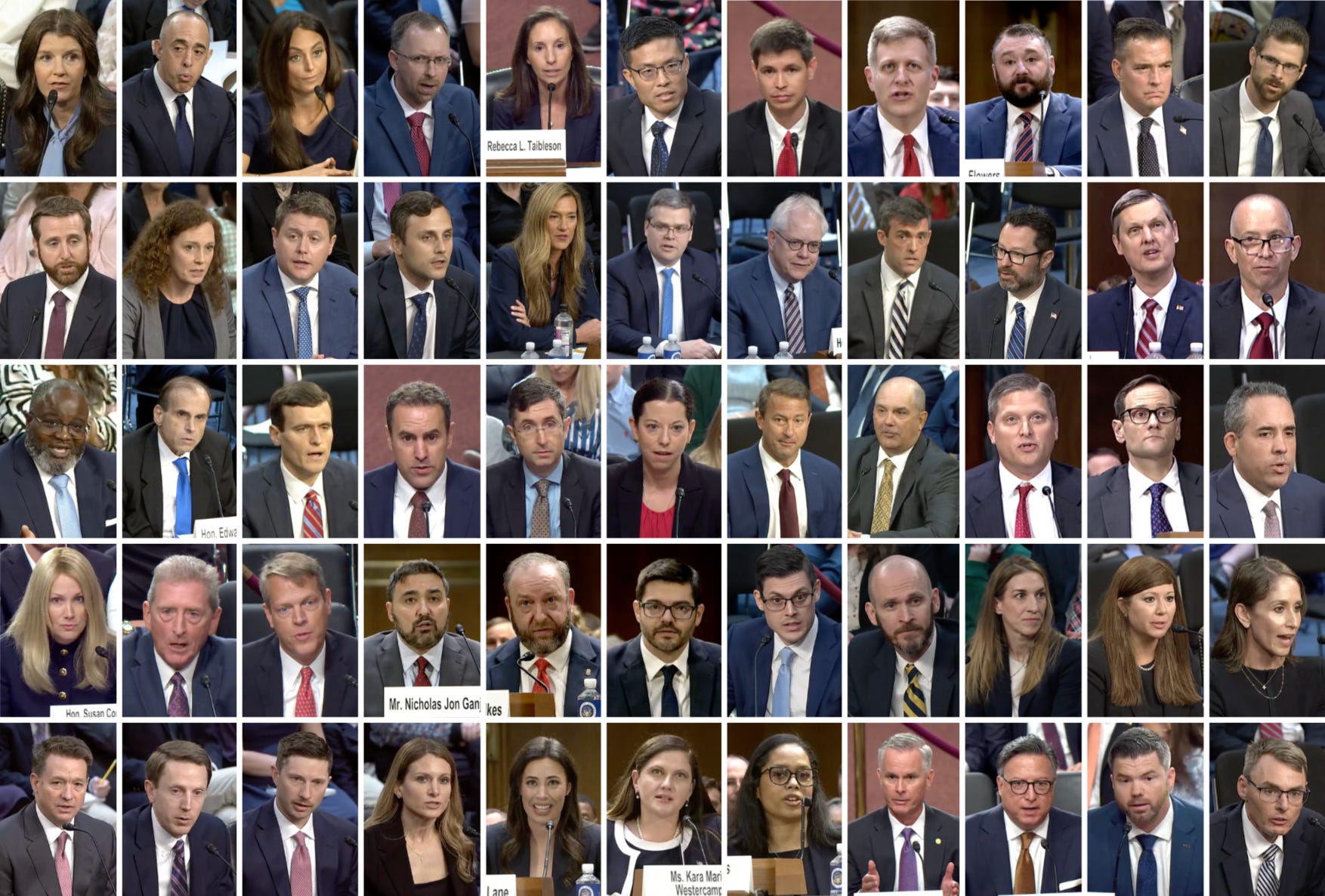
Since last year, 57 judicial nominees have appeared before the Senate Judiciary Committee to interview for life-tenured positions as federal judges. Those confirmation hearings, and the responses to written questions for the record returned by 55 of the nominees so far, have revealed a unified unwillingness of Trump’s judicial nominees to go against the president and admit the truth: Trump lost the 2020 election.
The very first judicial nominee of Trump’s second term, Whitney Hermandorfer, dodged questions from four Democratic senators in responses to written questions.
“President Biden was certified as the winner of the 2020 presidential election and served as the 46th President of the United States,” she told Senator Dick Durbin. Then she gave that response — verbatim — to Senators Sheldon Whitehouse, Chris Coons, and Cory Booker.
“The fact that she is willing to condone President Trump’s false claims further demonstrates a level of partisanship and deference to this president that is unacceptable for someone seeking a lifetime position on the federal bench,” Senator Durbin said in remarks on the Senate floor. Hermandorfer was ultimately confirmed to a Tennessee seat on the U.S. Court of Appeals for the Sixth Circuit. The four Missouri district court nominees who had their hearing the same day — and who also refused to answer that question, using similar language — were also confirmed.
Judicial nominees have begun shifting their responses to these questions over time — an acknowledgement, perhaps, that it is deeply humiliating to avoid stating a simple truth. Nevertheless, no matter the language they use, they continue to debase themselves in pursuit of pleasing Trump. The commentary that follows chronicles the evolution of these responses.
Joe Biden was certified as the winner
Following that first hearing last year, Trump’s judicial nominees used the “Biden was certified” response as a blueprint for showing their loyalty to the man who nominated them. When Third Circuit nominee Emil Bove — Trump’s former personal lawyer and DOJ henchman — appeared before the committee in late June 2025, Senator Peter Welch asked him who won the election in 2020.
“President Biden was certified as the winner of that election,” he responded. When Senator Welch pressed further, Bove accused Senator Welch of characterizing it in a “political” way, saying he couldn’t address it under the Canons and that the issue was tied up in ongoing litigation.
Bove expanded on this in responses to written questions, stating:
President Biden was certified as the winner of the 2020 presidential election and served as the 46th President of the United States. To the extent this question seeks to elicit an answer that could be taken as opining on the broader political or policy debate regarding the conduct of the 2020 presidential election or on statements by any political figure, my response, consistent with the positions of prior judicial nominees when asked questions regarding the 2020 election, is that it would be improper to offer any such comment as a judicial nominee.
In the months that followed, after those first two hearings, 20 more nominees would answer written questions using this response as a template. On December 17, Senator Richard Blumenthal walked into the Judiciary Committee hearing room prepared to make nominees respond to this question live, and on camera, for everyone in the nation to witness.
During that hearing, district court nominees from Indiana, Missouri, and Tennessee would not say that “Joe Biden won the 2020 election” — conceding only that he “was declared the victor.” They also would not say that he won the Electoral College. “Joe Biden was certified the winner and served four years,” Brian Lea of Tennessee stated. “Donald Trump was not certified as the winner of the 2020 election,” said Justin Olson of Indiana.
“You can choose not to answer the question, but please don’t insult my intelligence by asking me to accept that answer,” Senator Blumenthal said that day.
“I am incredulous,” the senator stated. “I am totally disbelieving that nominees for the federal district court will not answer purely factual questions just because you are in fear of — what? If you are so much in fear of answering these questions, how will you have the courage to be a fair and impartial judge who follows the law without fear or favor?”
Those types of remarks from Senator Blumenthal became commonplace, as 15 more lifetime judicial nominees — during hearings in February, March, and April — provided nearly identical responses to his questions. On February 4, 2026, when four more district court nominees wouldn’t directly answer, Senator Blumenthal stated that “I am insulted, as a member of this body, that you simply won’t tell us the truth. And that speaks chillingly of what you will do as a United States district judge if you’re confirmed.”
On March 25, three other lifetime nominees (and an Article IV territorial court nominee) followed suit, repeating the line that President Biden was certified as the winner in 2020. “I am amazed,” Senator Blumenthal said. “I am just amazed by the insult to this committee, of witness after witness, seeking to be a federal judge — subverting our Constitution and showing how you have no independence, which is essential to a federal judge.”
During that hearing, Senator Whitehouse piled on. “I hope you realize how ridiculous the four of you look — spouting these preposterous, canned answers in a forum in which, A, you’re supposed to tell the truth, and B, you’re supposed to demonstrate the judicial capacity to make independent, factual decisions in hard cases,” he said. “If you can’t even sit here and say that Joe Biden won that election or that the Capitol was attacked? What’s left?”
On April 15, when Trump’s personal lawyer Justin Smith appeared before the committee, Senators Durbin and Blumenthal both asked about the outcome of the 2020 election. “I acknowledge, as Chairman Grassley was talking about in his opening remarks, that under Article II and the 12th Amendment, that the Electoral College cast their votes in December of 2020,” Smith said. “In January of 2021, Congress met to open and count those votes, and as a result of that process, Congress certified Joe Biden as the president.”
Two weeks later, four district court nominees kept the tradition going. “I want to be mindful of the canons here,” said Ohio nominee Mike Hendershot. “I know this question has come up many times in these hearings, and it’s become an issue of significant political dispute and debate. So, with that, I’d say that President Biden was certified the winner of the 2020 election.” Hendershot seemed to know that his response would be deemed unacceptable. Still, the other nominees agreed with his answer.
Senator Blumenthal’s frustration that day was palpable.
I am amazed, and really appalled, that nominees for a lifetime appointment to the federal bench are unwilling to respond on an issue of fact. And I’m not going to try to get an answer out of you, because clearly you’ve been rehearsed to provide a stock answer, which I think really reflects not only on your honesty, but really on your fitness to be a federal judge, because you are supposed to be independent and to arrive at the truth based on the evidence before you. And I think it’s pretty irrefutable that Joe Biden won the election, but you’re unwilling to use that word because you are afraid. You are afraid — of what? President Trump? That is exactly what we do not need on the federal bench today. We need jurists who are fearless and strong — not weak and pathetic. And I can’t tell you how disappointed I am. We can disagree on issues of law…But for you to simply avoid a factual and responsive answer, I think, is a disrespect to this committee as well as to us.
Using a response from Justice Jackson to avoid answering
During the next hearing on May 20, the committee considered the nominations of circuit court nominees Benjamin Flowers and Matthew Schwartz. Chair Chuck Grassley, in his opening remarks, criticized Democrats for asking nominees about the outcome of the 2020 election. “For months now, my Democratic colleagues have relentlessly attacked nominees about the 2020 election. I think it’s been unfair, been hypocritical,” he said. He accused Democrats of asking these questions for a “soundbite” to go viral and said that they “don’t care about the answers.” He also called out “progressive media” for “gleefully” reporting on the topic.
Senator Grassley’s staff put up a poster showing Justice Ketanji Brown Jackson and the text of a response she gave to a written question. The question was: “Have you ever commented, publicly or otherwise, on the results of the 2020 election?” Justice Jackson responded by saying:
Consistent with the Code of Conduct for United States Judges and the positions taken by prior nominees, as a pending judicial nominee and a sitting federal judge, it would be inappropriate for me to publicly weigh in any subject of political debate. In my individual capacity, I have had private conversations on a wide variety of topics.
“Well, isn’t that something,” Senator Grassley said. “Justice Jackson, like every nominee to come before this committee this Congress, didn’t think it was appropriate for a judicial nominee to weigh into the political debate concerning the results of the 2020 election.” He claimed that Trump’s nominees are “making the exact same point that Justice Jackson made” and said that nominees moving forward “should just quote Justice Jackson.”
And that is exactly what happened during the hearing that day. When Senator Blumenthal asked Flowers who won the 2020 election, he immediately referred to Justice Jackson, saying “I’ll incorporate the answer that Justice Jackson gave that Chairman Grassley referred to earlier. It wouldn’t be appropriate for me to comment on the outcomes of any election, except to say that, legally speaking, Joe Biden was certified.”
Justice Jackson was not asked who won the election. She was also not nominated by a man who demanded loyalty from his appointees and who aggressively sought to overturn the results of an election he lost. She was asked if she had commented, indicated that she had private conversations about it, and said she wouldn’t say more as a sitting judge.
Senator Blumenthal pointed that out, noting that Justice Jackson’s response came both as a judicial nominee and as a sitting federal judge. Flowers still wouldn’t respond, leading Senator Blumenthal to say that his “failure to answer that question mocks this committee.”
“I know Justice Jackson,” Senator Blumenthal said. “You’re no Justice Jackson.”
When Senator Blumenthal asked Schwartz the same question, he also invoked Justice Jackson’s response. When he asked who won the popular vote in 2020, Schwartz responded the same way again. “It’s a factual question, Mr. Schwartz. It’s a matter of public record. You wouldn’t answer the question in this way if you were before a judge, would you?” In response, Schwartz said he was bound by the codes of conduct and couldn’t answer “in the way you want me to.” He said “the only legally and ethically correct answer is the one that prior nominees have given, which is that Joe Biden was certified as president in 2020.”
In responses to written questions, Schwartz abandoned this response and did not reference Justice Jackson at all. Flowers did. In fact, Flowers alleged that he discovered Justice Jackson’s responses while preparing for the hearing. “I believed they were sound and determined independently that I would answer as I did.” It is inconceivable that both Senator Grassley’s staff and Flowers independently discovered Justice Jackson’s written response and happened to bring it up at the hearing. More likely, they either collaborated on this messaging beforehand — or Flowers lied in his written responses that he “discovered” Justice Jackson’s responses prior to the hearing.
Eighth Circuit nominee Daniel Traynor tried the same dodge during his hearing last month. “This issue has become a question of political controversy. I’m a sitting federal district judge. I’m a nominee to the Eighth Circuit Court of Appeals,” Traynor began saying in response to Senator Blumenthal’s question about who won the 2020 election. As Traynor began to invoke Justice Jackson’s response, Senator Blumenthal stopped him. “It’s a political controversy, only because the president refuses to accept the results of the 2020 election,” he said.
Traynor brought up Justice Jackson’s response when answering written questions as well.
Biden won “as a matter of law”
Benjamin Flowers’ statement that “legally speaking, Joe Biden was certified” was actually a preview of a new script that judicial nominees would soon adopt.
Four district court nominees appeared before the committee on the same day as Traynor, but they tried out a different response. Senator Blumenthal prefaced his question with this: “I want to make clear about the questions I’m going to ask you. They’re not political theater. They’re not being clever. These issues are a matter of right and wrong. There are issues in life that involve right and wrong, as you know. Attacking the Capitol is wrong. Lying about whether it happened is wrong. Stating truth is right. And pardoning people who attack the Capitol is wrong. Failing to call it out is wrong.”
Notably, he began with Michael Martin, the Michigan district court nominee who allegedly assured Michigan’s Democratic senators that he would tell the truth during the hearing.
“From making clear Joe Biden won the 2020 election, to the attack on the Capitol on January 6th, to being clear that President Trump can’t run for a third term, these answers were important factors for me, and fundamentally different from President Trump’s judicial nominees to date,” Senator Elissa Slotkin said in a statement before the hearing, explaining why she returned her blue slip on Martin’s nomination. “I look forward to Mr. Martin conveying the same during his confirmation hearing, and to his service on the federal bench if confirmed.”
When Martin was asked during the hearing who won the 2020 election, he said that “as a matter of law, Joe Biden was the winner of the 2020 election.” When asked who got more votes, he said that “my focus as a judicial nominee is on the law, and as a matter of law, Joe Biden won the 2020 election.” When asked who got more Electoral College votes, he said that “Joe Biden received more Electoral College votes.” He would not say that President Biden received more popular votes than Trump, just that “as a matter of law” Biden won the election and received more Electoral College votes.
Martin’s answers appeared to be a newly approved set of responses that judicial nominees could give moving forward. Indeed, the two other nominees who were asked 2020 election-related questions that day agreed with Martin that Biden won “as a matter of law.” Senator Blumenthal called it “a new script, a new pre-negotiated effort to thread the needle, avoid the question, because the president refuses to acknowledge that he lost. He declines to accept the truth that he lost the 2020 election. You are protecting the lie by failing to acknowledge the truth, and it all goes to your independence. If you’re unwilling to show us that you’re independent of the president at this early stage of your service, you disqualify yourself as judicial nominees.”
“If [Trump] were not putting his thumb on the truth, you’d be willing to state it here, and you are putting loyalty to him above fidelity to the law and the Constitution,” Senator Blumenthal said. “The law doesn’t dictate the results of an election. The people do.”
In responses to written questions, those four district court nominees stuck to that script — repeating that Biden won the 2020 election “as a matter of law.” Some of them combined multiple dodges in their responses. “Under the process specified by the Constitution and federal law, Congress certified Joseph R. Biden as the winner of the 2020 election, and he served as the 46th President of the United States,” said Pennsylvania nominee Antonio Pozos. “Accordingly, as a matter of law, he was elected to the office of the President in 2020.”
This response appears to have already lost steam. On June 24, during the last judicial nominations hearing, two lifetime nominees reverted to previous dodges. Tenth Circuit nominee Daniel Domenico tried to cite Justice Jackson, but Senator Blumenthal slapped down that response before he could finish.
Ohio district court nominee Matthew Byrne stated that “Joseph Biden was declared the winner of the 2020 election by a joint session of Congress.” When Senator Blumenthal stated that “The people of America declared him the winner” and asked if that’s correct, Byrne said that “there was an election, and it proceeded through the normal procedures outlined in the Constitution.” Then, when asked if Biden won the popular vote, Byrne shifted again and said that “As a judicial nominee, it would be inappropriate” for him to comment on a political dispute. You could see Byrne, in real time, sorting through the various scripts in his head to decide which one he thought sounded best for each question.
Written responses from Domenico and Byrne are expected by early next week — so we’ll see which responses they go with in writing.
Two more judicial nominees await a hearing, likely on July 29. Anna St. John, who has been nominated to the Fifth Circuit, was confirmed to the Eastern District of Louisiana earlier this year. During her hearing for that district court seat, St. John said that “Joe Biden was certified the winner of the 2020 election and served four years.” When she responded to written questions, she similarly stated that “President Biden was certified the winner of the 2020 election and served as president for four years.” Gregory Cook, nominated to the Northern District of Alabama, is a self-proclaimed election law expert who also appears to be an election denier. He should appear at that hearing as well.
Judicial nominees have shown their loyalty to Trump in other ways, such as universally refusing to say that the U.S. Capitol was attacked on January 6, 2021. Senator Blumenthal has referred to nominees’ responses to these questions as “Orwellian in their denial of reality.” Executive branch nominees have also been refusing to answer basic, factual questions about the election and insurrection (here are two recent examples).
Still, a number of Democratic senators have voted to confirm some of Trump’s judicial nominees.
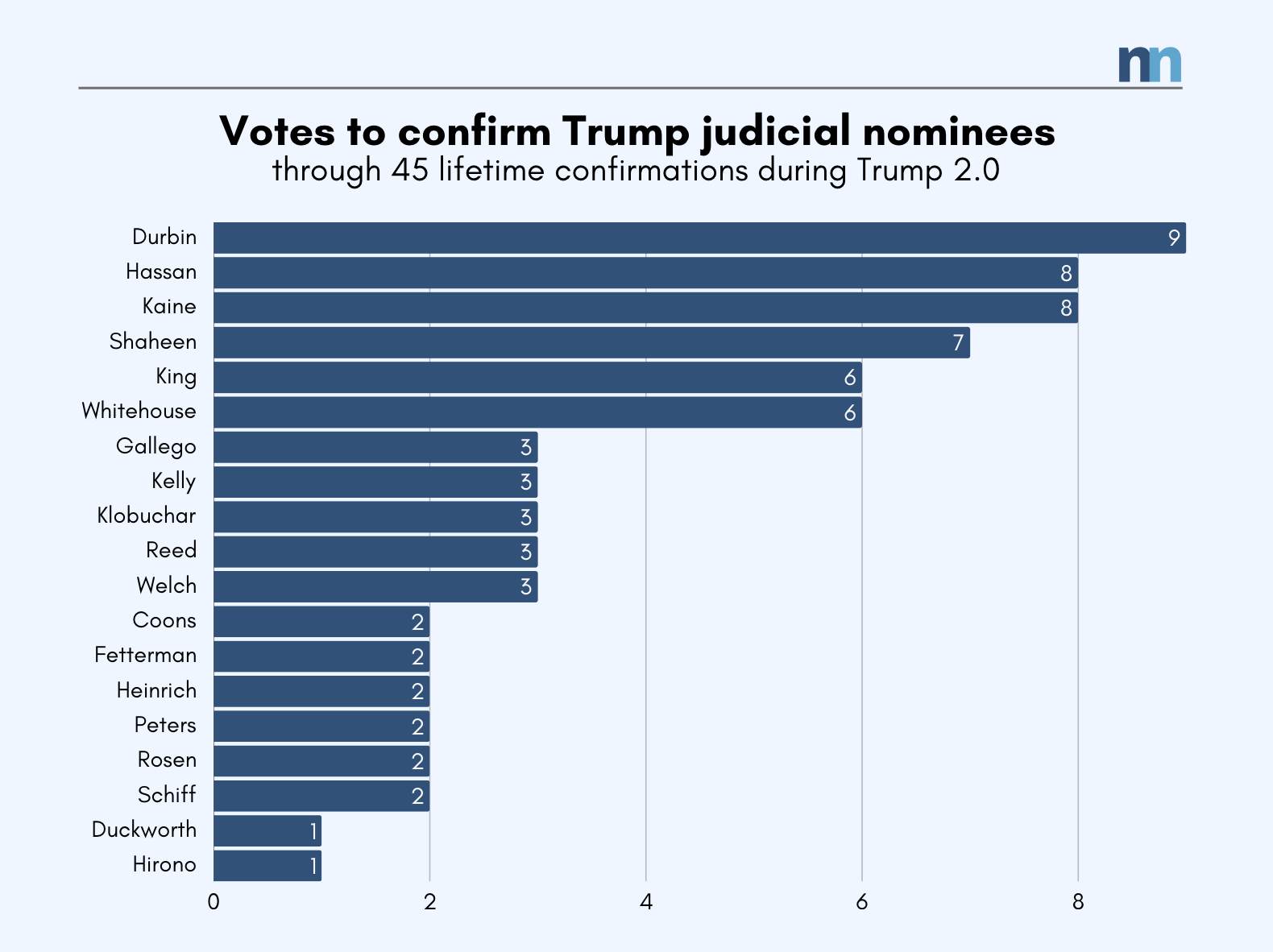
It is unlikely that nominees will suddenly begin to publicly acknowledge the truth. But as this commentary shows, their responses may continue to evolve. And they will continue to be unacceptable.