
Judicial nominees remain silent as senator asks whether Trump can run for a third term
They also refused to say that Biden won in 2020 or that the Capitol was attacked on January 6.
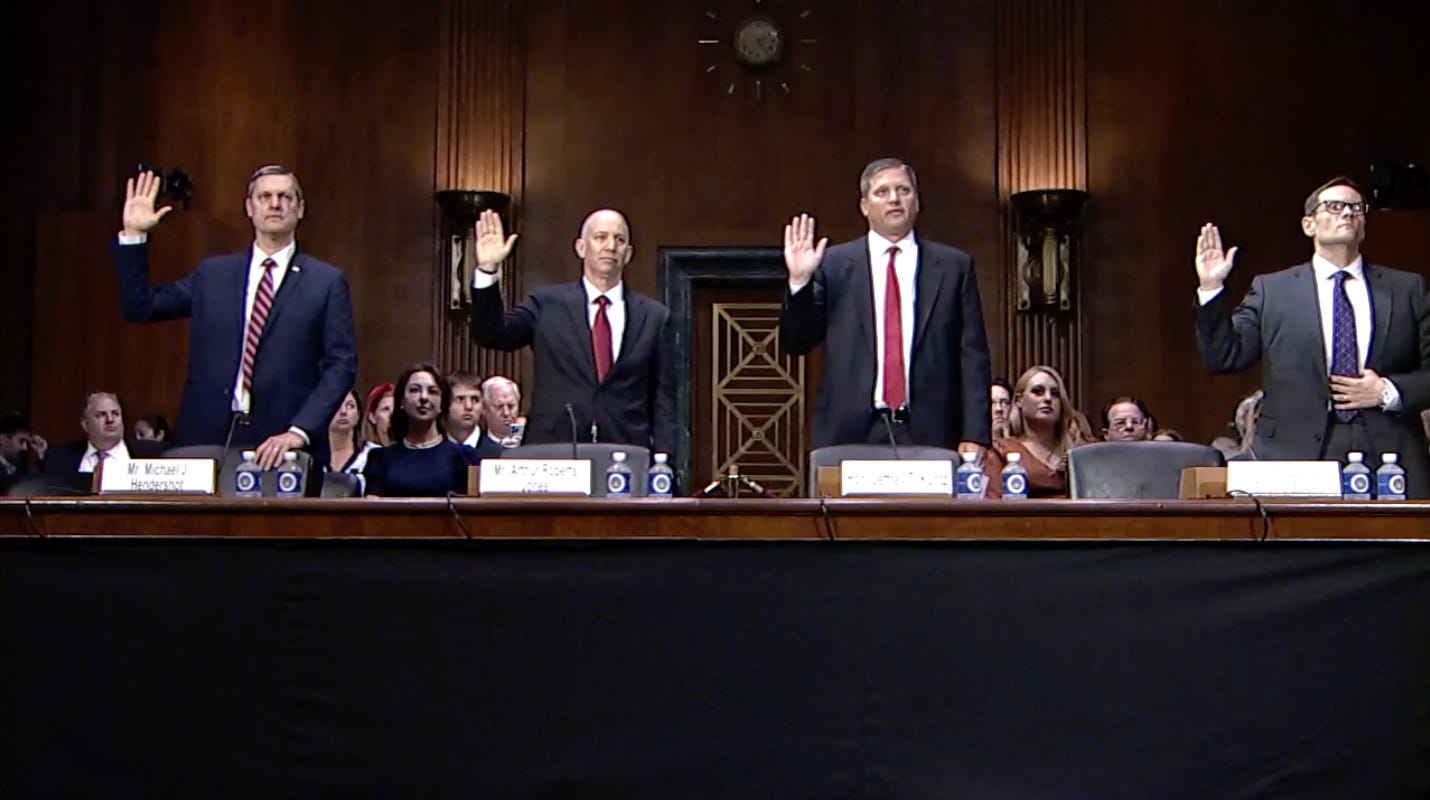
The Senate Judiciary Committee on Wednesday afternoon held a hearing to consider the nominations of Jeffrey Kuntz for the Southern District of Florida, Mike Hendershot for the Northern District of Ohio, Arthur “Rob” Jones for the Southern District of Texas, and John Marck for the Southern District of Texas.
Only six senators (total) asked questions during the hearing, including Chair Chuck Grassley, Ranking Member Dick Durbin, and Senators Chris Coons, Richard Blumenthal, John Cornyn, and John Kennedy.
During his opening remarks, Ranking Member Durbin said that “The nominees before us are being considered for lifetime appointments to the federal bench. Judges are truly the bulwark for the rule of law, which has never been more important as this administration has weaponized the Justice Department against political targets.”
“This administration’s lawless conduct makes clear that it’s never been more important for judges who are dedicated and committed to the law without fear or favor,” Senator Durbin said after providing several examples of the DOJ’s shameful actions. “Will these nominees be independent in their thinking, or a rubber stamp? Will they defend the rule of law?”
The nominees’ responses to questions today demonstrated that they will not be independent.
Trump’s eligibility for a third term
Several senators have been asking written questions for the record about whether Trump can run for a third term. Today, Senator Coons asked in person, turning first to John Marck to ask him what the 22nd Amendment actually says. Here’s how things went:
COONS: Just tell me about the 22nd Amendment. What does it provide?
MARCK: The 22nd Amendment — senator, my career has mostly been in criminal prosecution. I haven’t had an opportunity to use that one specifically.
COONS: Anyone able to help on the 22nd Amendment to the United States Constitution?
HENDERSHOT: Well senator, I believe it is the amendment that deals with the two-term limitation.
COONS: Correct. It states no person shall be elected to the office of the president more than twice. Mr. Marck, is President Trump eligible to run for president again in 2028?
MARCK: Senator, without considering all the facts and looking at everything, depending on what the situation is, this to me strikes as more of a hypothetical of something that could be…
COONS: It’s not a hypothetical. Has President Trump been elected president twice?
MARCK: President Trump has been certified the president of the United States two times.
COONS: Is he eligible to run for a third term under our Constitution?
MARCK: Um, I would have to review the…
COONS: All I need to tell you is the language of the constitutional amendment that makes it clear that, no, he is not eligible to run for a third term. Anybody else brave enough to say that the Constitution of the United States prevents President Trump from seeking a third term? Anybody willing to apply the Constitution by its plain language in the 22nd Amendment? Nobody. All right, let’s move on.
None of the nominees were willing to say that Trump cannot run for a third term. This should be disqualifying.
The 2020 election and January 6
Senator Blumenthal once again asked nominees about who won the 2020 election and whether the U.S. Capitol was attacked on January 6, 2021. He began with Hendershot, who stated that “I want to be mindful of the canons here. I know this question has come up many times in these hearings, and it’s become an issue of significant political dispute and debate. So, with that, I’d say that President Biden was certified the winner of the 2020 election.”
Jones echoed Hendershot, saying he has the same answer. Kuntz also said he has the same answer. “As Mr. Hendershot said, it has become a matter of political concern,” Kuntz said. Marck gave the same answer as well.
Senator Blumenthal’s response is worth reading in full:
I am amazed, and really appalled, that nominees for a lifetime appointment to the federal bench are unwilling to respond on an issue of fact. And I’m not going to try to get an answer out of you, because clearly you’ve been rehearsed to provide a stock answer, which I think really reflects not only on your honesty, but really on your fitness to be a federal judge, because you are supposed to be independent and to arrive at the truth based on the evidence before you. And I think it’s pretty irrefutable that Joe Biden won the election, but you’re unwilling to use that word because you are afraid. You are afraid — of what? President Trump? That is exactly what we do not need on the federal bench today. We need jurists who are fearless and strong — not weak and pathetic. And I can’t tell you how disappointed I am. We can disagree on issues of law…But for you to simply avoid a factual and responsive answer, I think, is a disrespect to this committee as well as to us.
Next, Senator Blumenthal asked the nominees whether the Capitol was attacked on January 6. Here’s how that went:
HENDERSHOT: The same kind of question has come up, I know, many times in these hearings, and under Canon 5, which I consider myself bound by, that is a matter of significant political controversy.
BLUMENTHAL: It’s a matter of what?
HENDERSHOT: It is a matter of significant political controversy.
BLUMENTHAL: It’s a matter of controversy that the Capitol of the United States was attacked? You’ve seen the videos, have you not?
HENDERSHOT: Senator, I’ve not seen many of the videos, to be honest.
BLUMENTHAL: How do you answer, Mr. Jones?
JONES: Senator, I also believe it is a matter of significant political controversy, and there’s also a possibility that there could be litigation still over those events that could appear before me, and as a nominee, I don’t believe the canons would allow me to comment on…
BLUMENTHAL: Well, I’m as troubled by that response as I am by Mr. Hendershot’s, because there’s zero chance that it will be before your court, if there is any litigation. Mr. Kuntz, how do you answer?
KUNTZ: I do agree with my colleagues that it is a matter of political concern. I believe the language used by the Supreme Court is that there was a breach, and I would leave it at that.
Senator Blumenthal appeared to run out of time before Marck could respond.
Kuntz’s ruling in favor of Trump
Last week, following a letter sent to the Senate by People For the American Way, I wrote about the time that Kuntz, who is a judge in Florida, ruled in favor of Trump while he sought a federal judicial nomination. The case was Alexander v. Trump, a defamation case in which Trump was a party in his personal capacity.
Senator Coons asked Kuntz about this during the hearing. Kuntz said he began speaking to Senator Rick Scott’s office about his interest in a federal judicial nomination in November 2024, he learned about and was assigned to the defamation case in January 2025, and then he issued his decision on February 12, 2025.
“So, you issued an opinion, where one of the litigants before you was the president, and in favor of the president, while you were in active conversation with the senator’s office about seeking a federal judicial appointment, is that correct?” Kuntz responded that he was in conversation about a position that he did not get. When Senator Coons asked Kuntz how, then, he ended up in front of him at today’s hearing, Kuntz only said that “It’s a different position, senator.” Kuntz is likely referring to the seat that went to Ed Artau, a judge appointed by Trump last year who joined Kuntz’s ruling in this case.
Kuntz said that he did not consider recusing because the canons that govern judges in Florida didn’t call for him to recuse. “Does the Florida canons not require you to recuse if one of the parties before you has an interest that could be reasonably concluded by any common citizen to cloud your judgment on that matter?” In response to Senator Coons’ question, Kuntz said that he disagreed with the characterization and that he didn’t hear from the White House until after his opinion was final.
But that’s sort of the point. Kuntz was contacted by the White House because of the opinion he issued in favor of Trump. And his assertion that he was seeking a different seat, at the time, than the one he ultimately got is bizarre — because it was still a seat, on the same court, that required a nomination from Trump.
Kuntz’s responses today require follow-up questions for the record.
Senator Kennedy’s questions
Republican Senator Kennedy of Louisiana asked several questions of the nominees, as he often does, and appeared visibly confused by some of the responses. When he asked Hendershot, for example, when the president needs to get permission from the U.S. Congress to use military force, Hendershot first said he wanted to be careful about hypotheticals. When Senator Kennedy said it’s not a hypothetical and he just wanted to know what the Constitution says, Hendershot’s response was a bunch of words that forced Senator Kennedy to say “I have no idea what you just said, Mr. Hendershot. Let’s try it again.”
Hendershot did try again, but it didn’t get any better. “I’m sorry, I don’t mean to be rude,” Senator Kennedy responded. “I just don’t understand what you said.”
Senator Kennedy later asked Kuntz under what circumstances a state legislature can draft a statute that makes a distinction that classifies people on the basis of race. Kuntz replied that he thought the circumstances would depend on specific Supreme Court case law and the state constitution at issue. When Senator Kennedy asked for some examples, Kuntz said that the “Supreme Court has held that there should be no classification” — before Senator Kennedy cut him off. “No, they just said you gotta have a compelling reason,” he said. After Kuntz acknowledged that Senator Kennedy was right, the senator asked for an example of what would be a compelling reason. “Senator, as we sit here today, I do not, cannot, give you a compelling reason.” Senator Kennedy thanked him for his honesty.
This is the second hearing this month during which Senator Kennedy’s questions tripped up nominees. Two weeks ago, District of Kansas nominee Tony Mattivi couldn’t respond to a very simple question about employment discrimination. Another Kansas nominee, Jeffrey Kuhlman, clarified in responses to written questions that he made a mistake in response to Senator Kennedy’s question during the hearing and that he appreciated the opportunity to correct his misstatement.
If only former civil rights lawyers were being nominated to the federal bench — perhaps then nominees could answer questions about Title VII and provide examples of compelling reasons for classifying people based on race.
Hendershot’s anti-voting rights record
Hours after the Supreme Court eviscerated the Voting Rights Act in its Louisiana v. Callais decision this morning, Senator Jon Husted introduced Hendershot. Referencing his own tenure as Ohio’s former secretary of state, Senator Husted said that “During that time as Ohio’s chief elections officer, Michael Hendershot was an invaluable partner in our fight for commonsense election security policies. He argued several cases defending Ohio’s election laws, ensuring that it lived up to the standard of making it indeed easy to vote and hard to cheat. He was on the front lines of this battle during pivotal moments, defending Ohio’s voter roll maintenance policies when they were challenged all the way up to the U.S. Supreme Court, in Husted v. Philip A. Randolph Institute [sic], a case that set a national standard after Ohio won in the Supreme Court. I would like to thank Michael Hendershot for his years of public service, to the people of Ohio, and for being a great partner in our endeavors to make our elections secure.”
Senator Husted praising Hendershot for his work on the Husted case is already weird enough. That case, of course, was decided in 2018 and upheld Ohio’s notorious voter purge law. It was authored by Justice Alito, just as today’s decision was.
Bizarrely, in response to a question from Senator Cornyn about the importance of an independent judiciary, Hendershot said this:
The last 15 years of my career, I’ve been defending whatever the policies of Ohio may be, from the legislature, the governor, the universities, and so forth. That does not always make me popular, whether it’s, as you heard in Senator Husted’s remarks about voting integrity laws, or laws about capital punishment. So those have cost me, you know, social and professional relationships, by defending those things. But that kind of courage I commit to bringing to the bench.
It’s very amusing that he brought up losing friends over his defense of anti-voting laws — and very troubling that he views that defense as courageous.
One other thing
When I read through these nominees’ Senate Judiciary Questionnaires, something that stood out is that Hendershot has wanted to be a judge for the past decade — and he has tried many times. When the questionnaire asked him to “state chronologically any unsuccessful candidacies you have had for elective office or unsuccessful nominations for appointed office,” he listed seven judgeships he previously sought but did not attain, including:
Appointment as a Magistrate Judge for the Southern District of Ohio in 2017.
Nomination to the District Court for the Southern District of Ohio in 2018.
Nomination to the District Court for the Northern or Southern District of Ohio in 2019.
Appointment as a Magistrate Judge for the Southern District of Ohio in 2020.
Nomination to the District Court for the Northern District of Ohio in 2021.
Appointment to the Ohio Supreme Court in 2023.
Appointment as a Magistrate Judge for the Southern District of Ohio in 2025.
Hendershot knows the immense power that comes with being a judge. And he has been desperate to attain it.
Senators have until next Wednesday, May 6, at 5 p.m. to submit written questions for the record.