
Judicial nominees try out “new script” for answering questions
Nominees are now saying Joe Biden won the 2020 election “as a matter of law.”
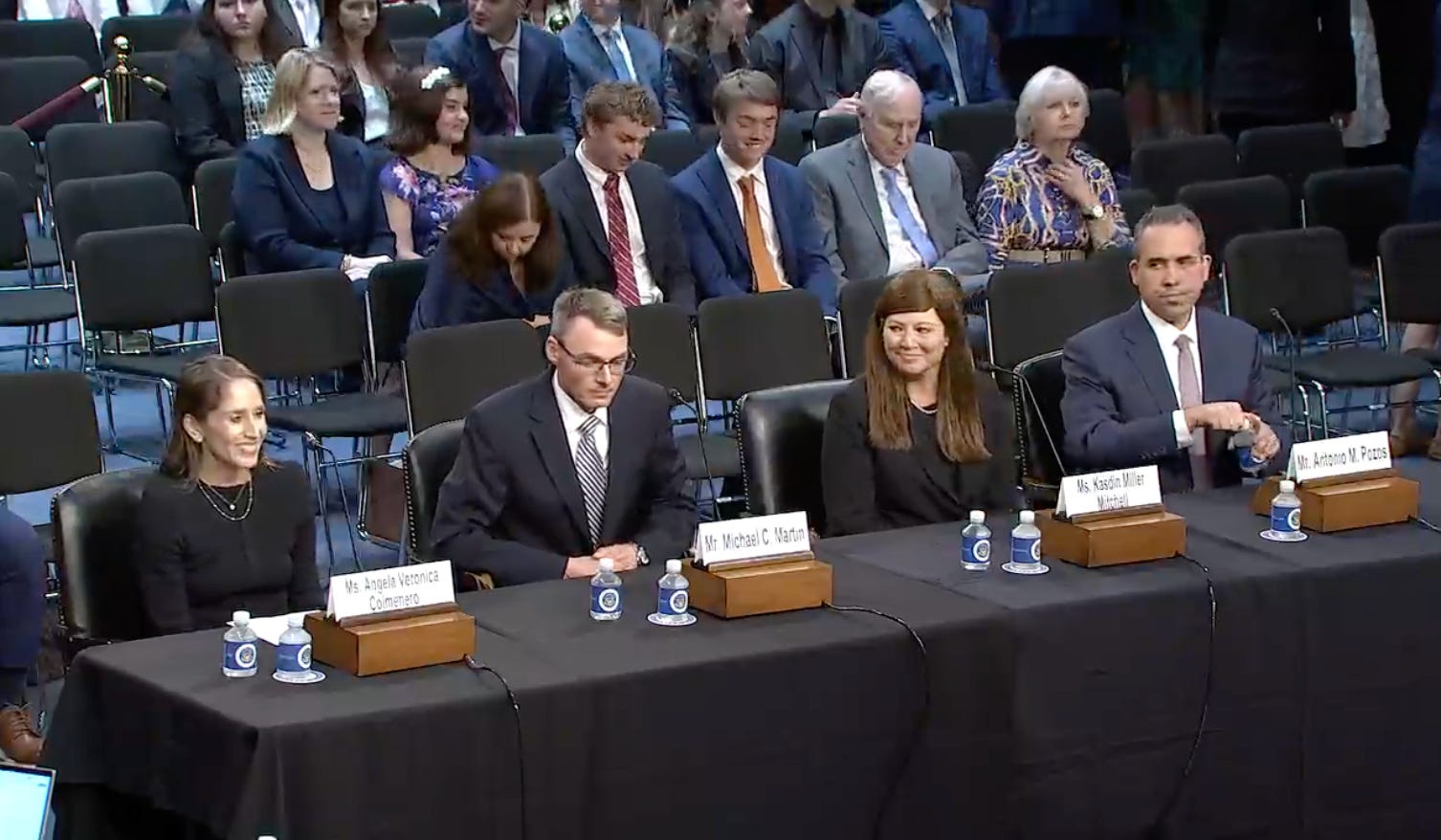
On Wednesday, the Senate Judiciary Committee held a hearing to consider the nomination of Daniel Traynor to serve in a North Dakota seat on the U.S. Court of Appeals for the Eighth Circuit, in addition to the nominations of Kasdin Mitchell for the Northern District of Texas, Angela Colmenero for the Southern District of Texas, Antonio Pozos for the Eastern District of Pennsylvania, and Michael Martin for the Eastern District of Michigan.
Traynor was appointed to the District of North Dakota during Trump’s first term. His elevation to the Eighth Circuit, if confirmed, creates a new vacancy on the district court for Trump to fill.
Inexcusably, Pozos and Martin only appeared at today’s hearing because Senators John Fetterman, Gary Peters, and Elissa Slotkin returned their blue slips for those nominees — clearing the way for their consideration and likely confirmation.
After Senator Fetterman returned his blue slip, the advocacy organization Demand Justice announced a six-figure ad buy targeting the senator for failing to block Pozos’ nomination. This morning, Senator Katie Britt read a statement from Chair Chuck Grassley calling out Demand Justice for their “campaigns against Senate Democrats who dared to return blue slips” for Trump’s nominees. “Demand Justice is threatening Senate Democrats because of these nominees. Shame on them, and anyone who doesn’t oppose these types of tactics,” the statement said. “They seek partisan advantage at all cost, and they don’t care if the casualties are good public servants or the judiciary as an institution. Groups like Demand Justice don’t care about the people of Pennsylvania or Michigan, or any other state for that matter.”
Demand Justice quickly responded. “Senator Grassley and Senator Britt may not like our work, but they are the ones enabling an authoritarian president who wants to undermine elections,” the organization wrote on Bluesky. “They are the ones voting for Trump’s judicial nominees who lie about the 2020 election and refuse to say January 6th was an attack — just to appease Donald Trump’s ego.”
Ranking Member Dick Durbin — who has voted to confirm more Trump 2.0 judicial nominees than any other Senate Democrat — said Demand Justice is “wrong” for their position.
The 2020 election and January 6
Senator Richard Blumenthal once again asked nominees about the outcome of the 2020 election and the January 6 insurrection.
“This issue has become a question of political controversy. I’m a sitting federal district judge. I’m a nominee to the Eighth Circuit Court of Appeals,” Traynor began saying in response to who won the 2020 election. As he began to dodge and invoke a response previously given by Justice Ketanji Brown Jackson, Senator Blumenthal stopped him. “It’s a political controversy, only because the president refuses to accept the results of the 2020 election,” he said.
Traynor said “this is an issue that Justice Jackson and other nominees have been asked. They’ve not provided a response.” But Justice Jackson was not asked who won the election. She was asked if she had ever commented on the results. Still, nominees have recently adopted this as their justification for refusing to answer simple questions.
“You understand why I’m asking you to state as a simple matter of fact: who got more votes? The reason is that the president seeks to perpetuate a lie. You are, in effect, protecting the lie if you fail to take an independent position as a matter of simple fact. Everybody in this room knows the answer. You’re unwilling to state it — instead adopting a script that’s been dictated to you by the White House.”
When Senator Blumenthal asked him whether the Capitol was attacked on January 6, Traynor stated that “the actions on January 6 were deeply troubling to watch, but I’m not going to characterize it beyond that” — and then Senator Blumenthal cut him off. “You’ve watched the videos. You’ve seen the pictures. You know about the injuries done to Capitol Police, law enforcement, who took the same oath you did as a district court judge. And you are unwilling to say that the Capitol was attacked on January 6?”
Traynor stated that he’s had cases related to that issue pending before him, but Senator Blumenthal had heard enough. He closed with this:
Let me just be very clear, judge. I am absolutely astonished, because you are in a position of trust right now. You are supposed to be in a position of consummate independence. You sit here already with a lifetime appointment, and you are unwilling to state an independent view on a factual matter that everybody in this room, everyone watching, knows the right answer to. You’re here to demonstrate your independence, and instead, you are in effect protecting and perpetuating a lie that the Capitol was not attacked? That’s what the president seems to believe. That’s the loyalty that he demands of you, and you are putting loyalty to the president above fidelity to the Constitution and the truth. I don’t know how you can continue as a district court judge let alone serve on the court of appeals. You have the protection already of a lifetime appointment, and you’re unwilling to tell the truth to this committee. I think that, frankly, it’s shameful.
When the four district court nominees appeared on the hearing’s second panel, Senator Blumenthal asked the same questions, and he prefaced them with this: “I want to make clear about the questions I’m going to ask you. They’re not political theater. They’re not being clever. These issues are a matter of right and wrong. There are issues in life that involve right and wrong, as you know. Attacking the Capitol is wrong. Lying about whether it happened is wrong. Stating truth is right. And pardoning people who attack the Capitol is wrong. Failing to call it out is wrong.”
Notably, he began with Michael Martin, the Michigan nominee who allegedly assured Michigan’s senators that he would tell the truth during the hearing.
“From making clear Joe Biden won the 2020 election, to the attack on the Capitol on January 6th, to being clear that President Trump can’t run for a third term, these answers were important factors for me, and fundamentally different from President Trump’s judicial nominees to date,” Senator Slotkin said in a statement on Monday. “I look forward to Mr. Martin conveying the same during his confirmation hearing, and to his service on the federal bench if confirmed.”
When Martin was asked who won the 2020 election, he said that “as a matter of law, Joe Biden was the winner of the 2020 election.” When asked who got more votes,” he said that “my focus as a judicial nominee is on the law, and as a matter of law, Joe Biden won the 2020 election.” When asked who got more Electoral College votes, he said that “Joe Biden received more Electoral College votes.” And when asked whether the Capitol was attacked on January 6, he said that “as part of my work as an assistant United States Attorney, I had the opportunity to look at pictures and videos from that day, and what I saw in those was that officers, law enforcement officers, were attacked, and the building was damaged and vandalized.” When he was asked why it’s “a matter of law” and not a matter of the popular vote, he said “No, sir. Under the Constitution, the popular vote is not the operative fact.”
Martin would not say that President Biden received more popular votes than Trump, just that “as a matter of law” Biden won the election and received more Electoral College votes. He also did not say that the Capitol was “attacked,” but that it was “damaged and vandalized.”
Martin’s answers, while they went further than Trump’s previous judicial nominees, appear to be a newly approved set of responses that judicial nominees will now be giving. Senator Blumenthal called it “a new script, a new pre-negotiated effort to thread the needle, avoid the question, because the president refuses to acknowledge that he lost. He declines to accept the truth that he lost the 2020 election. You are protecting the lie by failing to acknowledge the truth, and it all goes to your independence. If you’re unwilling to show us that you’re independent of the president at this early stage of your service, you disqualify yourself as judicial nominees.”
When asked what they thought of Martin’s performance today and whether they were satisfied with his responses, a spokesperson for Senator Slotkin told me that “As of now, we do not have anything to add.”
Senator Peters’ office offered this response from the senator: “Mr. Martin reiterated in our meetings, as well as at today’s hearing, that Joe Biden won the 2020 election, reassuring me that he will exercise independent judgment.”
Senator Blumenthal did not direct any questions to Mitchell, but Pozos and Colmenero similarly would not say that Biden received more popular votes, saying again that “as a matter of law” he won. They would not say whether the Capitol was attacked on January 6.
“If [Trump] were not putting his thumb on the truth, you’d be willing to state it here, and you are putting loyalty to him above fidelity to the law and the Constitution,” Senator Blumenthal said. “The law doesn’t dictate the results of an election. The people do.”
Josh Orton, president of Demand Justice, responded to the hearing and called out this “new script.” He said the White House “knows that peddling the Big Lie is a political loser. So it’s now directing its judicial nominees to use bizarre qualifiers like ‘by law’ Joe Biden won the 2020 election.”
“If a judicial nominee can’t say those facts — outright — they can’t be independent from Trump,” Orton said. “They should not have blue-slips returned on their behalf by Senate Democrats for their nominations. And they should absolutely not be given lifetime seats on the federal judiciary.”
Martin’s record
Ahead of today’s hearing, Alliance for Justice (AFJ) sent a letter to senators outlining their concerns with Martin’s record at the US Attorney’s office. “Martin’s tenure as the Criminal Chief at the United States Attorney’s Office for the Eastern District of Michigan continues to be riddled with questionable management and participation in politically motivated attacks,” the letter states.
AFJ’s letter highlights politically motivated firings of two assistant US Attorneys in the Eastern District of Michigan simply because they enforced violations of the Freedom of Access to Clinic Entrances (FACE) Act — a law that prevents threats of force or intimidation against reproductive care facilities. Those two prosecutors had successfully secured convictions during the Biden administration for a group of people who blocked access to abortion clinics. AFJ’s letter says that “Martin almost certainly would have had to sign off on” those firings, but under oath at today’s hearing he denied any involvement. “I had no role whatsoever in the decision to terminate them,” he said. It is curious that Martin said it wasn’t his “decision” to terminate them — but did not actually say whether he signed off on it.
Their letter also references prosecutions arising out of Operation Metro Surge in Minnesota. “Following the mass resignation of more than a dozen Minnesota AUSAs after Renee Good’s murder, Martin and Eastern District of Michigan AUSAs under Martin seemingly volunteered to join another state’s U.S. Attorney’s Office to support the filing of politically motivated cases coming out of Minnesota. At least one of these cases, filed by AUSA Danielle Asher (who reports to Martin), was filed in the Eastern District of Michigan, extending the prosecutorial tentacles from Minnesota all the way to eastern Michigan,” the letter states.
Martin was not asked about this today, but he should be questioned about it in written questions for the record.
AFJ President Rachel Rossi said after the hearing that “There are serious allegations that Martin has participated in the weaponization of the Justice Department to target those steadfastly committed to justice. After careful review of his record and speaking with several Michigan leaders, AFJ opposed his nomination.”
“Senators must remain vigilant to block loyalist judicial nominees who seek to quietly sneak through the confirmation process,” Rossi said. “Martin only revised the script used by nominees before him, providing updated but similar canned answers on democracy. He has also failed to address significant concerns about his willingness to advance this administration’s harmful weaponization of the Justice Department.”
The Columbia letter
Four senators asked Daniel Traynor about a letter he signed — alongside 12 other sitting Trump-appointed judges — announcing that they would not hire any law clerks from Columbia University. “As judges who hire law clerks every year to serve in the federal judiciary, we have lost confidence in Columbia as an institution of higher education. Columbia has instead become an incubator of bigotry. As a result, Columbia has disqualified itself from educating the future leaders of our country,” the letter states.
Senator Durbin asked him this question:
“You were a contributing author and signatory of a letter to Columbia University, criticizing the university’s response to protests on campus following Hamas’ October 7 attack on Israel. In that letter, you vowed not to hire anyone who joins the Columbia University community, beginning with the entering class of 2024. Yet, in denying a recusal motion in Thunderhawk v. County of Morton, which was brought by the Columbia Law School Initiative for a Just Society, you said, ‘I reaffirm my lack of bias toward any student or Columbia faculty or initiatives of its law school.’ With all due respect, judge, this statement seems contradictory — stating at one point that you would not hire anyone from Columbia, and second, that you have no bias against those from Columbia. Can you explain?”
The Thunderhawk v. County of Morton case concerned the protests over the Dakota Access oil pipeline and was filed by a lecturer and a professor at Columbia Law School who “included their affiliation with Columbia, currently via the Initiative for a Just Society at Columbia Law School, on every document filed in this Court, from the initial Complaint to this present motion.” Traynor wouldn’t recuse from the case.
Traynor responded with why he signed the letter, describing what he deemed to be “a cauldron of bias that was being promoted on that campus.” When Senator Durbin pressed him further, he said that “I don’t hold a bias against graduates of Columbia. I don’t hold a bias against people who attend the institution. The purpose of the letter was to do what little one can do as a federal judge.” He said that since the lawyers in this case “had graduated from Columbia long ago,” his letter “did not apply to them.”
Senator John Kennedy, a Republican from Louisiana, also expressed concern that Traynor signed the letter, asking “When a federal judge expresses a political opinion like you did, and your colleagues did, how does that help our effort to help the public understand that judges aren’t politicians?”
“You’re a judge. You can do what you want. I hope you won’t do something like that again,” Senator Kennedy said. “To do that as a private lawyer is one thing. To do it as a sitting federal judge is quite another, and I just don’t think it’s a good thing. It’s my personal opinion.”
Senators Peter Welch and Adam Schiff also asked Traynor about the letter, calling out the hypocrisy of refusing to comment on the “political controversy” of January 6 but inserting himself into the controversy at Columbia. “Senator Blumenthal was asking whether there was an attack on the Capitol on January 6, and you felt that you could not comment on that because there may be some case or controversy that will come before you,” Senator Welch said. “That was your answer to him, but doesn’t that same rationale apply to your letter to the administration of Columbia?”
Traynor was not interested in directly answering Senator Welch’s questions, prompting the senator at one point to exasperatingly say “Oh God, did I ask you that question?”
After a long back and forth with Traynor, including asking him again who won the 2020 election, a frustrated Senator Schiff ended his time with this:
This is completely inconsistent with your involvement in the whole Columbia controversy. Completely inconsistent. Because you involved yourself in that controversy. You went out of your way. Nobody asked you to write that letter. You took this upon yourself to do, to insert yourself into that. But you’re saying here you can’t answer a simple question about who won the 2020 election because it would somehow implicate you in controversy. I’m sorry. There’s no way to square those two things.
Part of that letter was also demanding that Columbia address “Viewpoint diversity on the faculty and across the administration — including the admissions office.” The judges were essentially telling the school to hire more conservatives, writing that “Recent events demonstrate that ideological homogeneity throughout the entire institution of Columbia has destroyed its ability to train future leaders of a pluralistic and intellectually diverse country. Both professors and administrators are on the front lines of the campus disruptions, encouraging the virulent spread of antisemitism and bigotry. Significant and dramatic change in the composition of its faculty and administration is required to restore confidence in Columbia.”
Senator Welch asked Traynor: “What right do you have as a judge to tell an academic institution who they should hire?” Traynor said he believed that “the letter was appropriate and consistent with my role as a public person.” Senator Welch, before yielding back, criticized Traynor once more for “getting involved in what is an incredible political controversy.”
The Voting Rights Act
Senator Durbin asked Kasdin Mitchell about a brief she co-authored in Shelby County v. Holder when she was serving as assistant solicitor general of Alabama. Here’s how that exchange went:
DURBIN: I want to ask you a question about the Voting Rights Act. You co-authored a brief in the Shelby County v. Holder case, did you not? It was on behalf of Alabama, in which you argued against the protections of the Voting Rights Act and claimed that the law undermined ‘state sovereignty.’ Do you remember that?
MITCHELL: I do remember that, senator.
DURBIN: You also claimed that certain provisions of the Voting Rights Act were inappropriate, because things in Alabama and the southern states had sufficiently changed since the original passage of the Voting Rights Act in 1965. Yet, time and again, as soon as the Roberts Court has weakened the protections of the Voting Rights Act, we have seen southern states move to further disenfranchise Black voters. Are you aware of the current controversy on redistricting and the prospect of many minority seats being eliminated?
MITCHELL: I’m not working on any of those matters, senator, but I’m generally familiar with them.
DURBIN: You still stand by your efforts to weaken the Voting Rights Act in light of what’s happened since?
MITCHELL: I don’t want to offer any of my personal views on that, but I stand by the arguments that Alabama made in that brief, which was an amicus brief concerning the constitutionality of the Section 5 preclearance requirement. And I believe we made good faith arguments under the law in the best interest of our client.
Their brief claimed that “Congress violated the Constitution” when it reauthorized the Voting Rights Act in 2006. It said that “Things in the South have, indeed, changed” — and that the state should no longer need the federal government’s approval of voting changes. “Alabama has a new generation of leaders with no connection to the tragic events of 1965,” the brief stated. “The effects of those events on voting and political representation have now, thankfully, faded away.”
That brief hasn’t aged well.
And while Colmenero wasn’t questioned about her voting rights record today, she also has a history of working against voting rights in VRA cases.
Traynor’s pro-Trump immigration rulings
Senator Durbin noted that Traynor volunteered to hear habeas petitions from immigrants who were rounded up as part of Operation Metro Surge. He cited Politico’s analysis finding that judges have ruled against the Trump administration’s mandatory detention policy more than 10,000 times — including a majority of Trump-appointed judges.
“You are an extreme outlier on this issue, which you’ve even acknowledged in several of your opinions,” Senator Durbin said. “In your opinions, you embrace the Trump position that it can detain any immigrant without a bond hearing, no matter how long they’ve been in the United States and even if they have no criminal history.”
According to Politico’s database, Traynor has ruled in 28 of these cases — each time siding with the Trump administration. When Senator Durbin asked him why he’s such an outlier, he said that “I reviewed the law. I felt that the administration was acting within their limits, and I made my decision. I based it on the law, and I also based it upon what I expected the Eighth Circuit Court of Appeals would do — and indeed, the position that I took, and the ruling that I made, was upheld by the Eighth Circuit.”
It is perhaps unsurprising that Traynor believed the appeals court would agree with him. The Eighth Circuit is made up of Republican appointees (except for Judge Jane Kelly), including four Trump appointees from his first term. The Eighth Circuit, a court on which a woman of color has never served, is almost entirely made up of white men.
If confirmed to the court, he’ll fit right in.
Senators have until next Wednesday, June 17, at 5:30 p.m. to submit written questions for the record.