
“Complete lack of independence and backbone”: Senators call out judicial nominees for evasive responses
Four more judicial nominees dodged questions related to the 2020 election and January 6.
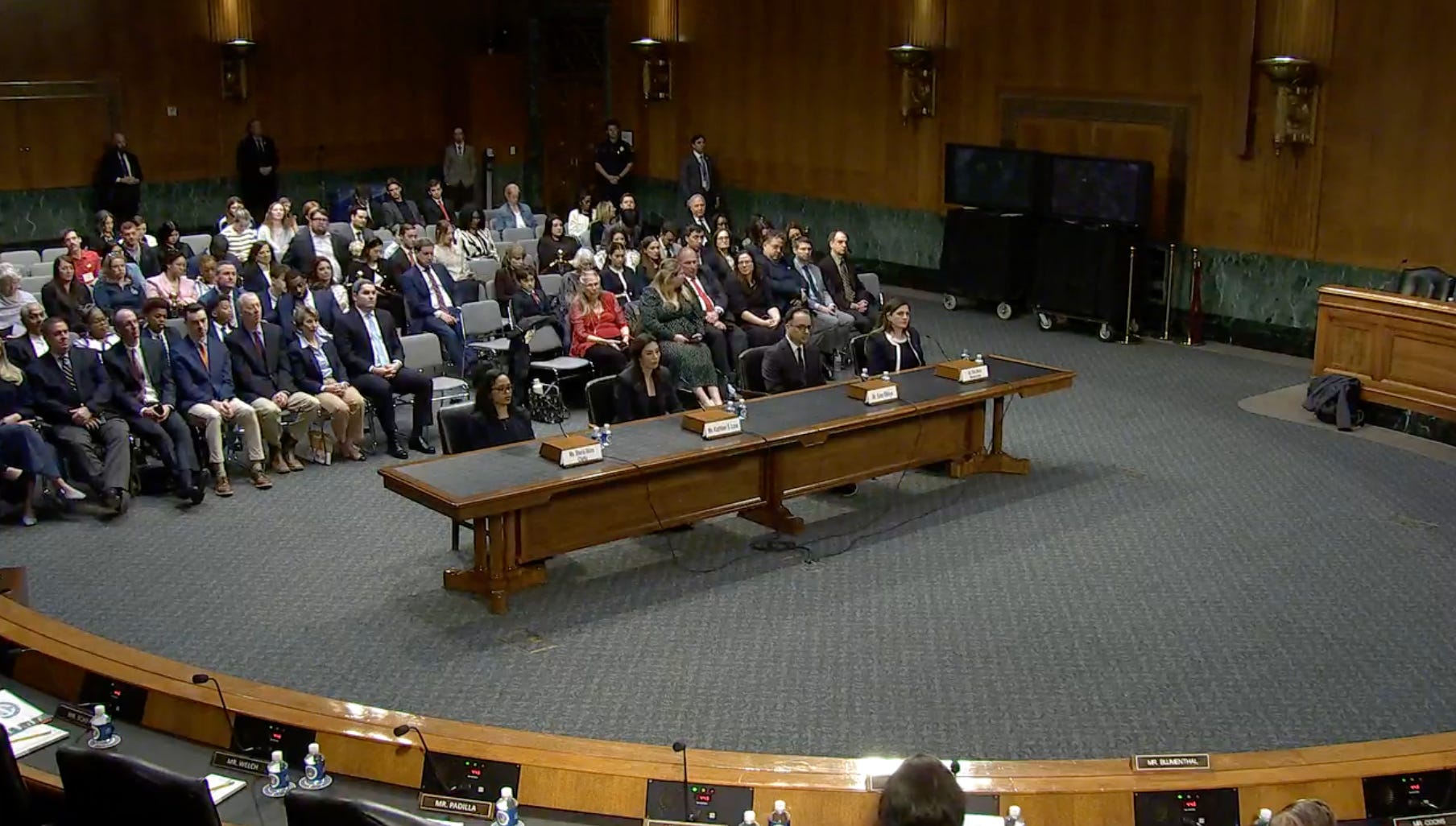
The Senate Judiciary Committee on Wednesday morning held a hearing on the nominations of Katie Lane for the District of Montana, Sheria Clarke for the District of South Carolina, and Kara Westercamp for the Court of International Trade (CIT). The committee also considered the nomination of Evan Rikhye for the District of the Virgin Islands, which is not a lifetime appointment.
During his opening remarks, Ranking Member Dick Durbin underscored the importance of committee members’ role in considering judicial nominees.
“As members of the Senate Judiciary Committee, it’s our responsibility to determine if nominees before us have the experience, independence, and temperament — and temperament — for a lifetime appointment to the bench. We evaluate each of these nominees with the first basic question: Will they follow the rule of law? That is all the more crucial now with a president who is constantly trying to break the law and defying court orders,” Senator Durbin said. “In his second term, President Trump has accelerated a pattern from his first term: Put in place a patently illegal policy, dare the courts to strike it down, and when the courts uphold the rule of law, respond by personally attacking the judges. President Trump’s tariff policy is a perfect illustration of this.”
Senator Durbin went on to discuss the Supreme Court’s recent decision on the president’s tariffs and Trump’s subsequent social media attacks on the justices who ruled against him.
“After losing before the Supreme Court, he wants to stack the courts, including the CIT, with MAGA loyalists who will rule in his favor and not give the refunds back to businesses and individuals,” Senator Durbin stated. “Today, the committee will consider the nomination of Kara Westercamp for a lifetime appointment to this court. Based on her record, it appears she will be faithful to the president. How about her faithfulness to the rule of law?”
Westercamp’s disturbing history of posting and amplifying biased political content
Senator Durbin pivoted to Westercamp’s past tweets and retweets, some of which were previously documented by Balls and Strikes here.
“Ms. Westercamp’s social media account reads like a Trump fanfiction — questioning the outcome of the 2020 election, whitewashing the January 6 attack on the Capitol, and attacking Chief Justice Roberts for not being sufficiently conservative,” Durbin said. He then provided examples, including multiple tweets claiming Democrats cheated to win the 2020 election, repeatedly calling Senator Mitch McConnell “Cocaine Mitch” and accusing him of “betraying Trump,” and attacking Senators Susan Collins and Lindsey Graham.
“This shameless display of extreme rhetoric does not reflect independence or judicial temperament required for a lifetime appointment to the federal bench,” Durbin stated at the end of his introductory remarks. “I look forward to hearing from her personally when we ask her questions.”
He indeed asked her questions.
“Throughout your prolific, inflammatory social media career, you launched personal attacks on multiple members of the Senate,” Senator Durbin said, before repeating what Westercamp wrote about Senators McConnell, Collins, and Graham. “Would you like to apologize to those senators and others which you’ve referred to in your social media today?”
Westercamp said she would, stating the following:
Yes, senator. And if I may: Any comments I made were in my personal capacity as a private citizen, but in hindsight, I think that using Twitter is not the right platform, especially retweets from someone I don’t know regarding political opinions, controversial topics, or even characterizations of people. And so I do sincerely apologize for those posts, and if confirmed, senator, I would faithfully uphold the judicial canons, which include avoiding any appearance of impropriety, and that would include social media. And I’ve also seriously considered…just completely deactivating Twitter.
Senator Durbin then noted that Westercamp “used social media to spread conspiracy theories” about the insurrection, including that “law enforcement was complicit in the violence” — and that she appeared to agree with a tweet that said the attack was “orchestrated by members of the Senate and members of the Capitol Police.” According to Senator Durbin, she also downplayed the violence on January 6, including assaults on law enforcement, by retweeting and posting that “we’re all supposed to be sending thoughts and prayers to traumatized members of Congress, whose workday was interrupted for a couple of hours.”
When asked if she was willing to denounce the violence on January 6, she stated that “I condemn all violence that occurred on January 6, and in addition, I think for what you quoted, senator, I think that is endemic of how it is not proper to use retweets from someone or from people I don’t know regarding such a controversial topic.” When asked if she would apologize to law enforcement officers for spreading the conspiracy theory that they were complicit in the violence, she repeated that she condemned the violence and regretted the retweets — but she did not directly apologize.
Senator Peter Welch asked Westercamp about her social media messages as well, including a post she retweeted from former Trump advisor George Papadopoulos that said — quoting Ulysses S. Grant — “There are but two parties now: traitors and patriots.” Senator Welch repeatedly asked Westercamp to identify who are the traitors and who are the patriots, but she deflected every time. “Unbelievable,” Senator Welch said. “You made an active decision to amplify a tweet. You thought other people should see it” — later adding, “You did this. You did it. You hit send.”
Senator Welch also asked her about a post she retweeted that read, in part, “big distinction between us and the party of hate.” Westercamp said that she doesn’t agree with everything that’s been retweeted in the past. “Do you agree with anything you did in the past? You have to figure that out,” Welch replied.
During his questioning, Senator Durbin emphasized why these questions were being asked:
What we’re trying to get to is whether you have the temperament for a lifetime appointment as a judge with extraordinary authority and power in that appointment. We don’t know — as we vote and send off judges to do their duty — whether they’re going to keep their word before us. We look at their background, we look at their values, and try to draw a conclusion as to whether they are stable and dependent, and whether or not they should have the authority and power for a lifetime on the federal bench.
Refusal to directly answer questions related to the 2020 election and insurrection
As he’s done during the last several nominations hearings, Senator Richard Blumenthal asked the nominees questions about the 2020 election and January 6.
He started with Kara Westercamp — asking her who won the 2020 election.
“Senator, under our Constitution, the Electoral College votes for the president, and then that is certified by Congress. And in 2020, President Biden was certified by the Electoral…” Senator Blumenthal cut her off. “That’s not my question. Who won the election?” Westercamp began to give the same response, and Senator Blumenthal jumped back in. “I know who was certified,” he said. “And I know what you think of certification, because you tweeted on January 6 in a post saying, in reference to the 2020 election results: a certified lie is still a lie. I’m asking you: Who won the 2020 election?”
It didn’t go well. “I’m not asking you for what the Constitution says. I am asking you for your view factually,” Senator Blumenthal said. “And frankly, we’ve received this kind of canned, ridiculous answer before, as you know, because you were instructed to give this answer, right?” When Senator Blumenthal asked her whether the United States Capitol was attacked on January 6, Westercamp would only say that “I condemn all of the violence that occurred on January 6.”
Clarke, Lane, and Rikhye were also asked about who won the 2020 election, and all three nominees would not directly answer.
“I am amazed. I am just amazed by the insult to this committee, of witness after witness, seeking to be a federal judge — subverting our Constitution and showing how you have no independence, which is essential to a federal judge,” Senator Blumenthal said.
When asked whether the Capitol was attacked on January 6, Rikhye would only say that “there was violence that occurred here on that date.” When Lane was asked the same question, she said that “the characterization of January 6 is ongoing, is subject to ongoing controversy and debate, and as a nominee, it would be inappropriate for me to characterize it.”
“The answers here, which obviously are canned — they’re pre-rehearsed, they’re Orwellian in their denial of reality, and they are a subversion of this process. They’re an insult to this committee, but they also fundamentally show a complete lack of independence and backbone and impartiality, which are the fundamental requirements of a United States district court judge, or a judge on any panel,” Senator Blumenthal stated. “And I’m a little bit disappointed that you’re not more original, that you can’t think of a few different words. I’m just amazed.”
Senator Sheldon Whitehouse was up next, and he began by commenting on what he just witnessed:
Just to finish Senator Blumenthal’s point, I hope you realize how ridiculous the four of you look — spouting these preposterous, canned answers in a forum in which, A, you’re supposed to tell the truth, and B, you’re supposed to demonstrate the judicial capacity to make independent, factual decisions in hard cases. If you can’t even sit here and say that Joe Biden won that election or that the Capitol was attacked? What’s left? What’s left if a hard case comes your way as a judge, and let’s say the Trump administration is bearing down on that. Why would we ever believe that you would give the litigants a fair hearing and a fair decision if the executive branch was leaning in on you, when we can’t get a reasonable answer out of any of you with the executive branch leaning in on you to give these ridiculous answers today?
Lane’s breathtaking lack of experience
Yesterday, I wrote about Katie Lane’s record of hostility to civil and human rights. No senators questioned Lane about her appalling record on these issues, though Senators Adam Schiff and Chris Coons did ask questions revealing her astonishing lack of experience for this role.
On her Senate Judiciary Questionnaire, Lane was asked to “State the number of cases in courts of record, including cases before administrative law judges, you tried to verdict, judgment or final decision (rather than settled), indicating whether you were sole counsel, chief counsel, or associate counsel.” She replied that “I have had one four-day bench trial where I served as associate council [sic].”
When Senator Schiff asked Lane if she’s ever tried a case to verdict before a jury, she said that she’s worked on a bench trial and that “as a federal law clerk, I handled seven trials.”
“I was a federal law clerk as well. I wouldn’t say that I handled the trials. I think the judge handled the trials,” Schiff responded. He zeroed in on the one bench trial she worked on, noting that she’s never served as the sole or chief counsel in a case that went to verdict, judgment, or final decision.
“I’m not trying to denigrate your experience as a law clerk. I think it’s a great experience, and I highly encourage those graduating from law school to pursue clerkships. But having tried cases as an assistant US Attorney, it’s not the same thing — to observe them and to do them yourself. I’m sure you would agree, but thank you,” he said.
Senator Coons said that he was “deeply concerned by the lack of legal experience” she would bring to a lifetime appointment, noting that Lane graduated from law school in 2017. Putting aside her two clerkships, he asked her how many years she has actually practiced law. Lane did not provide a number of years and instead sought to quantify her experience with the cases she’s worked on and the motions she’s filed in federal and state courts.
Then this exchange followed:
COONS: You mentioned in your questionnaire that, while at Consovoy McCarthy, you drafted outlines for direct and cross examinations and cross-examined a witness. You only mention one cross examination. You’ve certainly conducted more than one cross examination in federal court, is that correct?
LANE: I conducted that one cross examination, senator, but I’ve been very involved in the preparation of witnesses.
COONS: There’s one cross examination in federal court. Is that correct?
LANE: I have, senator, and I have also worked extensively with preparing experts, helping prepare. I also took a deposition.
COONS: You took a deposition of an expert witness. You’ve certainly taken more than one deposition in your legal career, is that correct?
LANE: Senator, I’ve taken a deposition of an expert, but I’ve also been deeply engaged in…
COONS: You’ve taken one deposition.
LANE: Yes, senator, and I’ve also had the opportunity…
COONS: You said in responses in your questionnaire that you’ve drafted outlines for direct examinations. How many direct examinations have you conducted?
LANE: Senator, I have, like I said, drafted outlines for direct examinations and helped prepare witnesses, and second-chair depositions…
Chair Grassley cut off the questioning.
Senators can submit written questions for the record by next Wednesday, April 1, at 5 p.m.
They must do so.