

Judicial nominees dodge their way through Senate confirmation hearing
Daniel Domenico and Matthew Byrne gave various nonanswers about who won the 2020 election.
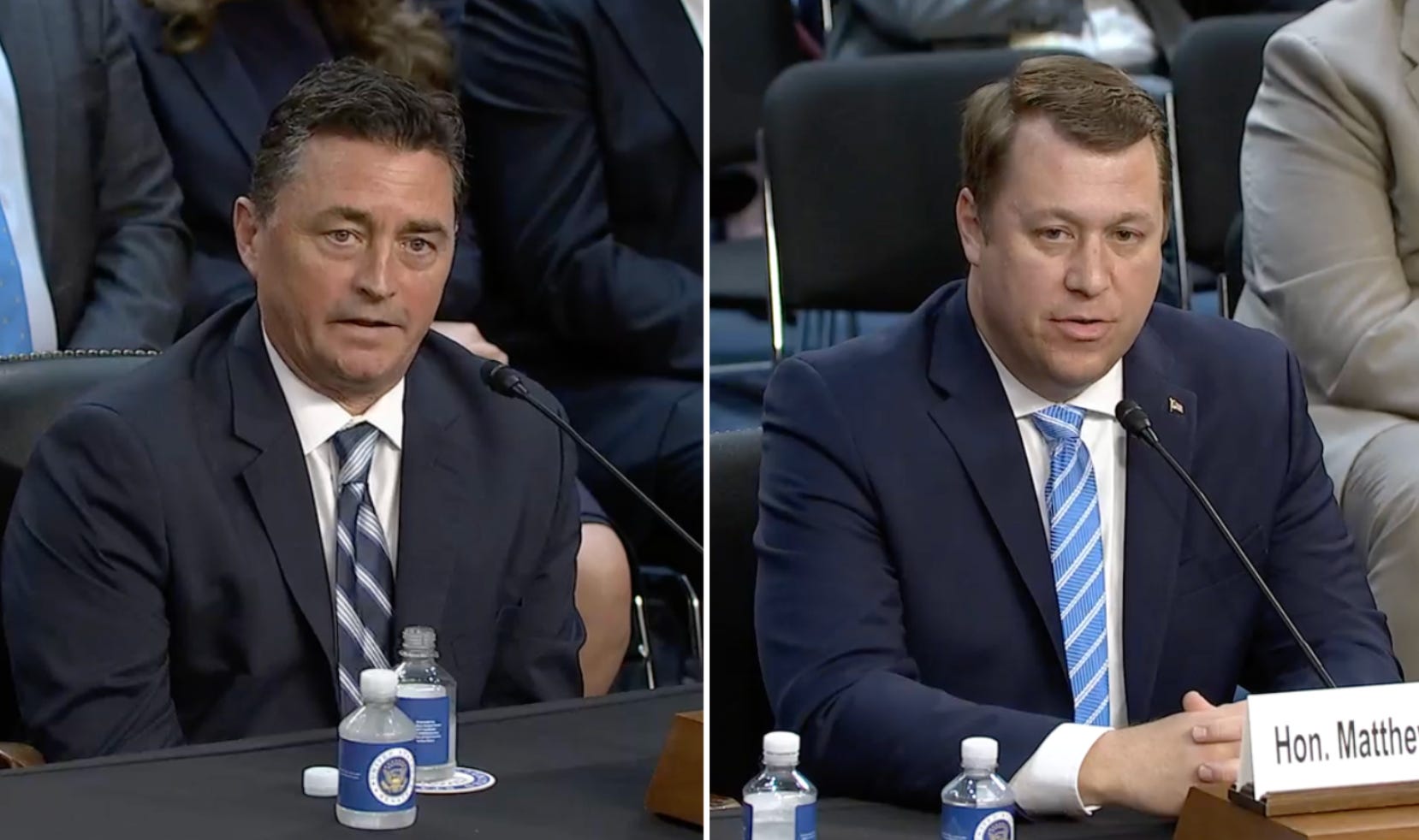
The Senate Judiciary Committee on Wednesday held a hearing on two more of Trump’s nominees for lifetime federal judgeships: Daniel Domenico for a Colorado seat on the U.S. Court of Appeals for the Tenth Circuit and Matthew Byrne for the U.S. District Court for the Southern District of Ohio. The committee also considered the nomination of Konstantinos Ligris, nominated to serve as assistant attorney general for the Office of Justice Programs at the Department of Justice.
During his first term, Trump appointed Domenico to the District of Colorado, where he is currently chief judge. If confirmed, Domenico will take the place of Judge Timothy Tymkovich — for whom he clerked more than two decades ago.
Colorado’s senators did not introduce Domenico at the hearing, but Ranking Member Dick Durbin entered a statement into the record from Senator Michael Bennet. The senator’s office did not respond to requests for that statement. Weirdly, Domenico was introduced by Senator Ted Cruz, whose prepared introduction was read by Chair Chuck Grassley.
During his opening remarks, Chair Grassley noted that both judicial nominees are already sitting judges. “It’s hard to imagine better experience for federal judgeships than those of you that have prior experience,” he said. “They already know what it takes to do the job of judging, and their track record speaks for itself.”
Chair Grassley also hyped up his work processing Trump’s judicial nominees, saying that under his chairmanship this Congress the committee is processing judicial nominees “at a historic pace.” He said that “if you look at the time between nomination and confirmation, we’ve advanced and confirmed Article III judges faster than any time since Ronald Reagan’s presidency. In 2025 and 2026, we’ve advanced and confirmed circuit judges nearly twice as fast as during the first Trump and Biden administrations. And we’ve even had greater success with district court nominations, where we have tripled the pace of the first Trump administration.”
I am not doing the math to determine whether that is correct with respect to “time between nomination and confirmation.” But compared to Trump 1.0 and President Biden’s term, confirmations have slowed. During Trump’s first term, for example, the Senate confirmed 12 circuit court judges in 2017 alone and had confirmed 21 by this point in 2018. By this date during Biden’s presidency, the Senate had confirmed 16 circuit court judges. The Senate has only confirmed seven circuit court judges since Trump regained the presidency last year. They are currently outpacing Trump 1.0 in terms of district court confirmations, but they are not outpacing Biden. Thirty-seven lifetime district court judges have been confirmed so far during Trump’s second term (that number should reach 39 by tomorrow), while 52 had been confirmed at this point in Biden’s term.
Ranking Member Dick Durbin used his opening statement to preview next month’s confirmation hearing for attorney general nominee Todd Blanche, saying that “he has used the department as a shield to protect the president and his MAGA allies, and a sword to attack the president’s opponents.” He also expressed gratitude that Chair Grassley shares his commitment to preserving the blue slip, but he said that Grassley “inaccurately accused Democrats of obstruction for refusing to return blue slips” for some nominees. “Blue slips are an important part of the Senate’s constitutional duty of advice and consent, and in the face of a lawless administration, they help senators defend the integrity of US Attorney’s offices and the independence of our judiciary,” he said.
The 2020 election and January 6
Senator Richard Blumenthal once again asked the judicial nominees who won the 2020 election — and once again the nominees recited various scripts in response.
Domenico was up first. “As Justice Jackson explained when she was asked, essentially that question, about both 2020 and 2016, it would be inappropriate for me…” — but Senator Blumenthal jumped in, clarifying that Justice Jackson was not asked the same question. “So the question is slightly different,” Domenico conceded. When asked who won the popular vote in the 2020 election, he again tried to cite Justice Jackson, saying it would be inappropriate for him to comment on a matter of political debate.
Senator Blumenthal noted that Domenico already has a lifetime judgeship, saying that “You have the independence right now to say what really factually happened in the 2020 election, and you are evading that question with the same scripted, canned answer that everyone nominated so far recently has given. I think the American people ought to be deeply disappointed — and members of this committee.”
Domenico would also not say that the U.S. Capitol was attacked on January 6, 2021, instead stating that from the videos he’s seen “a number of individuals attacked police officers” and engaged in violence and vandalism. “Individuals engaged in attacks on police officers, which I clearly condemn,” he said. “More broadly characterizing the events of that day beyond what a number of individuals did I think would put me in the same position as Justice Jackson when asked about the same events.”
“I’m willing to say that if I were in your courtroom and I gave these kinds of answers to you, as a judge on the federal bench, you would throw me out of your courtroom,” Senator Blumenthal said in response. “And I’m disappointed that you’re not willing to be more forthcoming as to the facts here, because one of the key questions about any nominee for the federal bench is independence of mind and action.”
Senator John Kennedy tried to clean up the mess. He got Domenico to say that Biden was president before Trump (but not that Biden won the election) and that January 6 was a “dark day” (but not that the Capitol was attacked). His efforts to rehabilitate Domenico only reinforced his dodges.
When Matthew Byrne was asked the same questions during the hearing’s second panel of nominees, he was well-prepared with a different script. “Joseph Biden was declared the winner of the 2020 election by a joint session of Congress,” he said. When Senator Blumenthal stated that “The people of America declared him the winner” and asked if that’s correct, Byrne said that “there was an election, and it proceeded through the normal procedures outlined in the Constitution.” Then, when asked if Biden won the popular vote, Byrne shifted again and said that “As a judicial nominee, it would be inappropriate” for him to comment on a political dispute.
You could see Byrne, in real time, sorting through the various scripts in his head to decide which one he thought sounded best for each question.
Like Domenico, Byrne would not directly say whether the Capitol was attacked on January 6. “There was violence and vandalism on that day, including with regard to law enforcement officers. I think all of that was inappropriate and wrong,” he stated.
“Everybody in America has seen the videos. Everybody in America knows that Capitol police were injured, some died,” Senator Blumenthal said. “Wasn’t it an attack on the Capitol?” Byrne would only say that it was “an attack on a number of individuals” — adding that “as a judicial nominee, I’m here to talk about questions of law, not fact.”
“No, you’re here to talk about what we ask you to talk about, and questions of fact are absolutely to the point when we are asking whether you are willing to state facts, honestly and candidly, because it goes to your integrity and independence,” Senator Blumenthal said. “If you’re going to be a lap dog to Donald Trump, which is exactly what you’re indicating here by failing to answer these questions, we can’t approve you as a judge. That’s one of our most solemn responsibilities — to make sure that our federal judiciary is independent, above politics, and independent of Donald Trump and his fixation on the 2020 election, denying that Joe Biden won it.”
Byrne repeated that “Joe Biden was declared the winner of the 2020 election by a joint session of Congress,” leading Senator Blumenthal to conclude his questioning. “You lack that essential backbone that is necessary to be a federal judge,” he said.
Immigration
Senator Durbin asked Domenico about his rulings in cases related to ICE detention.
Let me ask what lies behind your rulings in some of these cases. Around the country, the Trump administration has detained tens of thousands of immigrants, more than 70 percent without any criminal record. Overwhelmingly, district court judges appointed by both presidents, Republican and Democrat, have held that mandatory detention of these individuals is illegal and unconstitutional. According to Politico’s analysis, judges have ruled against the administration’s policy almost 14,000 times. And even a majority of Trump-appointed judges have ruled against the administration. You, however, are an outlier, which even you’ve acknowledged in several of your opinions denying habeas petitions. In your opinions, you’ve embraced the Trump administration position that it can detain any immigrant without a bond hearing, no matter how long they’ve been in the United States, and even if they have no criminal history. In light of your embrace of the Trump administration’s position, even when judges have ruled against the administration’s policy nearly 14,000 times, why should anyone have confidence that you could be a neutral arbiter presiding over challenges to this administration’s action — that you can treat immigrants in a fair manner?
According to Politico’s database, Domenico has ruled in eight of these cases — each time siding with the Trump administration.
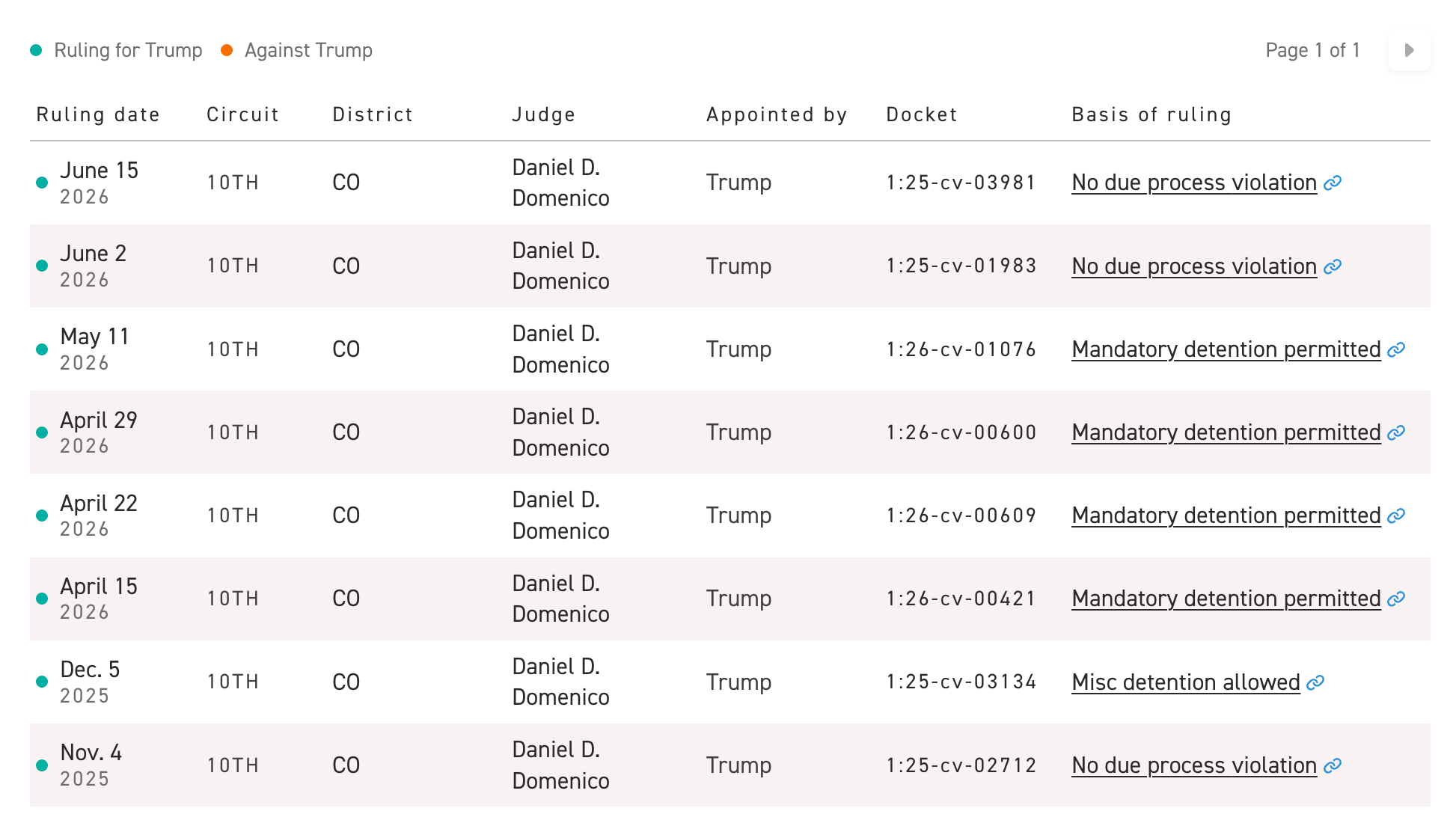
Domenico told Senator Durbin that “There is a clear division of opinion about how that particular statutory provision applies” — an attempt to frame his rulings as more within the mainstream than they are. “For you to be in a position that you are and to deny, consistently, opportunities for people to have bond and to be released if they are no danger — but to rule consistently against immigrants — is not a good thing to encourage on the bench,” Senator Durbin said in conclusion.
In their letter opposing Domenico’s confirmation, People For the American Way wrote that “as Donald Trump requested, Domenico reinterpreted the immigration statute to give Trump the power to imprison immigrants already living in the country without bond. Domenico acknowledged that no other federal judge in Colorado had interpreted the law that way” at the time. Alliance for Justice’s report on Domenico’s nomination also called out his “extreme deference to ICE and the administration’s draconian and unprecedented immigration policies.”
Marriage equality and abortion access
In addition to questions about the 2020 election and January 6, Senator Blumenthal also asked Byrne about a judicial candidate survey he filled out in 2020 while running for his current judgeship. That survey, which he filled out while seeking the endorsement of an anti-abortion organization, asked how supportive he is of this statement: “The judiciary does not possess the authority to expand the definition of marriage to include anything but one man and one woman.” Byrne answered “Fully supportive.”
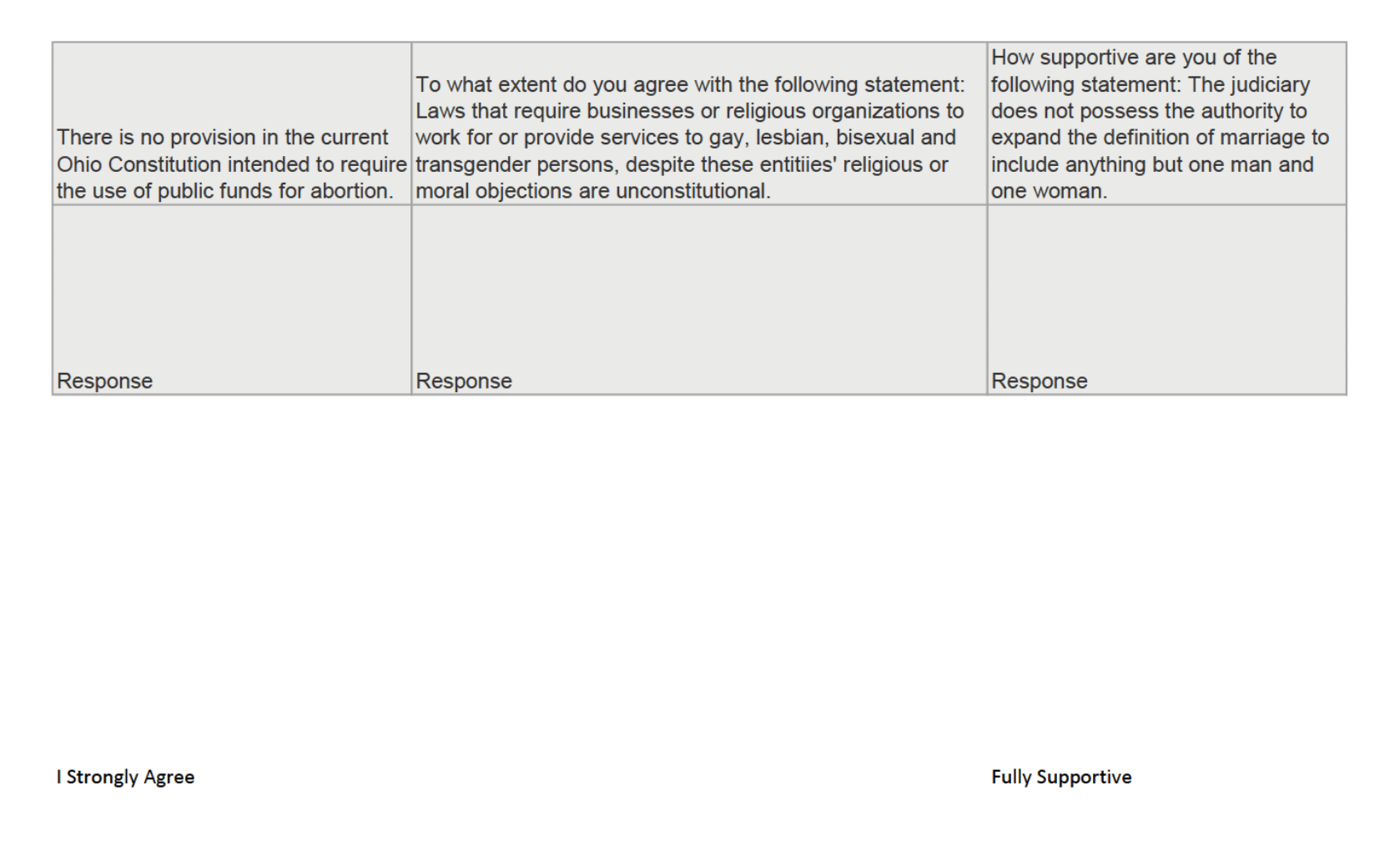
Byrne confirmed that he provided that response. When asked whether he believes that there’s a right to same-sex marriage under the Constitution, he cited Obergefell. But as Senator Blumenthal pointed out, Byrne responded to this survey question five years after the Supreme Court decided Obergefell, making marriage equality the law of the land. Senator Blumenthal asked Byrne whether it was correctly decided, but he would only say that “as a judicial nominee, it would be inappropriate for me to comment on whether a Supreme Court decision was correctly decided or not.”
“Well, you did as a nominee for the state court. You said you disagreed that there was a constitutional right to same-sex marriage. I don’t understand why you can’t respond to the question now,” Senator Blumenthal said. “It’s well established as law in the United States of America.”
Senator Mazie Hirono also asked Byrne about a judicial survey he filled out, noting that he checked a box indicating he believes abortion is not acceptable in any situation (including rape or incest) other than to preserve the life of the mother. Underneath, he wrote “I strongly agree. However, I believe the ‘life of the mother’ should be strictly defined so as to avoid creating loopholes.”
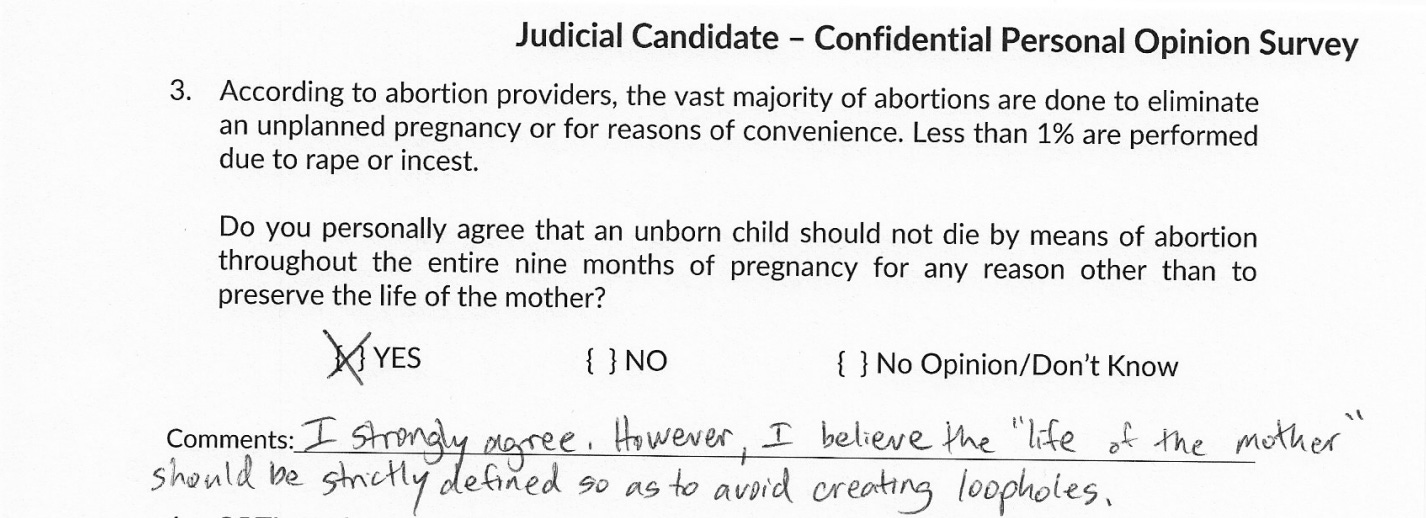
“The loophole that you refer to is that there might be a doctor who might perform an abortion before the life of the mother is at risk, and that is the only loophole I can think of,” Senator Hirono remarked. “That’s just amazing to me that that is the kind of standard you would apply. And I assume that as a judge, you may be confronted with a case where the issue is whether the life of the mother was at risk. And I believe that you would apply your strict definition as to what constitutes a risk to the life of the mother.”
Senator Hirono also asked Byrne about the time he was serving as a visiting justice in an Ohio Supreme Court case concerning Ohio’s “heartbeat bill” that banned abortion before most people know they’re pregnant. “You previously helped organize testimony in support of that same legislation,” Senator Hirono noted. “And yet, when you were sitting as a visiting judge on a case that involved that legislation, your impartiality would be, I think, legitimately reasonably questioned. Why did you not recuse yourself from this case?”
Byrne said that he considered recusing himself, as he does for all cases, and he concluded that there was no basis for recusal. When Senator Hirono asked whether he had a conflict there, or at least the appearance of one, he said he did not. “Well, I obviously disagree,” she responded.
For his anti-abortion record and deeply held beliefs, Byrne is now being rewarded with a lifetime judgeship in Ohio — and he had his hearing, today, on the anniversary of Dobbs.