
In responses to written questions, Trump’s circuit court nominees continue dodging
Benjamin Flowers and Matthew Schwartz want us to believe they’ll be fair and impartial. They won’t be.
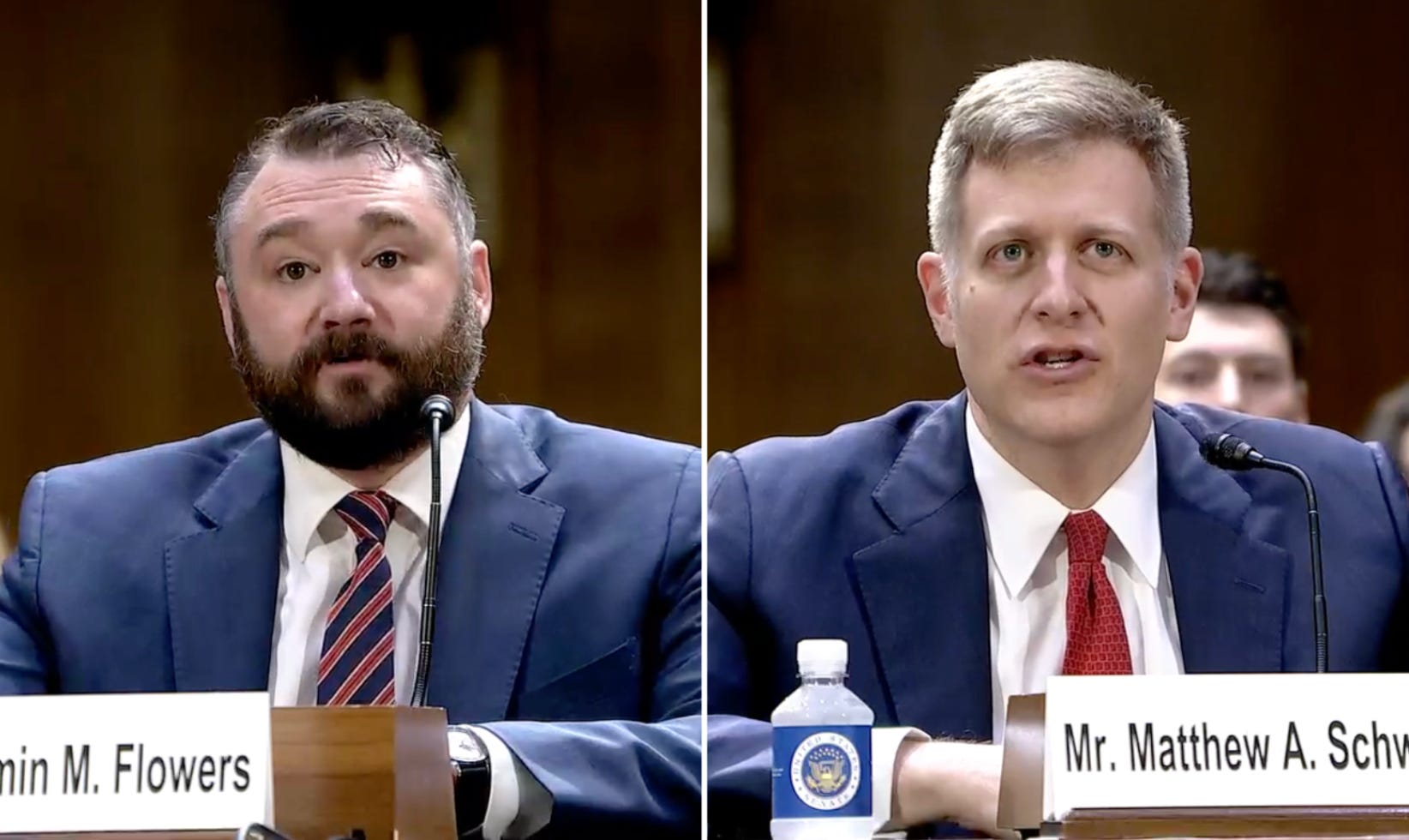
The Senate Judiciary Committee on Wednesday posted responses to written questions for the record from Benjamin Flowers, nominated to the U.S. Court of Appeals for the Sixth Circuit, and Matthew Schwartz, nominated to the U.S. Court of Appeals for the Second Circuit. Schwartz is also one of Trump’s personal lawyers.
In their responses, Flowers and Schwartz repeated what they said during their confirmation hearing: Joe Biden was merely “certified” as the winner of the 2020 election, and it would be “inappropriate” for them to answer questions related to the January 6 insurrection — other than stating that they condemn violence.
During the Flowers/Schwartz hearing last month, Chair Chuck Grassley’s staff put up a poster showing Justice Ketanji Brown Jackson and the text of a response she gave when asked in writing “Have you ever commented, publicly or otherwise, on the results of the 2020 election?” Justice Jackson responded by saying: “Consistent with the Code of Conduct for United States Judges and the positions taken by prior nominees, as a pending judicial nominee and a sitting federal judge, it would be inappropriate for me to publicly weigh in any subject of political debate. In my individual capacity, I have had private conversations on a wide variety of topics.”
Chair Grassley sought to compare Justice Jackson’s response to this question — asking her whether she’s commented on the 2020 election — with Trump’s judicial nominees refusing to say who won the election, saying that Trump’s nominees are “making the exact same point that Justice Jackson made.”
In responses to written questions for the record, only Flowers doubled down and repeatedly invoked this excuse to avoid answering questions. Schwartz did not reference Justice Jackson at all.
Before I continue, I want to encourage you to read my previous reporting on these nominees and their records. Senators’ written questions didn’t cover all of what I’ve previously flagged in my stories, and in some places where they did, I wasn’t able to include everything in this piece.
Trump nominates anti-civil rights extremist Benjamin Flowers to the Sixth Circuit
Second Circuit nominee Matthew Schwartz lambasted a same-sex wedding at Princeton
Trump’s judicial nominees seem to share his white supremacist vision for America
Benjamin Flowers’ writing makes clear why Trump wants him on the Sixth Circuit
“You both know better”: Trump’s loyalist circuit court nominees dodge questions during hearing
The 2020 election and January 6
When asked in writing by Ranking Member Dick Durbin whether Trump lost the 2020 election, Flowers responded this way:
Joe Biden was certified the winner of the 2020 election. To the extent this question asks for my opinion about the existence or non-existence of fraud, election irregularities, or other matters pertaining to the fairness or integrity of the election, I agree with Justice Ketanji Brown Jackson who, in her responses to this Committee’s questions for the record pertaining to the 2016 and 2020 elections, explained that under the Code of Conduct for United States Judges, it is inappropriate for judicial nominees to comment on election results.
Senator Chris Coons asked Flowers about whether he was instructed to avoid answering these 2020 election-related questions. Flowers recounted what he said during the hearing and commented on Justice Jackson’s written responses. “I discovered these answers while preparing for my hearing. I believed they were sound and determined independently that I would answer as I did,” he said. It is inconceivable that both Senator Grassley’s staff and Flowers independently discovered this response and happened to bring it up at last month’s hearing. More likely, they either collaborated on this messaging beforehand — or Flowers is lying in his written responses that he “discovered” Justice Jackson’s responses prior to the hearing.
When Senator Alex Padilla asked Flowers whether he accepted “that the 2020 presidential election was a free and fair election,” Flowers referred to a previous response where he refused to answer (again invoking Justice Jackson). In response to a question from Senator Cory Booker, he would not say whether he believes “that the results of the 2020 election, meaning the vote count, were accurate.”
Schwartz also wouldn’t say whether the vote counts were accurate. And when Senator Durbin asked him if Trump lost in 2020, he said this:
Congress certified President Biden as the winner of the 2020 presidential election. In keeping with the position of prior judicial nominees, it would be inappropriate for me to opine on political, policy, or legal debates regarding the integrity 6 of any election, including the 2020 presidential election. See Code of Conduct for United States Judges, Canons 3(A)(6), 5.
He gave this (or a very similarly worded) answer seven times throughout his responses. Senator Coons sought clarification, asking Schwartz whether being certified the winner of a presidential election also means that candidate won the election. Schwartz would only say that “My understanding is that if Congress certifies a candidate as being the winner of a presidential election, it means the candidate has been elected President.”
Both nominees stated multiple times that they condemn all violence, including against law enforcement, when asked about January 6. But they would not specifically denounce the insurrection or state that the attacks on January 6 represented an insurrection. They also phrased their responses in a way that suggests violence just happened to occur that day at the Capitol, declining to affirm that the attacks were directly on the Capitol (at Trump’s direction) and that they happened in an attempt to stop the certification of the election.
“Because the characterization of the events of that day is a matter of political controversy and is also subject to pending litigation, it would be inappropriate for me to comment further,” Flowers stated. “As a judicial nominee, it would be inappropriate for me to comment on legal issues that could come before me if I am fortunate enough to be confirmed, and that are also matters of political controversy,” Schwartz said.
Senator Adam Schiff asked Flowers what violence he is aware of that occurred on January 6 at the Capitol, asking him to “Please list any events that you recall reading about, watching, or seeing in subsequent media reports.” Flowers responded by saying “I cannot recount particular examples, but I have seen footage of the events of that day.”
Schwartz’s legal representation of Trump
Schwartz — who stated that Justice Samuel Alito is his role model when it comes to conducting himself ethically — was asked several questions about his legal representation of Trump. When Senator Sheldon Whitehouse asked him to explain the legal work he’s done for Trump, Schwartz explained that he is part of his law firm’s team representing Trump in seeking to overturn on appeal his 2024 conviction in People of the State of New York v. President Donald J. Trump. He said that he has “also been a member of the team representing President Trump, Donald Trump Jr., Eric Trump, and various entities within the Trump Organization in appealing the decision by a New York State trial court finding them liable for allegedly inflating assets on their financial statements and awarding the State over $464 million in disgorgement and injunctive relief.”
Schwartz added that, since 2025, “the team has also provided legal advice to President Trump on aspects of other matters when they have implications for the arguments being made on President Trump’s behalf in the two above-described matters.”
During his confirmation hearing, Schwartz promised that if confirmed he would “be impartial” and “rule without fear or favor” — saying that he will take his oath “extraordinarily seriously” and wouldn’t violate it if confirmed. He agreed to recuse himself from all matters in which he previously represented Trump, which he again did in writing multiple times.
Senator Booker asked Schwartz whether he discussed pursuing a federal judgeship with Trump or any person associated with him while he’s been representing the president. Schwartz noted that he has spoken with individuals at the White House Counsel’s Office and the Department of Justice “whose responsibilities include making recommendations to President Trump on judicial candidates.” He said they talked about his interest in being a federal judge and his qualifications for the job. Senator Schiff pressed him on this more, asking Schwartz whether he’d agree that his representation of Trump contributed to his nomination. “I cannot agree or disagree with the suggestion that my representation of President Trump contributed to my nomination, as I was not told why I was nominated other than my qualifications and references,” he responded.
Given that Schwartz is the third Trump lawyer nominated to a federal appeals court during his second term, this is not really up for debate: Schwartz was nominated for his representation of and loyalty to Trump. He was the ninth circuit court nominee during Trump’s second term at the time of his nomination — when fully one third of all Trump 2.0 circuit court nominees had worked as Trump’s personal lawyer.
Senator Schiff also asked Schwartz if he’s “represented any clients in private practice or public service that argued they were the subject of ‘weaponization’ or ‘lawfare’ by the federal government.” Schwartz cited both cases in which he is representing the president, saying that “we argue, with overwhelming evidence, that President Trump was targeted” in both cases “for political reasons.”
What they’re most proud of
Senator Coons asked both nominees what case or legal matter they are most proud of working on. Schwartz cited his work for the president, signaling to Trump just how much he means to him.
Although I am proud of many matters on which I have worked, I am most proud of my representation of President Trump in seeking to overturn on appeal his 2024 conviction in People of the State of New York v. President Donald J. Trump, No. 2025-00648 (App. Div. 1st Dep’t). This appeal not only raises extremely important and correct appellate arguments in favor of overturning the conviction, but also will stand as an important precedent for whether local prosecutors can specifically target an individual for criminal conviction and punishment for actions taken in the individual’s capacity as President of the United States.
Flowers cited his work on Ohio v. Dep’t of Lab., Occupational Safety and Health Admin., in which he led a multi-state coalition in a successful challenge to OSHA’s vaccine mandate during the Biden administration. When Justices Breyer, Sotomayor, and Kagan dissented in that case, they wrote that the decision “stymies the Federal Government’s ability to counter the unparalleled threat that COVID–19 poses to our Nation’s workers.”
But Flowers seemed to relish that decision, which came as almost 1 million Americans had died from COVID-19. “Few things create bonds the way that hard-won success does. I treasure the connections I built with the attorneys, particularly those in the Ohio Solicitor General’s office, who worked so hard with me to win this case,” he said in his response to Senator Coons’ question.
That these nominees are most proud of their work representing Trump and making Americans less safe during a pandemic is deeply concerning.
Loyalty to the president
As he’s done for nearly every judicial nominee during Trump’s second term, Senator Durbin asked Flowers and Schwartz this question:
On May 26, 2025, in a Truth Social post, President Trump referred to some judges whose decisions he disagrees with, as “USA HATING JUDGES” and “MONSTERS”, who “…SUFFER FROM AN IDEOLOGY THAT IS SICK, AND VERY DANGEROUS FOR OUR COUNTRY…” Do you agree that these federal judges are “USA HATING” and “MONSTERS” who “…SUFFER FROM AN IDEOLOGY THAT IS SICK, AND VERY DANGEROUS FOR OUR COUNTRY…”?
Neither would directly respond. Flowers said that, “As a judicial nominee, it would be inappropriate for me to opine on a political issue or a statement by any political figure. See Code of Conduct for United States Judges, Canon 5.” Schwartz’s response was almost identical, only inserting three extra words. “As a judicial nominee, it would be inappropriate for me to opine on a political issue or a statement by any elected official or political figure. See Code of Conduct for United States Judges, Canon 5,” he said.
When they were asked whether it’s a crime for a judge to rule against Trump’s desired outcome in a particular case, both used similar language to avoid answering, with Schwartz adding that he wasn’t aware of any related criminal offense. Their responses differed when asked this question: “Is it possible for a judge’s decision to be correct, as a matter of fact and law, even if it differs from President Trump’s desired outcome?” Flowers declined to respond, but Schwartz said that “It is possible for a judicial decision to be correct even if a President disagrees with it” (though notice he omitted Trump’s name when responding).
Senators have become more specific in their questions about whether Trump can be elected president for a third time. Both nominees did concede in writing that the 22nd Amendment prevents him from being elected again.
LGBTQ+ and reproductive rights
Issues related to LGBTQ+ and reproductive rights came up throughout both nominees’ written questions. Here’s a taste:
Flowers:
Senator Coons asked about a Supreme Court brief he filed in Little v. Hecox/West Virginia v. B.P.J., which referred to trans women as “males” and argued against trans women and girls participating in sports. When Senator Coons asked Flowers whether he would agree that his work on that case creates at least the appearance of partiality with respect to cases involving the rights of transgender people, Flowers said “No.”
Senator Blumenthal asked this question: “During your time in the Ohio Solicitor General’s Office, you defended Ohio’s abortion restrictions and challenged the standing of abortion providers on multiple occasions. If confirmed, how can future litigants trust that you will remain unbiased on reproductive rights issues?” Flowers said he was simply doing his job as solicitor general and that he did so to the best of his abilities — noting the difference between the role of an advocate and a judge. He hopes litigants trust his impartiality!
Senator Padilla asked Flowers whether he believes that people have any constitutionally protected right to make reproductive health care decisions. Flowers cited Griswold in saying that the “Supreme Court has interpreted the Due Process Clause as guaranteeing a right to use contraceptives,” and — just to make sure everyone knows — he cited Dobbs to say that “the Constitution does not guarantee a right to abortion.”
Schwartz:
Many senators asked Schwartz about this article he wrote as a student at Princeton — which condemned, in dehumanizing terms, the first same-sex wedding hosted at Princeton’s chapel.
Senator Coons asked Schwartz whether he agrees that his statements in the article create at least the appearance of partiality with respect to cases involving the rights of LGBTQ+ people. Schwartz said “No,” explaining that it was a long time ago and that, as an adult, he has “treated everyone equally and with respect.” He promised that he would “faithfully uphold and apply U.S. Supreme Court precedent, including precedent concerning same-sex rights.”
Senator Padilla asked whether Schwartz’s views on LGBTQ+ individuals and rights have shifted since he published that story. Oddly, Schwartz replied that his piece “did not express any views regarding individuals.” His piece certainly did, calling both men out as “gay atheists” who chose to “hold their wedding in a building that represents religious groups, almost all of which not only disagree with gay marriage, but moreover, teach that homosexuality is immoral.” It decried their “political” goals of holding the wedding in the chapel. And it is hard to read his words, about the wedding of two individual gay men, and not understand it to be about both them and his more general disdain for same-sex marriages hosted in religious settings.
Given what Schwartz wrote in his story about adoption, Senator Durbin asked Schwartz whether he still questions the parenting abilities of LGBTQ Americans. Schwartz wrote that it would be inappropriate for him to discuss his personal views, but that he understands there is Supreme Court precedent “concerning the rights of same-sex couple [sic] to have and raise children.” Senator Schiff also asked about this, writing: “You also questioned whether same-sex parents can raise children that are emotionally and psychologically healthy. As of your nomination, do you believe that same-sex parents can raise children who are emotionally and psychologically healthy?” Schwartz provided a very similar response, citing that one Supreme Court precedent but saying it would be inappropriate to discuss his personal views.
It is appalling that he could not bring himself to say that same-sex parents can raise children who are emotionally and psychologically healthy.
Senator Padilla asked Schwartz the same question he asked Flowers — whether he believes that individuals have any constitutionally protected right to make reproductive health care decisions. While Flowers at least cited Griswold, Schwartz didn’t refer to any rights in particular, simply responding that “If I am fortunate enough to be confirmed, I will faithfully apply all binding Supreme Court and other precedent.”
I encourage you to read through their responses for more on these — and other — critical issues.
Oopsie!
Flowers disclosed in writing that he inadvertently did not include one of his op-eds in his initial Senate questionnaire. That article, published in January 2024 by the Daily Caller, was titled “Businesses Be Warned—Your Lawyers Are Pushing A Left-Wing Agenda” — and it is available here. “I had no memory of the article, which did not appear in online search engines or my original review of my records,” Flowers said.
Flowers and Schwartz could advance out of the Senate Judiciary Committee as soon as next Thursday, June 11. They could see full Senate consideration as soon as the following week.