
“You both know better”: Trump’s loyalist circuit court nominees dodge questions during hearing
Judicial nominees now claim that one of Justice Jackson’s responses justifies their evasive answers. It makes no sense.
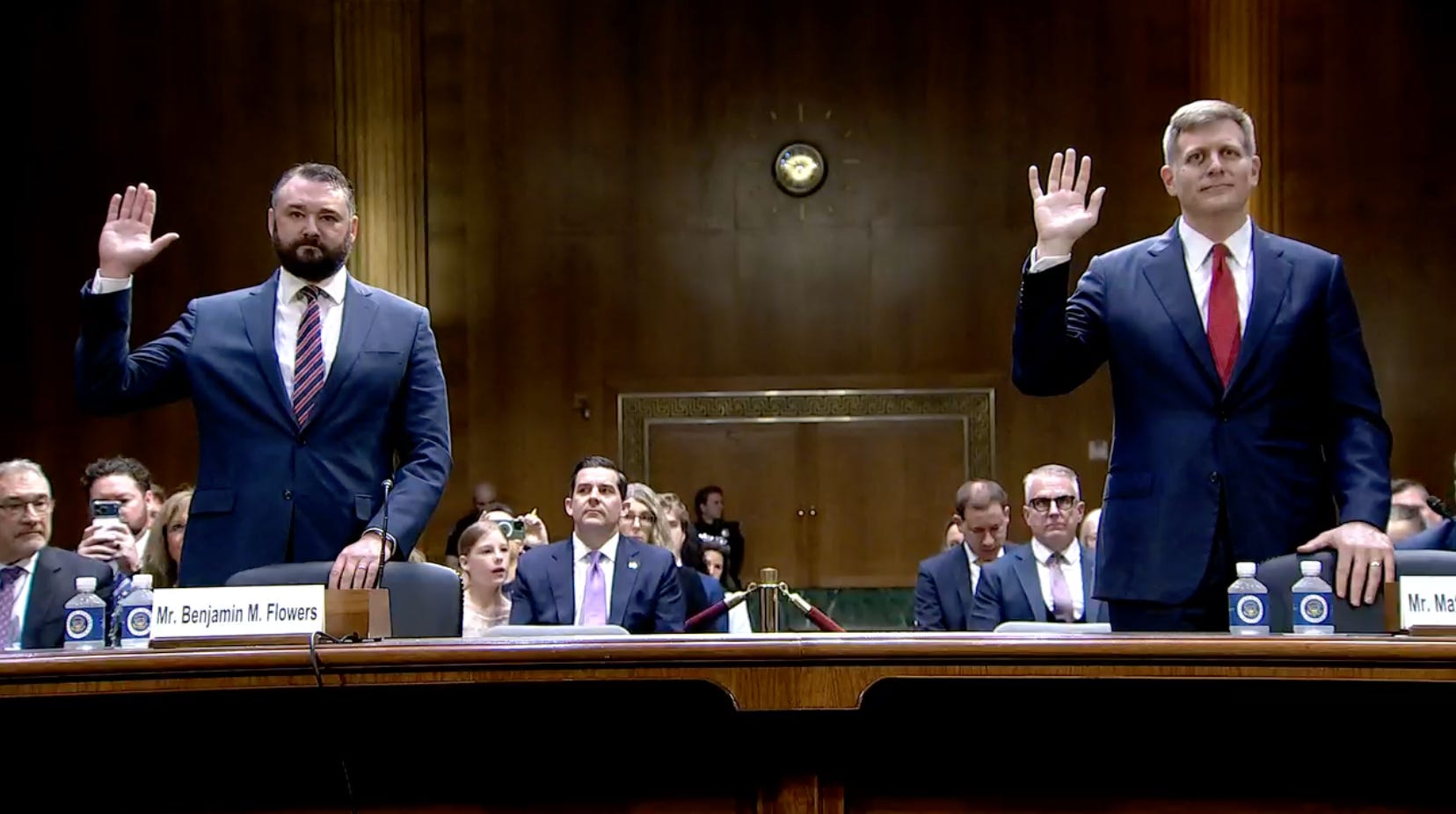
The Senate Judiciary Committee on Wednesday held a hearing to consider the nominations of Benjamin Flowers, nominated to serve in an Ohio seat on the Sixth Circuit, and Matthew Schwartz, nominated to serve in a New York seat on the Second Circuit. Schwartz currently serves as one of Trump’s personal lawyers.
Flowers and Schwartz would replace Judges Jeffrey Sutton and Debra Ann Livingston, respectively. Those two judges both announced that they were taking senior status on February 20 — the same day Trump attacked the Supreme Court justices who ruled against him in the tariffs case.
During his opening remarks this morning, Ranking Member Dick Durbin once again called out Trump’s expectation of loyalty from his judicial nominees. “Hearings like the one we’re holding today are a crucial part of the Senate’s advice and consent process. It has never been more important that the Senate exercise this constitutional duty given that President Trump expects his nominees to be loyal — first and last loyal to him, not to the Constitution or the rule of law,” Senator Durbin said. “This is not hyperbole. It is not conjecture. Just last week, President Trump posted another rant on social media lambasting judges who had the audacity to follow the law instead of catering to his whims.”
Senator Durbin noted that Matthew Schwartz is the third circuit court nominee during Trump’s second term who has served as one of Trump’s personal lawyers. “For his loyalty to the president, Mr. Schwartz has been rewarded with a lifetime appointment to the second highest court in the land,” he said. And what about Benjamin Flowers? “For aspiring judges not lucky enough to become one of the president’s personal attorneys, they can jockey for President Trump’s support in another way: supporting his legal arguments. Benjamin Flowers, who is before us today, fits that bill,” Senator Durbin stated. He cited a brief that Flowers filed after the 2020 election and another brief he filed before the Supreme Court in support of Trump’s position on birthright citizenship.
Senator Durbin said that Trump in his second term “demands that appointees bend a knee, kiss the ring, and demonstrate blind loyalty. President Trump is now putting forward nominees who’ve shown they’re willing to ignore the rule of law so long as they follow his agenda. That is in direct conflict with what we require of federal judges throughout the history of this country.”
Yesterday, Senator Durbin voted to confirm one of Trump’s judicial nominees.
The 2020 election and the insurrection
During Chair Chuck Grassley’s opening remarks, he criticized Democrats for asking nominees about the outcome of the 2020 election. “For months now, my Democratic colleagues have relentlessly attacked nominees about the 2020 election. I think it’s been unfair, been hypocritical,” he said. He accused Democrats of asking these questions for a “soundbite” to go viral and said that they “don’t care about the answers.” He also called out “progressive media” for “gleefully” reporting on the topic.
Senator Grassley then focused on Justice Ketanji Brown Jackson’s Supreme Court confirmation process, noting that she wouldn’t define the word “woman” for Senator Marsha Blackburn. “How can my Democrat colleagues criticize nominees for giving a direct, legal, correct answer when their own nominees wouldn’t answer a basic factual question that we’ve understood for the entire 6,000 year history of humankind? We all know why: It’s because my Democrat colleagues aren’t concerned about evasive answers. They want political theater,” Senator Grassley said.
There is a lot to unpack with that statement, but Senator Grassley wasn’t done. His staff then put up a poster showing Justice Jackson and the text of a response she gave to a written question. The question was: “Have you ever commented, publicly or otherwise, on the results of the 2020 election?” Justice Jackson responded by saying:
Consistent with the Code of Conduct for United States Judges and the positions taken by prior nominees, as a pending judicial nominee and a sitting federal judge, it would be inappropriate for me to publicly weigh in any subject of political debate. In my individual capacity, I have had private conversations on a wide variety of topics.
“Well, isn’t that something,” Senator Grassley said. “Justice Jackson, like every nominee to come before this committee this Congress, didn’t think it was appropriate for a judicial nominee to weigh into the political debate concerning the results of the 2020 election.” He claimed that Trump’s nominees are “making the exact same point that Justice Jackson made” and said that nominees moving forward “should just quote Justice Jackson.”
And that is exactly what happened.
When Senator Richard Blumenthal asked Flowers who won the 2020 election, he immediately referred to Justice Jackson, saying “I’ll incorporate the answer that Justice Jackson gave that Chairman Grassley referred to earlier. It wouldn’t be appropriate for me to comment on the outcomes of any election, except to say that, legally speaking, Joe Biden was certified.”
To be clear, Justice Jackson was not asked who won the election. She was also not nominated by a man who demanded loyalty from his appointees and who aggressively sought to overturn the results of an election he lost. She was asked if she had commented, indicated that she had private conversations about it, and said she wouldn’t say more as a sitting judge.
Senator Blumenthal pointed that out, noting that Justice Jackson’s response came both as a judicial nominee and a sitting federal judge. Flowers still wouldn’t respond, leading Senator Blumenthal to say that his “failure to answer that question mocks this committee.”
“I know Justice Jackson,” Senator Blumenthal said. “You’re no Justice Jackson.”
When Senator Blumenthal asked Schwartz the same question, he also invoked Justice Jackson’s response. When he asked who won the popular vote in 2020, Schwartz responded the same way again. “It’s a factual question, Mr. Schwartz. It’s a matter of public record. You wouldn’t answer the question in this way if you were before a judge, would you?” In response, Schwartz said he was bound by the codes of conduct and couldn’t answer “in the way you want me to.” He said “the only legally and ethically correct answer is the one that prior nominees have given, which is that Joe Biden was certified as president in 2020.”
Senator Blumenthal then asked both nominees who they met with in the White House to prepare for the hearing. Flowers said he met with people from the White House Counsel’s Office to “practice moots.” Schwartz said he “did moots with Mr. Flowers and other people.”
Finally, Senator Blumenthal asked Schwartz whether the Capitol was attacked on January 6. Schwartz said “there was definitely trespass and violence at the Capitol on January 6, and obviously violence against law enforcement or against political actors is unacceptable.” But when Senator Blumenthal asked him to clarify whether or not it was attacked, Schwartz said “you’re asking me to weigh in on sort of public characterizations. What I will say is that the Capitol was, there was trespass and there was violence at the Capitol on January 6.”
That response led Senator Blumenthal to close this way:
What makes me angry is not just the insult to the role of this committee, but to our intelligence. Do you really expect us to accept these canned, rehearsed, practiced answers, repeated again and again and again, by judicial nominees who have an obligation to be truthful — and most important, you have an obligation to be independent. You both know better. You both have records of litigating, and you both would expect more of nominees in your position — because above all, a federal judge must be independent without fear or favor. And your fear, apparently, of Donald Trump — so much so that you practiced with the White House before you came here and rehearsed this answer, and are repeating, by rote, what you’ve been told to say — in my view is disqualifying. And I’m really disappointed in both of you because I would have expected better.
But his emails
Senator Durbin read some emails that Flowers sent during his time in the Ohio attorney general’s office that have been made publicly available. As he said:
In response to an email from then Missouri Solicitor General John Sauer about joining a brief that Missouri planned to file as part of Texas’ challenge to the results of the 2020 election, you emailed the attorney general of Ohio, and here’s what you said: Everyone I’ve spoken with agrees this suit is a terrible idea and will tarnish the credibility of any office that gets involved. Another email you wrote, and I quote, Arizona’s solicitor general was in agreement with me that a new brief would not solve the problem. The danger stems not from Missouri’s brief, but rather from the case itself. In another email, you noted, and I quote, Missouri, Arkansas, Louisiana, Mississippi, South Carolina, and Utah have now moved to intervene, adopting the allegation in Texas’ bill of complaint. You added, and I quote, this is really becoming a disgrace, close quote, in reference to the election denialism lawsuit. Do you still believe the lawsuit challenging the results of the 2020 election was a terrible idea?
Flowers said that he wasn’t referring to election denialism as a disgrace and pointed Senator Durbin to the brief he filed in the case. “We said that the Supreme Court had a constitutional obligation to hear the case, but that pursuant to the independent state legislature theory, which we had advanced in other cases as the state of Ohio, we would not be able to join because of the particular relief being sought,” he said.
When Senator Durbin asked him whether he still believes that the attempt to dispute the outcome of the 2020 election was a “disgrace,” Flowers said he didn’t believe that’s what the emails said — and then, seemingly flustered, referred back to Justice Jackson’s response about not weighing in (he did, for the record, try to weigh in before defaulting to Justice Jackson’s response).
Schwartz’s legal representation of Trump
During his questioning, Senator Durbin also addressed Schwartz, saying that “It’s clear that President Trump expects you as a nominee to be loyal to him from the bench, should you be confirmed.” Durbin wanted to know: Why should we trust you to place the Constitution ahead of the president?
Schwartz promised that if confirmed he would “be impartial” and “rule without fear or favor” — and “that will be an oath that I will take extraordinarily seriously and will not violate if I’m put on the Second Circuit.” He agreed to recuse himself from all matters in which he previously represented Trump.
When it was Senator Cory Booker’s turn, he focused on Schwartz’s legal representation of Trump as well. “The independence of the judiciary is vital — sacrosanct I would even say. And I have some concerns,” he began. “The man who’s nominated you to a lifetime appointment, as your client, his PAC owes you, is it $400,000 for legal bills?” Schwartz said he has no idea because he doesn’t handle that aspect of the relationship.
Senator Booker asked: “Why not disclose any financial obligations this president might have to you? Don’t you think that’s germane to our evaluation of your objectivity — if the president of the United States owes you $400,000?”
Schwartz said that the money would be paid to his “very large firm.” And when pressed, he conceded that his compensation is based upon the clients he represents (including Trump).
“So you’re telling me that this body of senators should not know about any financial obligations the president has to your firm, and the actual pecuniary, the actual financial benefits that you stand to get from this case, when that very president has nominated you.” Without pausing for a response, Senator Booker asked Schwartz whether the president pays all of his legal bills to the firms that have represented him in the past. Again, without really pausing for an answer, Senator Booker stated:
It’s well reported…he stiffs firms constantly. So this president potentially owes your firm money. You have a financial stake in that, and he nominates you to the bench. Objectively, as an objective person, would that not raise questions to this committee, and shouldn’t we ask you what your financial tie is to the president of the United States?
Schwartz oddly responded that his firm has revenues of almost $2 billion per year, so the amount that they might take in from Trump “would be an extraordinarily small amount.”
Senator Booker pointed out that Trump has his personal lawyers all over the government and that “America is seeing right now that this president is turning out to be a grifter who uses his financial relationships to appoint people who have financial ties to them.” He wanted to know: “Don’t you think you should be more transparent with your financial ties to this president before we have to vote on you to confirm you?”
Schwartz said that if confirmed he would resign his partnership with his law firm and make no money moving forward. “Senator, to be clear, the $400,000 that you mentioned, which obviously is a lot of money for the average American, goes to my firm. If there is profit at the end of the year of my firm, I receive a minuscule amount of that money,” he said. In that response, he sounded more confident in — or at least didn’t question — the $400,000 figure.
“We should know the fullness of his financial entanglements with the president of the United States of America. It is absolutely unconscionable that the Senate continues to confirm people that have financial entanglements with the president,” Senator Booker said. “That goes to their objectivity when it comes to issues regarding the president of the United States and his interest when it comes to separations of powers and more. And I’m hoping that my questions for the record will be answered candidly and in detail.”
Flowers’ writing about textualism
Flowers published a piece last year — titled “Some thoughts on the future of textualism” — arguing that textualism (which he says “rests on the premise that the words in statutes, constitutions, and others [sic] legal texts mean what they meant when they were written down”) must be aggressively applied. He said that “Timid textualism will not, to borrow a phrase, Make America Great Again. Only judges committed to applying textualism aggressively are up to the task.” I referenced Flowers’ piece in this story yesterday.
During her questioning, Senator Amy Klobuchar asked him about this post. Strangely, Flowers said that the story he published (under his name) didn’t necessarily represent his views. “What I was addressing in that article was particularly the Supreme Court, and certain resistance to textualism among some younger attorneys that I was meeting at law schools. I was not saying that those are my personal views,” he said. Nowhere in the piece does he issue such a disclaimer. In fact, he uses the word “we” 12 times, including saying that “We must condemn timid textualism when we see it, and we must demand the appointment of textualists who will apply their principles aggressively.”
But again, in response to a follow-up question, Flowers would only say that “I wasn’t describing my views. I was saying that for the people who wish to curtail the administrative powers, they would not be content with a certain approach to textualism, and I was speaking only about the Supreme Court.”
And then it happened again with Senator Mazie Hirono. When she asked Flowers about what he meant by “Timid textualism is not useful for those who wish to reverse, not just stop, the degradation of America’s constitutional order and traditional Western values,” Flowers offered “freedom of speech” as an example of a traditional Western value — but then distanced himself from his post. “I was not, to be clear, referring to my views. I was addressing the views of many young lawyers who I’ve heard express these concerns, and based on those concerns, express skepticism about textualism. I was not advocating that courts set out to do this, and as a judge, as a circuit judge, I would faithfully apply the law and abide by Supreme Court precedent.”
Senator Hirono wasn’t impressed. “You certainly give the implication that you would become a non-timid judge who would be seeking to restore traditional Western culture,” she said. “And I would say those are words that do not necessarily talk about freedom of speech, which this regime is very busy trying to stifle, by the way.”
Flowers certainly seems to have misled (or lied to) the committee about this under oath.
Some other noteworthy moments
Senator Klobuchar noted that Flowers defended Ohio’s law that banned abortion before most people know they’re pregnant at just six weeks — which included no exceptions for rape or incest. She asked Flowers:
As you know, a 10-year-old girl in Ohio got pregnant when she was raped. Following the rape, she couldn’t get the care she needed at home because she was three days past Ohio’s six-week limit, and there was no exception for rape — so she had to travel to Indiana to get access to abortion care. You urged the court to lift a trial judge’s preliminary injunction of Ohio’s abortion ban, arguing each day the law was enjoined, it inflicted “irreparable harm” on the state. Do you believe that this girl and other women in the state who were impacted by the law suffered irreparable harm?
While Flowers agreed that she did, he said he was just doing his job and defending the laws of the state. Senator Klobuchar followed up and asked him: “Given that you argued the court should uphold Ohio’s law a full year after this incident with this 10-year-old Ohio girl who was raped, what would you say to litigants who question that you can be even-handed in applying the law, including to women trying to vindicate their rights?”
Flowers asserted that it would be his “top priority” to ensure litigants recognize that he is “fairly considering the cases” that come before him as a judge. It should be noted that if Flowers had prevailed in this case, the state’s ban on abortion before most people know they’re pregnant would have gone into effect — wiping out abortion access for people in Ohio. After Ohio voters passed the Reproductive Freedom Amendment in November 2023, the case was ultimately dismissed.
In the middle of his questions about Schwartz’s financial ties to Trump, Senator Booker also asked him about an article he wrote at Princeton about the first same-sex wedding in the university’s chapel. I wrote about Schwartz’s article here. It was bad!
Senator Booker asked Schwartz if he still holds those anti-gay views today. “You’re asking about personal and religious views. What I will say is the language that I used in that article was harsh, unacceptable, and reflected my views as a teenager,” Schwartz said.
In response, Senator Booker asked: “Do you think it’s germane for me to ask, if you wrote an article that said ‘I hate Black people,’ do you think it’s relevant for me to know your views today about your views on African Americans, on Italian Americans, on Catholic Americans, or gay Americans?” Schwartz said it’s a fair question, and he said that “throughout my adulthood, over the last 20, 30 years, and as a professional, I’ve always treated everybody equally and with respect, whether they are gay or straight.”
Convincing!
Senator Klobuchar noted that Flowers filed a brief in a Supreme Court case challenging the administration of the 2020 election in Pennsylvania. She then noted that Trump issued an executive order to overhaul the nation’s elections and assert federal control over state-run elections, but that a coalition of states sued and won a preliminary injunction. She asked Flowers whether he agreed with the judge in that case, who wrote that “The Constitution does not grant the President any specific powers over elections.”
He wouldn’t answer.
Schwartz, then, also provided a non-answer to Senator Klobuchar’s question about presidential power. Senator Klobuchar noted that Trump has claimed he has the right to do whatever he wants to do as president, and she asked Schwartz if he believes that’s true. Schwartz said he wouldn’t comment on those specific words and didn’t know the context for them, but he said that “we obviously have a constitutional system of checks and balances. The executive branch is obviously very strong in certain areas and has tremendous amounts of power and discretion. And in other areas, the other branches have power and discretion, and there’s a balance amongst them.”
“Senator, without knowing the context of that, I really couldn’t comment further on it,” he said. Schwartz wouldn’t simply say that “No, presidents can’t do whatever they want.”
Written questions for the record are due from senators by Wednesday, May 27 at 5 p.m.