

Four more lifetime judicial nominees could be confirmed by the end of next week
Here’s who could still be confirmed before the Senate’s scheduled recess.
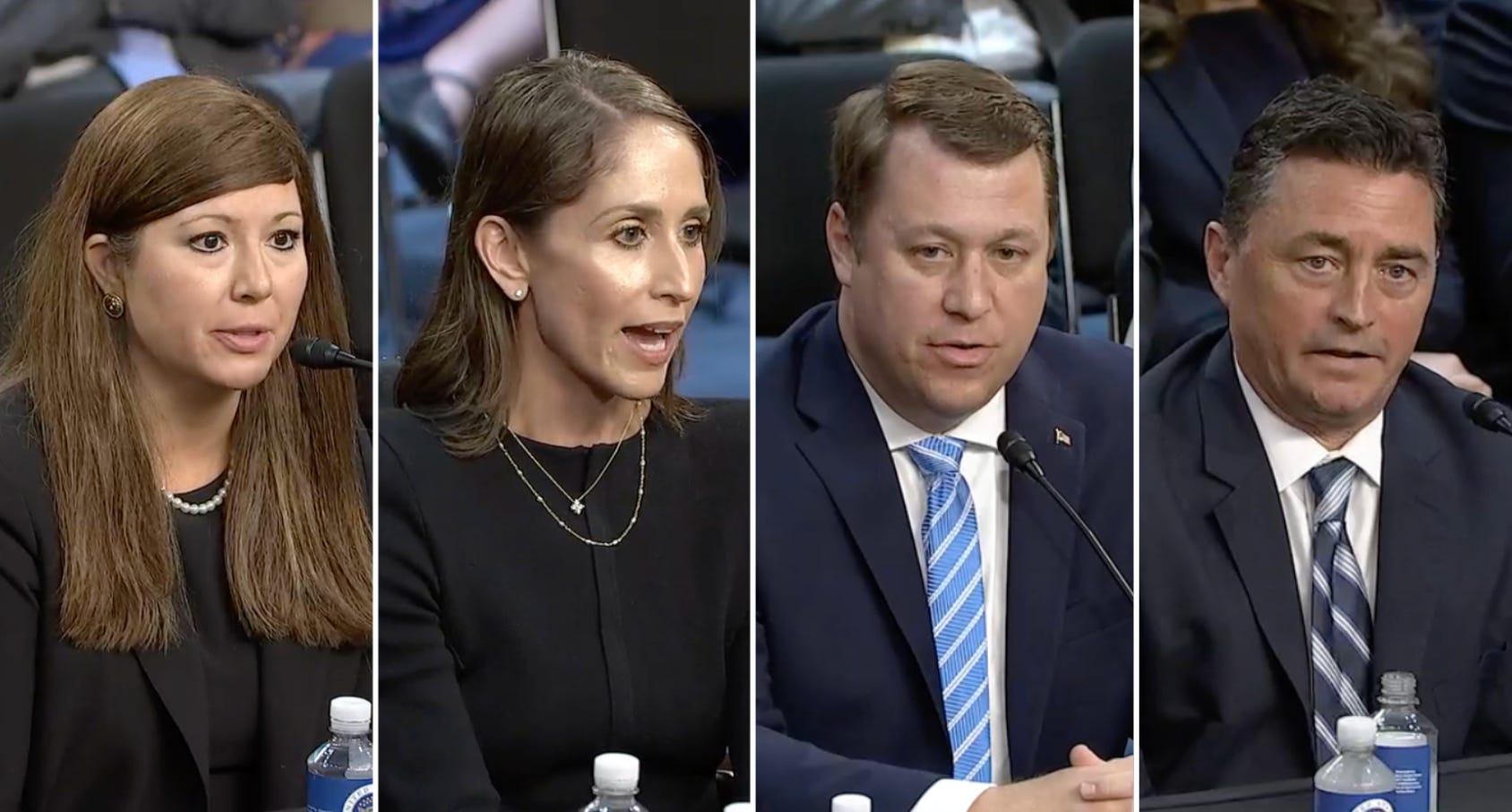
Senate Republicans — with some help from Senate Democrats — have been rushing to confirm as many of Trump’s judicial nominees as possible before their summer break begins. That recess is scheduled to start following the conclusion of the Senate’s business next week, though some Republicans want the Senate to stay in session to pass voter suppression legislation.
While Senate Majority Leader John Thune has not yet filed cloture on additional judicial nominations, there is still time for him to line up votes on the four judicial nominees who remain pending on the Senate floor.
These are the nominees who could be confirmed by the end of next week:
Kasdin Mitchell
Mitchell, nominated to the Northern District of Texas, is backed by a network of far-right activists who urged the Texas senators to support her nomination to this specific court. She has been a member of the Federalist Society since 2010 and the Leonard Leo-chaired Teneo Network since 2013, and she was previously a fellow at the right-wing, anti-democracy Claremont Institute.
Fresh out of law school while serving as assistant solicitor general of Alabama, Mitchell co-authored a brief in Shelby County v. Holder in which Alabama urged the Supreme Court to gut the Voting Rights Act of 1965. The brief claimed that “Congress violated the Constitution” when it reauthorized the Voting Rights Act in 2006 and argued that “Things in the South have, indeed, changed” — and that the state should no longer need the federal government’s approval of voting changes. During her hearing, Mitchell said that she stood by the arguments Alabama made in that brief.
2020 election: Mitchell was not asked about this during her hearing, but in response to written questions she agreed with her fellow nominees that President Joe Biden won the 2020 election “as a matter of law.” When asked what this means, she said that “Article I, Section 1 of the United States Constitution prescribes the process by which a candidate ‘shall be the President’ following an election.”
January 6: Mitchell said she denounces violence. When asked if the Capitol was attacked on January 6, she wrote: “I was not present at the United States Capitol on January 6, 2021, but, based on video footage, I observed violence against police officers and other unlawful conduct. The characterization of this conduct is currently a matter of pending litigation and political debate; as a judicial nominee, it would not be appropriate for me to provide further comment.”
Read more from Alliance for Justice, National Council of Jewish Women, and Reproductive Freedom for All.
Angela Colmenero
Colmenero is Trump’s fourth nominee to the Southern District of Texas during his second term and his ninth appointee to this court overall. She is the first Latina (and second woman of color) lifetime judicial nominee during his second term. Colmenero has served as the deputy chief of staff to Governor Greg Abbott and has worked in his office for more than eight years. She previously worked in the Texas Office of the Attorney General for nine years, including as assistant attorney general. She has been a member of the Federalist Society since 2018 “with periodic lapses in membership,” according to her Senate questionnaire.
Colmenero, like her fellow Texas nominee, has attacked the Voting Rights Act. She has also defended the state’s abortion bans and has worked against immigrant protections and trans rights. Given her lengthy career in Texas state government working for conservative politicians, it is not surprising that she possesses a record of deep hostility to civil and human rights.
2020 election: During her hearing, Colmenero stated that Biden won in 2020 “as a matter of law.” In response to written questions, she said that “The Constitution outlines the legal framework for electing the President and certifying the results of an election.” When asked again whether Biden won in 2020, Colmenero combined multiple methods of dodging this question, writing that “As a matter of law, Joe Biden was the winner of the 2020 election. He was certified as the winner of the 2020 election and served as the 46th President of the United States.”
January 6: Colmenero wrote that “trespass and violence” took place on January 6 and said she categorically condemns violence “against law enforcement and political actors.” But she wouldn’t characterize what happened that day because it remains “a matter of significant political debate,” writing that it “would be inappropriate for me to comment further” as a judicial nominee because of pending litigation.
Read more from Alliance for Justice, National Council of Jewish Women, and Reproductive Freedom for All.
Matthew Byrne
Byrne, nominated to the Southern District of Ohio, currently serves as a judge on Ohio’s Twelfth District Court of Appeals and previously worked in private practice for more than 13 years. If confirmed, he will be Trump’s ninth white lifetime appointee in the state of Ohio — where only eight lifetime judges of color have ever served. He’s been a member of the Federalist Society for more than two decades, including serving as president of the Cincinnati Lawyers Chapter for five years.
As I’ve detailed, Byrne is a fierce opponent of reproductive freedom and abortion access. While running for his current judgeship, he wrote on one candidate survey that his “pro-life credentials cannot be questioned.” He is also hostile to LGBTQ+ equality, writing that he is fully supportive of this statement: “The judiciary does not possess the authority to expand the definition of marriage to include anything but one man and one woman.”
2020 election: During his hearing, Byrne said that “Joseph Biden was declared the winner of the 2020 election by a joint session of Congress.” When Senator Richard Blumenthal stated that “The people of America declared him the winner” and asked if that’s correct, Byrne said that “there was an election, and it proceeded through the normal procedures outlined in the Constitution.” Then, when asked if Biden won the popular vote, Byrne shifted again and said that “As a judicial nominee, it would be inappropriate” for him to comment on a political dispute.
In response to written questions, he continued to evade. “Questions involving who won the popular vote in the 2020 election have become matters of political controversy often discussed and debated by political leaders of both parties, and are also related to ongoing litigation,” he wrote in response to one question.
January 6: Byrne would not directly say at his hearing whether the Capitol was attacked on January 6. “There was violence and vandalism on that day, including with regard to law enforcement officers. I think all of that was inappropriate and wrong,” he stated. He would only say that it was “an attack on a number of individuals” — adding that “as a judicial nominee, I’m here to talk about questions of law, not fact.” He dodged written questions as well.
Read more from Alliance for Justice, National Council of Jewish Women, and Reproductive Freedom for All.
Daniel Domenico
During his first term, Trump appointed Domenico to the District of Colorado, where he is currently chief judge. If confirmed he will take the place of Judge Timothy Tymkovich, for whom he clerked more than two decades ago. Senator Michael Bennet of Colorado, who supported Domenico for the district court, now opposes his elevation to the appellate bench. He is Trump’s third white appointee to the Tenth Circuit — a court where only two judges of color (and no women of color) have served.
Domenico was questioned during the hearing about his rulings in cases related to ICE detention policies. At the time, Domenico had ruled in eight of these cases — each time siding with the Trump administration. He has been a member of the Federalist Society intermittently for more than 25 years.
2020 election: Domenico would not say at his hearing who won the 2020 election. “President Biden was certified as the winner of the 2020 presidential election and served as the 46th President of the United States,” Domenico wrote in response to a written question. When asked who won the popular vote in 2020, he couldn’t bring himself to unconditionally state that more people voted for Joe Biden. “According to the certified results, President Biden received the most popular votes nationwide in the 2020 presidential election. To the extent this question asks about anything beyond the official results, please see my response to Question 5.a.,” he said.
January 6: During the hearing, Domenico would not say that the U.S. Capitol was attacked on January 6, instead stating that from the videos he’s seen “a number of individuals attacked police officers” and engaged in violence and vandalism. “Individuals engaged in attacks on police officers, which I clearly condemn,” he said. In response to written questions, he stated again that he condemned the violence and vandalism that occurred on January 6, but he said he couldn’t specifically comment on the “events” at the Capitol that day because their characterization remains the subject of “significant political debate” and because of ongoing litigation. He referred to damaged property “on the Capitol grounds” but not to the actual Capitol building.
Read more from Alliance for Justice, National Council of Jewish Women, People For the American Way, and Reproductive Freedom for All.
Leader Thune could move forward on some or all of these nominees when the Senate convenes later today. The earliest confirmation could come this Thursday.