
Trump’s Texas judicial nominees are coming for your voting rights
Two new nominees have worked on Voting Rights Act cases — in opposition to voting rights.
Twelve days after the U.S. Supreme Court’s evisceration of the Voting Rights Act in Louisiana v. Callais, Trump took to Truth Social to announce six more lifetime judicial nominees. Two of them — Kasdin Mitchell and Angela Colmenero — were nominated to district court seats in Texas, a state previously covered by Section 5 of the Voting Rights Act (VRA) because of its history of racial discrimination in voting.
But that ended in 2013 when the Supreme Court, in its Shelby County v. Holder decision, invalidated the VRA’s Section 4(b) coverage formula and rendered Section 5 inoperable. Former Congressman John Lewis, who was nearly killed in 1965 while marching for voting rights on Bloody Sunday, famously said that the Court’s Shelby County decision “put a dagger in the heart” of the VRA.
In 2013, Kasdin Mitchell (then Kasdin Miller) was serving as assistant solicitor general of Alabama, and her name appears on the state’s Shelby County brief arguing that “Things in the South have, indeed, changed” — and that the state should no longer need the federal government’s approval of voting changes. “Alabama has a new generation of leaders with no connection to the tragic events of 1965,” their brief stated, even though John Lewis was still in Congress at the time. “The effects of those events on voting and political representation have now, thankfully, faded away.”
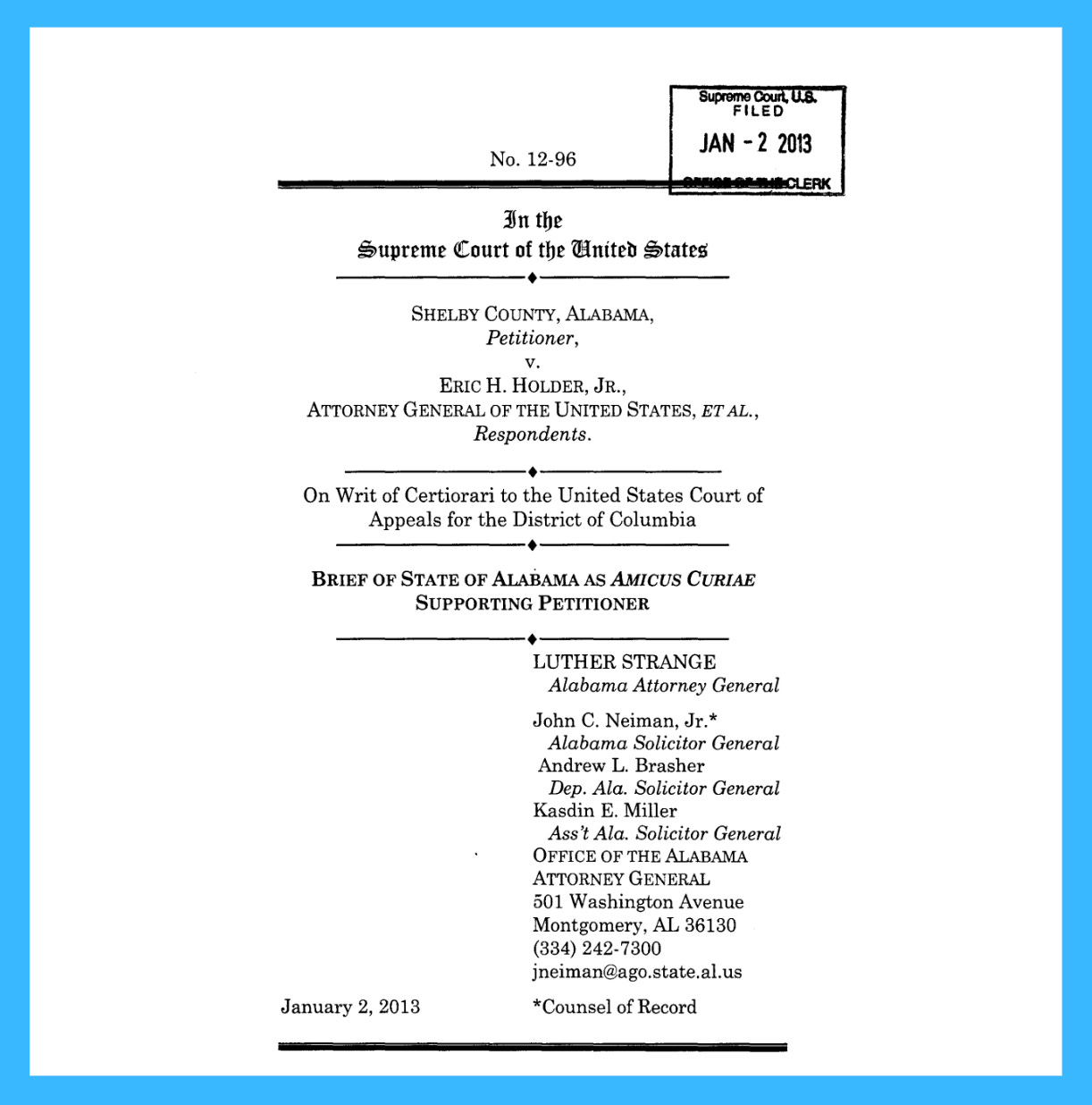
Their brief, which claimed “Congress violated the Constitution” when it reauthorized the Voting Rights Act in 2006, hasn’t aged well. In a post on Bluesky this week, former US Attorney for the Northern District of Alabama Joyce White Vance — who was in that role when Shelby County was decided — shared a press release from Alabama Governor Kay Ivey celebrating the demise of voting rights. “I read these words and I hear Bull Connor and George Wallace saying them,” Vance wrote.
Things in the South have not changed — not nearly enough. That has been evident in Texas, where Trump ordered Republicans to redraw its map — “supercharging a new war on democracy.” Over the past many years, Angela Colmenero, nominated to the Southern District of Texas, has been defending Texas’ discriminatory voting laws. On her Senate questionnaire, three of the 10 “most significant litigated matters” that she reports handling were Voting Rights Act cases in which she argued on the opposite side of civil rights organizations and in support of voter suppression.
Colmenero worked on Veasey v. Abbott, a case challenging Texas’ discriminatory photo ID law that only went into effect because of the Shelby County decision. After the district court found that Texas adopted its voter ID law with the purpose to discriminate, Colmenero filed briefs stating that “Defendants do not concede that SB 14 has a discriminatory effect or purpose.” When plaintiffs in the case alleged that the Texas legislature’s new ID law (SB 5) was also discriminatory, Colmenero called their claims “absurd.” As civil rights organizations and co-counsel noted in an appellate brief, the state’s new ID law “perpetuated almost all of SB14’s discriminatory features, and thereby subjects the victims of intentional discrimination, disproportionately Black and Latino voters, to further burdens…before their votes can be counted.”
Colmenero assisted in advising the Texas legislature on that new legislation, which civil rights and voting rights organizations opposed.
During her time in the Office of the Texas Attorney General, she also worked on Perez v. Perry, which involved a challenge to Texas’ 2011 and 2013 congressional and state legislative maps, and Texas v. United States, when Texas initially tried (and failed) to get its 2011 redistricting plans approved under Section 5 of the Voting Rights Act before Shelby County ended preclearance. Again, in both of these cases, the opposing counsel included prominent civil rights attorneys in private practice and from organizations like the Mexican American Legal Defense and Educational Fund (MALDEF) and the Southern Coalition for Social Justice.
It should come as no surprise that Trump would nominate someone who has defended discriminatory voting laws and maps — because he’s been doing it since his first term. Judge J. Campbell Barker, now serving on the Eastern District of Texas, also worked on Veasey v. Abbott as the state’s deputy solicitor general. Judge Brantley Starr of the Northern District of Texas worked on that case as well, in addition to defending Texas’ discriminatory redistricting plans. Right above Kasdin Mitchell’s name on Alabama’s Shelby County brief was deputy solicitor general Andrew Brasher, who was appointed to the Middle District of Alabama and then elevated to the Eleventh Circuit. Brasher also defended restrictive voting laws in a number of other cases. After Shelby County, several Trump 1.0 nominees — including Thomas Farr (not confirmed), Kyle Duncan (Fifth Circuit), and Stephen Schwartz (Court of Federal Claims) — defended North Carolina’s voter suppression law that “targeted African Americans with almost surgical precision.”
There are dozens of Trump appointees across his two terms who have disgraceful voting rights records, including Trump 2.0 appointees Edmund LaCour (Northern District of Alabama), Andrew Davis (Western District of Texas), and many more.
Mitchell and Colmenero could appear before the Senate Judiciary Committee as soon as June 10, making them eligible to be listed on a committee markup agenda, for the first time, on Thursday, June 25 — the anniversary of Shelby County v. Holder. While the nation marks 13 years without the full protections of the Voting Rights Act thanks to that decision, senators will be considering nominees who urged the Supreme Court to gut the landmark civil rights law — and then defended voter suppression measures in its aftermath.