
Trump’s Supreme Court appointees made Callais possible — and he’s still appointing anti-voting judges to the bench
Many are still pending before the Senate and must not be confirmed.
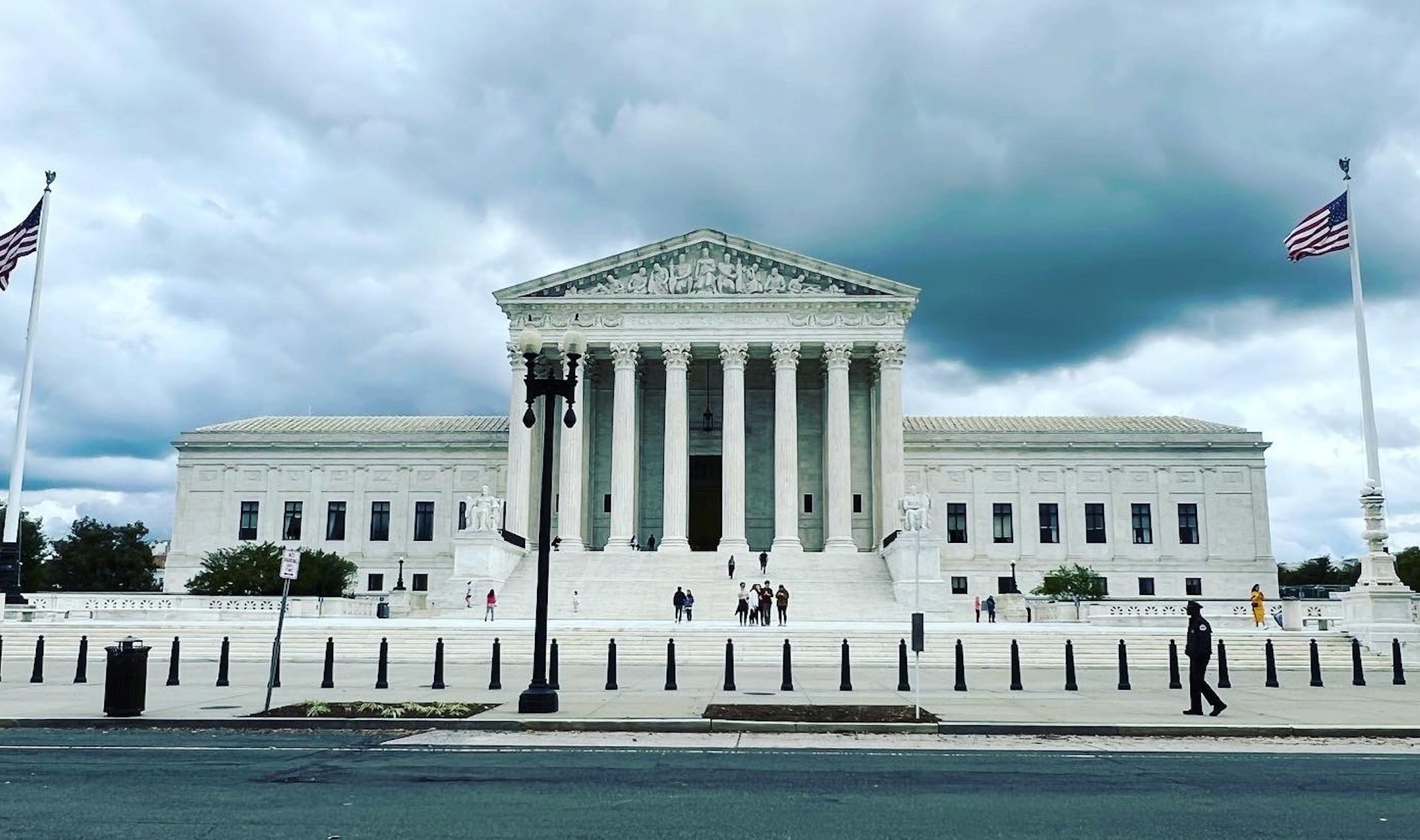
The U.S. Supreme Court on Wednesday issued its decision in Louisiana v. Callais, with the Court’s extremist majority further gutting the Voting Rights Act of 1965 and invalidating Louisiana’s second majority-Black congressional district. The 6-3 opinion, written by Justice Samuel Alito, was joined by all three of Trump’s appointees.
In her dissent, Justice Elena Kagan called this decision “the majority’s now-completed demolition of the Voting Rights Act.” She warned that “If other States follow Louisiana’s lead, the minority citizens residing there will no longer have an equal opportunity to elect candidates of their choice. And minority representation in government institutions will sharply decline. At the first stage of this judicial project to destroy the Voting Rights Act, the Court maintained that Section 5 was no longer needed because in recent decades ‘African-Americans attained political office in record numbers.’ At this last stage, the Court’s gutting of Section 2 puts that achievement in peril.”
The justices appointed by Trump made Callais and its devastating consequences possible. During Trump’s first term, the NAACP highlighted the connection between the president’s judicial selections and efforts to restrict the vote. Today, Trump continues to nominate — and the Senate continues to confirm — lifetime federal judges who have alarmingly bad voting rights records.
In Alabama — the birthplace of the Voting Rights Act — Trump appointed Edmund LaCour to the Northern District, which is home to Birmingham. In a letter submitted to Senate and Senate Judiciary Committee leadership on September 10, 2025, the NAACP Legal Defense Fund (LDF) wrote that LaCour, who was solicitor general of Alabama, “has been directly involved in both designing and defending laws that federal courts have found violate the constitutional and statutory rights of Black people.” LDF detailed LaCour’s role in Allen v. Milligan, which he argued before the U.S. Supreme Court in October 2022 in defense of voter suppression. According to LDF:
On appeal to the Supreme Court, Mr. LaCour defended Alabama’s racially discriminatory map. He urged the Supreme Court to overturn decades of precedent to hold that Section 2 of the Voting Rights Act was unconstitutional and asked the Court to embrace a new standard for Section 2 cases that would make it nearly impossible for Black voters to win. Fortunately, the Supreme Court rejected Mr. LaCour’s arguments and affirmed the three-judge court.
When the case returned to the Northern District — the court on which LaCour now serves — so that the congressional map could be corrected, Alabama drew a map that did not comply with the clear directions the state was given. According to LDF, “Alabama drew a map that Mr. LaCour acknowledged did not comply,” and he “played a direct role in drawing Alabama’s non-compliant and unconstitutional map” and “supplied legislators with talking points and legal reasoning to support the State’s non-compliance.”
More recently, as LDF wrote:
In May 2025, after a trial, the three-judge court issued an over 500-page decision finding that the Alabama Legislature intentionally discriminated in passing the 2023 map. The Court highlighted the unique role Mr. LaCour played in both drawing and defending the 2023 map. The Court also emphasized the threat to the rule of law that Alabama’s intentional defiance of court orders, led by Mr. Lacour, represents.
Someone with such a clear and disgraceful record of attempting to disenfranchise Black voters does not belong on the federal bench — in Alabama or anywhere. But Trump’s installation of this man, on this court, is particularly disturbing. And it’s happening elsewhere.
As Trump’s judicial nominees uniformly refuse to say that he lost the 2020 election, it is notable that Andrew Davis — confirmed this month to the Western District of Texas — represented Fox News in Dominion Voting System’s defamation lawsuit against the network. According to Alliance for Justice (AFJ):
Davis represented Fox News in one of the biggest defamation suits in history, one in which Fox enabled the spread of President Trump’s lies about the outcome of the 2020 election. Voting machine provider Dominion Voting Systems sued the media company for parroting Trump’s lies about Dominion voting machines being rigged to steal the 2020 US Presidential victory from Trump. Despite Fox News agreeing to pay Dominion $787.5 million and admit that its anchors made false statements, the lies they perpetuated continue to undermine American democracy and further election denialism.
Davis also defended Texas Governor Greg Abbott’s redistricting plan in Abbott v. Perez. According to AFJ, “Voters of color challenged the plan as an unconstitutional racial gerrymander that violated the Voting Rights Act. Davis helped draft the briefs in this case and prepped the Texas Solicitor General for oral argument before the Supreme Court. The conservative majority sided with Davis and Texas, ensuring that large swaths of minority voters would no longer be protected by the Voting Rights Act in many of the ways Congress had intended. His work directly undermined their most important and basic democratic rights.”
Many nominees who remain pending before the Senate have anti-voting rights records as well. Earlier this month, Trump nominated Benjamin Flowers to serve in an Ohio seat on the Sixth Circuit. Last October, Flowers filed a brief before the U.S. Supreme Court on behalf of Restoring Integrity & Trust in Elections urging the Court to do away with Gingles, the landmark case won by the NAACP Legal Defense Fund 40 years ago, which established factors that courts have continued to use to determine whether a voting practice violates Section 2 of the Voting Rights Act.
“By abandoning Gingles—either by adopting an alternative test or ending race-based districting altogether—the Court can extricate federal courts from the sordid and politically fraught process of overseeing race-based voting districts,” Flowers’ brief states. “Beyond being unworkable, Gingles inflicts severe damage on public trust in the country’s democratic institutions and the federal courts.”
Flowers may be getting what he wanted: Today’s Callais decision doesn’t necessarily abandon Gingles — it “updates” its framework, according to Justice Alito. But Justice Kagan warns that the majority’s “supposed ‘updating’ of Gingles overthrows Congress’s decision to make Section 2 liability hinge on an electoral practice’s effects—on how it actually works.” She adds that “The majority has made its own assessment of current needs and concluded that preventing racial vote dilution does not count among them,” saying that today’s “decision renders Section 2 all but a dead letter.”
Justin Smith, Trump’s personal lawyer and nominee to serve in a Missouri seat on the Eighth Circuit, has also worked to undermine our democracy. According to People For the American Way’s letter to the Senate in opposition to his nomination:
Before joining the Otis Law Group, Smith was chief of staff and first assistant to Missouri Attorney General Eric Schmitt (who is now a senator). Smith participated in writing an amicus brief after the 2020 election to help Trump unlawfully hold onto power. With his assistance, Missouri supported the state of Texas in a meritless lawsuit against four swing states that had voted for Joe Biden. The case was filed directly in the Supreme Court on the basis of the court’s original jurisdiction over lawsuits by one state against another. This was widely recognized at the time as an abuse of the court system in an effort to subvert the will of the voters.
Smith will likely receive a vote in the Senate Judiciary Committee on Thursday, May 14.
Katie Lane, nominated to the District of Montana, is set to receive a committee vote tomorrow. In his announcement of Lane’s nomination, Trump wrote that “Katie brings fantastic experience to her new role, previously serving as Deputy Solicitor General of Montana, a State I love and won big three times! Katie has also played a critical role in stopping Voter Fraud as Senior Counsel for Litigation at the Republican National Committee.”
When asked on her Senate Judiciary Questionnaire to “Describe the ten (10) most significant litigated matters which you personally handled,” the first case Lane listed was McClure v. Jefferson County Commission. Lane represented the commission in Alabama when it was sued for racial gerrymandering in drawing district lines. Among the opposing counsel in that case were five lawyers with the NAACP Legal Defense Fund and former Judge U.W. Clemon — an iconic civil rights lawyer and the first Black lifetime judge to ever serve in the state of Alabama.
That Lane was working on the opposite side of them tells you everything you need to know about what she sought to accomplish in this case. Indeed, the court found “powerful circumstantial evidence of racial gerrymandering” in violation of the Equal Protection Clause of the 14th Amendment, with the judge saying that the commission’s “purported reliance on traditional redistricting criteria” was “not credible.”
In their letter opposing Lane’s confirmation, People For the American Way discussed another voting case, which Lane listed second on her list of significant litigated matters. According to People For:
Lane also defended a Montana law that imposed criminal penalties for registering to vote in more than one place (including out of state), and for not providing previous voter registration info when registering. She represented the Republican National Committee, which had intervened in the case to help Montana defend the law. A federal district court enjoined enforcement of the law because it chilled voter registration even in situations where a person neither double-votes nor has any intention to do so. This overbreadth put it in violation of the First Amendment.
Mike Hendershot, nominated to the Northern District of Ohio, is being considered by the Senate Judiciary Committee this afternoon. In his post announcing Hendershot’s nomination, Trump said that “Mike has strongly, and successfully, represented Ohio in Election Law cases, and challenged the Radical Left Policies of the Obama and Biden Administrations.”
Hendershot has served as chief deputy solicitor in the Ohio Attorney General’s Office for nearly 15 years and is listed on the brief in Husted v. A. Philip Randolph Institute — the 2018 Supreme Court decision, written by Justice Samuel Alito, that upheld Ohio’s notorious voter purge law. The state’s solicitor general at the time, Eric Murphy, argued the case and was rewarded during Trump’s first term with a seat on the Sixth Circuit.
Several other confirmed judges possess troubling voting rights records. For example:
Emil Bove, Third Circuit:
Bove also represented Trump in his election obstruction case, which included Trump’s efforts to pressure Vice President Mike Pence to certify a false slate of electors and his role in inciting the violent January 6 Capitol attack. In defending Trump, Bove argued that Trump’s illegal actions were immune from prosecution simply because he was the president, a radical interpretation that effectively places the executive above the law.
Robert Chamberlin, Northern District of Mississippi:
In 2014, in the first legislative session after the Supreme Court’s Shelby County v. Holder decision gutted federal preclearance protections under the Voting Rights Act, Chamberlin introduced SB2250, a restrictive voter ID law. Defending the measure in his Legislative Report, he claimed that “voter identification will help eliminate potential fraud in our elective process” — echoing the pretextual voter fraud claims often used to justify suppressing minority voters.
Josh Divine, Eastern and Western Districts of Missouri:
Divine’s writings reveal not only a narrow view of voting rights and democratic participation, but also a concerning loyalty to Donald Trump. He has defended voter ID laws as neither discriminatory nor burdensome, despite extensive evidence of their disproportionate impact on voters of color. Even more troubling, he has expressed support for requiring literacy tests as a voting prerequisite — a practice historically used to disenfranchise Black Americans and long deemed unconstitutional.
Much has been written, including by me, about Trump’s judicial nominees and their uniform refusal to say that he lost the 2020 election. This is deeply troubling. But we must also be concerned about how they will answer questions — and issue decisions — about future elections when they are serving, if confirmed, as lifetime federal judges across the country.
There is still time to stop some of them. Senators must refuse to confirm anti-voting rights judges who will do immense harm to our democracy.