

Trump’s nominee for the U.S. Sentencing Commission has curated a flawless right-wing resume
Jason Manion has been affiliated with several of the most extreme organizations in America.
When Trump announced his latest judicial nominees one month ago, he also posted the names of two nominees for the U.S. Sentencing Commission — an independent agency created in 1984 by Congress to “reduce sentencing disparities and promote transparency and proportionality in sentencing.”
Those nominees included Jason Manion, formerly a counselor to then-Attorney General Pam Bondi and now a White House staffer advising the Task Force to Eliminate Fraud. In both capacities, he’s been on detail from the US Attorney’s Office for the Northern District of Ohio.
Manion’s nomination, which is expected to be considered next Wednesday by the Senate Judiciary Committee, hasn’t received much attention. He is not up for a lifetime judgeship, as I usually cover here. Rather, his term as a commissioner would only last, at least initially, until October 31, 2029. But he certainly could be a future judicial nominee. And after reading through his Senate questionnaire, it’s hard not to highlight the ways in which he’s chosen to affiliate himself with some of the most extreme, far-right organizations in America.
According to his questionnaire, Manion was born in 1991 and received his B.S.B.A. degree from Thomas Edison State College in 2010 (when he would have been 18 or 19 years old). He later graduated from Harvard Law School in 2017.
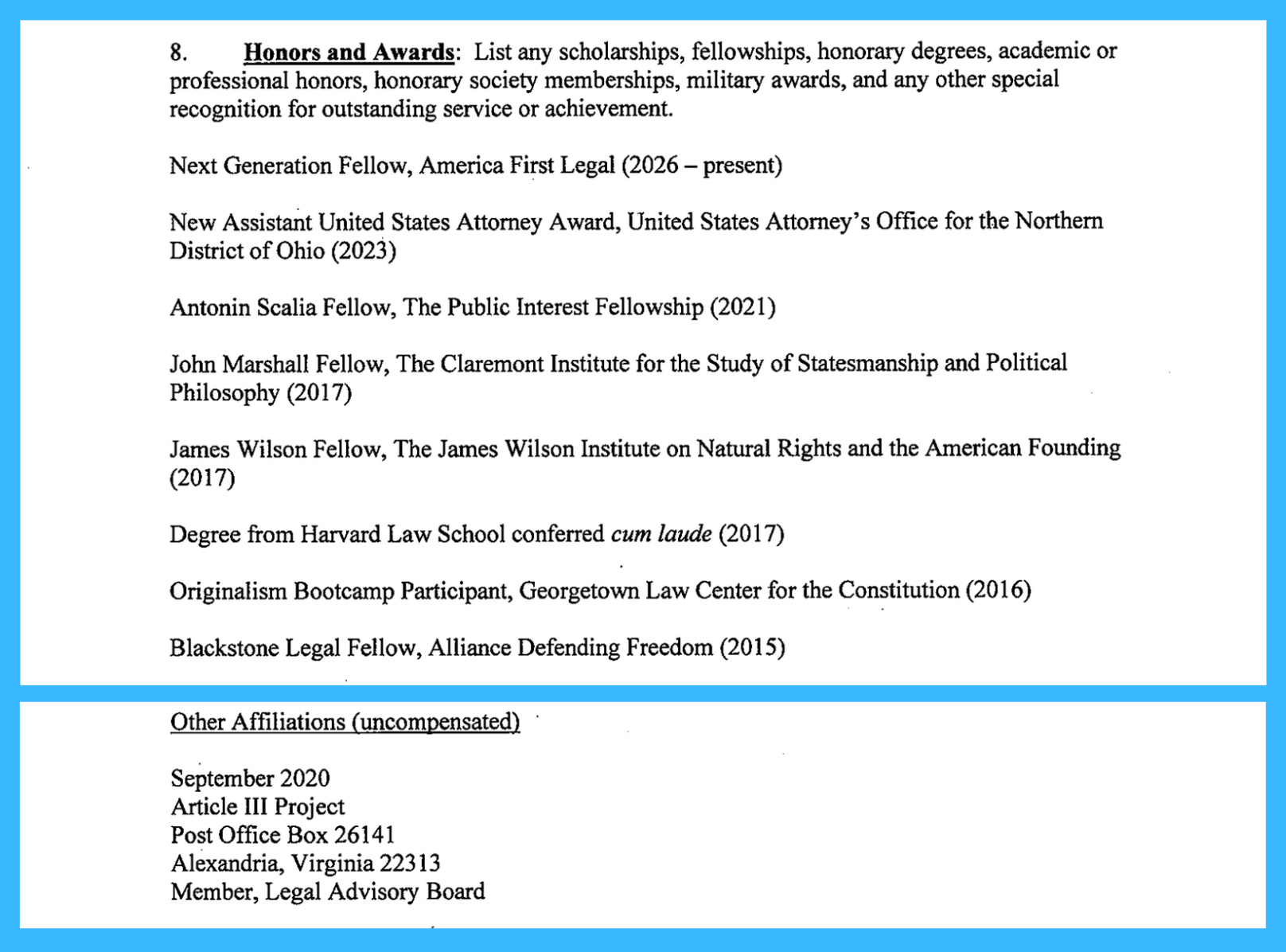
While in law school, Manion joined the Federalist Society in 2015 and served that year as a Blackstone legal fellow at the Alliance Defending Freedom (ADF) — an SPLC-designated hate group that aggressively works against LGBTQ+ rights and reproductive freedom. The fellowship is for Christian law students and invites them “to think Christianly across disciplines.”
ADF contends that the rights of the American people don’t come from the government. “We know that our rights come from God alone, and we believe this truth should guide the law in America,” their website says. “One way we work toward this goal is through a ministry called the Blackstone Legal Fellowship, which aims to build and strengthen a community of like-minded believers while training and equipping the next generation of Christian law students.”
The following year, Manion participated in an Originalism Bootcamp at Georgetown Law Center for the Constitution (now called the Originalism Summer Seminar) before jumping into two other fellowships in 2017.
That included serving as a James Wilson Fellow at the James Wilson Institute on Natural Rights and the American Founding, an organization that opposes abortion, same-sex marriage, and trans equality. Several Trump 2.0 judicial nominees — including Zachary Bluestone, Katie Lane, and Jordan Pratt — previously completed fellowships there. As the FFRF Action Fund wrote when opposing Bluestone’s nomination, “The Wilson Institute is a conservative think tank that advocates for natural law, which is the idea that there is a set of universal truths, principles and rules, historically tied to religion, that properly govern moral conduct.”
His other fellowship in 2017 was at the Claremont Institute, where he was a John Marshall Fellow alongside Chad Mizelle, Kathryn Kimball Mizelle, and Kasdin Mitchell. Mitchell’s nomination to the U.S. District Court for the Northern District of Texas is currently pending on the Senate floor and is backed by a network of far-right activists.
A story in The New Republic, which labeled Claremont as the “anti-democracy think tank,” also called it “an indispensable part of right-wing America’s evolution toward authoritarianism.” According to Katherine Stewart’s piece, “Claremont represents something new in modern American politics: a group of people, not internet conspiracy freaks but credentialed and influential leaders, who are openly contemptuous of democracy. And they stand a reasonable chance of being seated at the highest levels of government—at the right hand of a President Trump or a President DeSantis, for example.”
And according to one report in The Guardian, “The president of the rightwing Claremont Institute and another senior Claremont official are both closely involved with the shadowy Society for American Civic Renewal (SACR), an exclusive, men-only fraternal order which aims to replace the US government with an authoritarian ‘aligned regime,’ and which experts say is rooted in extreme Christian nationalism and religious autocracy.”
Between 2017 and 2020, Manion clerked for two conservative judges on the U.S. Court of Appeals for the Sixth Circuit — Alice Batchelder and Eric Murphy. Judge Murphy was appointed during Trump’s first term and took Batchelder’s seat when she assumed senior status. In between those clerkships, Manion briefly worked in the Office of the Ohio Attorney General, including as deputy solicitor general.
In September 2020, Manion served as a legal advisory board member of the Article III Project — the extremist organization run by MAGA warrior Mike Davis that “brings brass knuckles to fight leftist lawfare.” Their website includes this quote from Davis: “I started the Article III Project in 2019 after I helped Trump win the Gorsuch and Kavanaugh fights. We saw then how relentless—and evil—too many of today’s Democrats have become. They’re Marxists who hate America. They believe in censorship. They have politicized and weaponized our justice systems.” Like Manion, the group’s senior counsel (Josh Hammer) was also a fellow at the James Wilson Institute and Claremont Institute.
Around the same time, Manion briefly worked as special counsel to Senator Ted Cruz during the Senate’s rushed confirmation of now-Justice Amy Coney Barrett.
In November 2020, he “served as a volunteer participant in an Election Day legal ‘war room’ coordinated by the Ohio Republican Party and the Donald J. Trump for President campaign in Ohio,” his questionnaire states.
The following year, he was an Antonin Scalia Fellow at The Public Interest Fellowship. “Over the course of 10 monthly dinner discussions,” their website says about the fellowship, “a highly-select cohort will explore the conservative legal movement in historical perspective; delve into current legal debates; and consider opportunities for advancing the rule of law in a wide variety of areas.” Sessions are run by Adam White of the American Enterprise Institute (White also previously worked for the right-wing Manhattan Institute).
According to his questionnaire, Manion is currently a Next Generation Fellow at America First Legal, the white supremacist legal group co-founded by white supremacist Stephen Miller. This fellowship, according to their website, “offers a unique opportunity to deepen professional skills while contributing meaningfully to the America First legal movement.”
At the Trump DOJ, Manion defended the administration’s discriminatory trans military ban in proceedings before Judge Ana Reyes of the DC District Court. In its reporting last year, The Advocate called Manion “a Federalist Society-affiliated lawyer and former special counsel to Republican Sen. Ted Cruz of Texas” who “stumbled through the entire hearing, appearing flatfooted.” According to that report, “When Manion admitted he hadn’t read the studies cited in the Pentagon’s memo, Reyes, eyebrows raised and grimacing, paused proceedings for a 30-minute recess, firmly instructing government attorneys, ‘Get out the studies. We’re going to go over them.’”
Another report said that Judge Reyes “mercilessly lambasted Manion and other DOJ counsel for what she saw as problems with their basic competence, middling legal analysis, lack of preparation, intellectual honesty, and more.” At the DC Circuit, Judge Pillard “was obviously and audibly askance of arguments advanced by U.S. Department of Justice attorney Jason Manion.”
Manion appears to be a Trump loyalist who is deeply devoted to ultra-conservative causes, raising questions about why the president has chosen him for this position. As civil rights organizations have noted, the Sentencing Commission “shapes both individual sentences as well as the composition of the entire federal prison population. Its function is crucial to working toward addressing the racial disparities in our federal criminal-legal system and administering a fair and equitable system.” But this administration — including individuals like Harmeet Dhillon with whom Manion worked at DOJ — is more interested in deepening racial disparities and perpetuating a white supremacist vision of America.
The Senate Judiciary Committee should question Manion’s affiliation with organizations like America First Legal, Alliance Defending Freedom, Article III Project, Claremont Institute, and James Wilson Institute — and question whether he is committed to the important work that the Sentencing Commission is charged with tackling in pursuit of a more just and equitable America.