

Judicial nominees continue to humiliate themselves when answering senators’ questions
And they continue to promise that, if confirmed, they will be unbiased and uphold the Constitution.
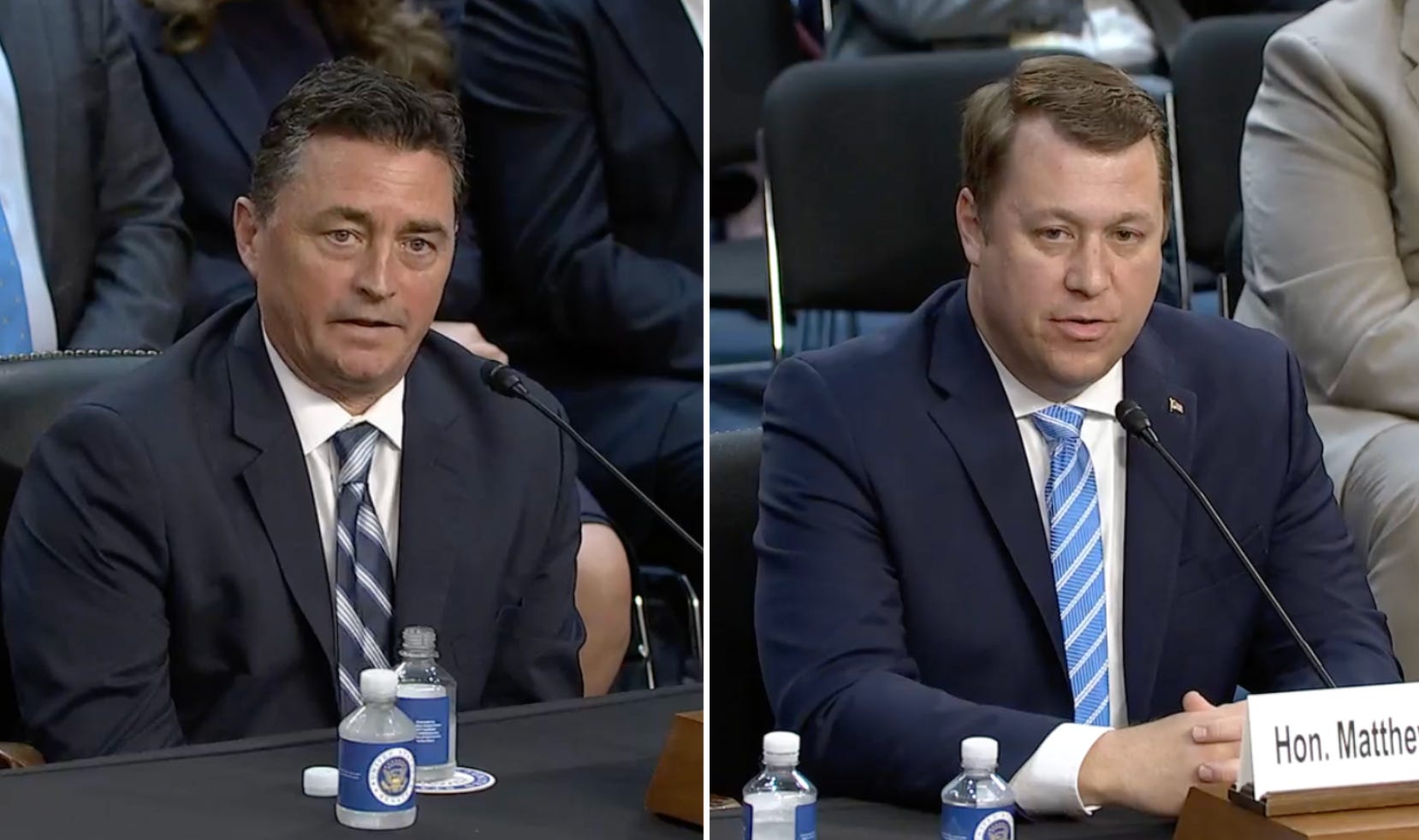
The Senate Judiciary Committee recently posted responses to written questions from two more of Trump’s judicial nominees — Daniel Domenico for the U.S. Court of Appeals for the Tenth Circuit and Matthew Byrne for the U.S. District Court for the Southern District of Ohio.
Domenico was confirmed to the District of Colorado during Trump’s first term and now seeks a promotion to the appellate bench. Democratic Senator Michael Bennet of Colorado, who previously supported Domenico’s confirmation to the district court, opposes his elevation to the Tenth Circuit.
“An appellate level role on the federal circuit is fundamentally different from and more consequential than that of a district court judge, and serious questions remain about his interpretations of constitutional and statutory text,” Senator Bennet said when announcing his opposition. “Moreover, we are considering Judge Domenico for this new position at a moment when the Trump Administration has spent years undermining the rule of law and eroding the independence of the federal courts. I cannot support his nomination in this context.”
In their responses to written questions, Domenico and Byrne continued to dodge questions related to the outcome of the 2020 election and the January 6 attack on the U.S. Capitol — deploying a variety of nonanswers to signal their loyalty to the man who nominated them.
“President Biden was certified as the winner of the 2020 presidential election and served as the 46th President of the United States,” Domenico wrote in response to a question from Senator Dick Durbin. “Beyond that, I agree with Justice Ketanji Brown Jackson, who, in her responses to this Committee’s questions for the record pertaining to the 2016 and 2020 elections, explained that under the Code of Conduct for United States Judges it is inappropriate for a sitting federal judge to publicly comment on such matters of political dispute. See Canons 3(A)(6), 5.”
When Senator Mazie Hirono asked Domenico who won the popular vote in 2020, he couldn’t bring himself to unconditionally state that more people voted for Joe Biden. “According to the certified results, President Biden received the most popular votes nationwide in the 2020 presidential election. To the extent this question asks about anything beyond the official results, please see my response to Question 5.a.,” he said.
Domenico stated that he condemned the violence and vandalism that occurred on January 6, but he said he couldn’t specifically comment on the “events” at the Capitol that day because their characterization remains the subject of “significant political debate.”
“Litigation arising from those events — including litigation over the legal effect of the pardons granted to persons prosecuted for their involvement — also remains ongoing in the federal courts, and individuals who were present at the Capitol that day could appear as parties in cases before me,” he wrote.
Domenico referred to damaged property “on the Capitol grounds” but not to the actual Capitol building. Nominees routinely refuse to say that the Capitol itself was attacked that day. To do so would be a clearer confession that, at Trump’s direction, insurrectionists stormed the Capitol, caused damage and death, and attempted to stop the certification of a free and fair election.
Byrne’s responses weren’t any better.
When asked about the 2020 election, he wrote that “Joseph R. Biden was certified as the winner of the 2020 presidential election by a joint session of Congress after the counting of the Electoral College votes.” He said he used the word “declared” rather than “won” — when asked about this during the hearing — because he “was attempting to use a word that accurately described the relevant legal process of determining a presidential election winner.” Byrne also repeatedly invoked Justice Jackson in his responses, saying that he was simply responding “consistent with the precedent established by Justice Jackson” in her written responses. It should be noted that Justice Jackson was never asked in written questions about who won the 2020 election.
“Questions involving who won the popular vote in the 2020 election have become matters of political controversy often discussed and debated by political leaders of both parties, and are also related to ongoing litigation,” he wrote in response to one question.
Both nominees, when asked which presidential candidate lost in 2020, just restated that Biden was certified as the winner.
When questioned about January 6, Byrne said that he condemns “all acts of violence and vandalism, including the acts of violence and vandalism that were committed at the U.S. Capitol on January 6, 2021, especially with regard to law enforcement officers.” He said the word “insurrection” is a legal one and applying it “to a particular event” has legal consequences. “Additionally, the question of whether the events at the U.S. Capitol on January 6, 2021, were an ‘insurrection’ has become a matter of political controversy often discussed and debated by political leaders of both parties. As a judicial nominee, it is not appropriate for me to opine on whether those events constituted an ‘insurrection,’” he wrote.
Promises to be fair
As judicial nominees tend to do, both men promised that they would set aside their personal beliefs, treat all litigants fairly, and uphold the Constitution and apply binding precedent no matter what. Trust us, they said.
In a 2020 judicial candidate survey, Byrne agreed with the idea that “The judiciary does not possess the authority to expand the definition of marriage to include anything but one man and one woman.” He endorsed that statement five years after the U.S. Supreme Court declared marriage equality the law of the land.
Still, he promised to apply all binding precedent — including Obergefell v. Hodges — if confirmed. He wrote that “My response to a 2020 judicial candidate survey was made in my capacity as a private citizen and a candidate for office. I was not providing legal analysis.” He wrote that he was “not providing legal analysis” three times in his written responses when senator after senator asked him about this issue. Mind you, he was running to be a judge.
Domenico also promised to continue applying Obergefell if elevated to the Tenth Circuit. “Every litigant who comes before me is entitled to, and will receive, a fair and impartial application of the law,” he wrote. Domenico was questioned about this because, as solicitor general of Colorado, he previously defended the state’s ban on same-sex marriage and argued against the authority of clerks to issue same-sex marriage licenses. “The positions I advanced in that role were those of the State, not expressions of my personal views,” he stated.
When Byrne was pressed about his deeply held anti-abortion beliefs, he said that he can be trusted to be an impartial jurist. “Future litigants can trust that I will remain unbiased on reproductive rights issues because I have long and repeatedly expressed my strongly-held view that judges must set aside their personal opinions and decide cases on the factual and legal merits,” he wrote.
He said that “There are no examples in any case I have decided that would suggest that I would not uphold the Constitution and protect the rights of litigants. Instead, my body of work reveals that I consistently apply binding precedent. I will continue to do so in the future.”
But as a visiting justice of the Ohio Supreme Court, Byrne demonstrated that he would not protect people’s rights and remain unbiased. Instead, when the court rejected the state’s six-week abortion ban appeal, Byrne was the only jurist who objected to the dismissal and who wanted the court to move forward with considering Ohio’s abortion ban.
There is much more to explore in written responses from Domenico and Byrne.
They are currently scheduled to receive committee votes this Thursday, July 23. If they are approved by the committee, the full Senate could consider their nominations as early as next week.