
Four judicial nominees concede that Trump is not "eligible to be elected president” in 2028
They were not willing to say that during their confirmation hearing in April.
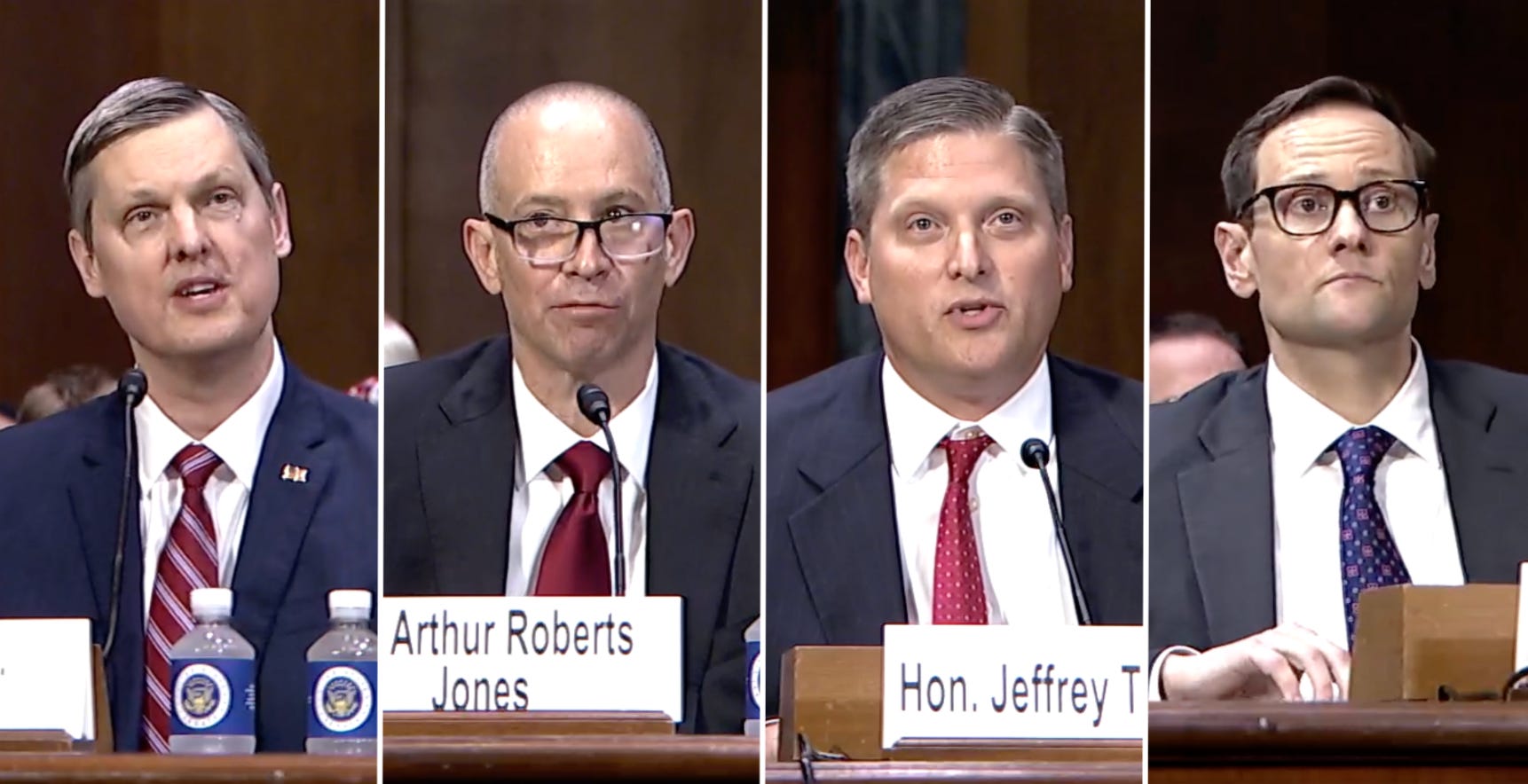
The Senate Judiciary Committee on Monday afternoon posted responses to written questions for the record from four more of Trump’s judicial nominees — Mike Hendershot for the Northern District of Ohio, Arthur “Rob” Jones for the Southern District of Texas, Jeffrey Kuntz for the Southern District of Florida, and John Marck for the Southern District of Texas.
In their responses, nominees told senators that President Joe Biden was “certified” as the winner of the 2020 election and dodged questions related to January 6. But after these four nominees would not say during their hearing that Trump can’t run again for a third term, their responses to written questions seemed to reverse course.
During that April 29 hearing, John Marck was unable to tell Senator Chris Coons what the 22nd Amendment said — and then, when he learned that it states “no person shall be elected to the office of the president more than twice,” he was unwilling to say whether Trump could run again, calling it “more of a hypothetical.” When Senator Coons asked whether any of the nominees were “brave enough to say that the Constitution of the United States prevents President Trump from seeking a third term,” none responded.
In writing, Senator Coons asked a series of questions that all nominees answered the same way:
a. Was President Trump elected to the office of the President twice? Response: Yes.
b. If President Trump were elected again in 2028, how many times in total would he have been elected to the office of the President? Response: Three.
c. Is President Trump eligible to be elected President for a third term in 2028? Response: No.
Senator Alex Padilla also asked all four nominees: “Are you aware of any provision of the Constitution, federal statute, or judicial precedent that would permit Donald Trump to be elected to a third term?” Again, all four nominees responded “No.”
The 2020 election and January 6
Still, these four nominees would not say that Biden won in 2020. Jones replied that “Congress certified Joseph Robinette Biden, Jr. as the winner of the 2020 election.” Kuntz wrote that “Joseph R. Biden, Jr. was certified the winner of the 2020 Electoral College and, as a result, became the 46th President of the United States.” And Marck said that “Joseph Biden was certified as the winner of the 2020 election.”
Hendershot used more words, writing that “Joseph Biden was certified as the winner of the 2020 presidential election and served as President of the United States. To the extent this question asks for my opinion about political debate or political commentary regarding that election, the Code of Conduct for United States Judges prevents me from answering further.”
Hendershot was also asked by Senators Durbin, Blumenthal, Coons, and Welch about a brief he joined in 2020 asking the Supreme Court to grant certiorari and reverse a Pennsylvania Supreme Court decision that allowed the counting of absentee ballots received after Election Day. When asked whether “attempting to discard validly cast ballots after an election has been called is consistent with democratic principles,” Hendershot said he couldn’t respond because he is bound by the Code of Conduct for United States Judges. “I am bound not to comment either on political controversies or questions that may arise in ligation should I be so fortunate to be confirmed. I cannot opine on this hypothetical,” he said. He wrote that the brief “represents the litigating position of a client” and that he “advanced the best argument on behalf of [his] client’s position.”
Senator Blumenthal also noted that he defended Ohio’s gerrymandered congressional and state legislative maps, which the Ohio Supreme Court struck down five times — and he asked Hendershot how future litigants can trust that he’ll remain unbiased on voting rights issues. Hendershot responded by stating the difference between an advocate and a judge and by noting that he’s proud of the support he has from lawyers and judges in Ohio.
Senator Padilla also asked the nominees several questions about the 2020 election, including these two:
On January 7, 2021, a joint session of Congress certified 306 electoral votes for Joseph Biden and 232 electoral votes for Donald Trump. Joe Biden received more votes than Donald Trump across 25 states, DC, and NE-02 in the 2020 election. Do you have any reason to believe that Congress was wrong to certify each of these states’ electoral votes?
More than 60 federal and state courts, including courts presided over by judges appointed by Republican presidents, dismissed legal challenges to the 2020 presidential election results for lack of evidence, lack of standing, or lack of merit. Do you have any reason to believe that any of those courts reached the wrong conclusion?
The nominees acknowledged that Congress is charged with the certification of election results under the 12th Amendment, but they would not say more. Marck said that “It would be inappropriate for me, as a judicial nominee, to opine further.” Kuntz wrote that under the code of conduct “it would not be appropriate for me as a sitting judge and judicial nominee to comment on political and policy issues.” Jones stated that “this question calls for a response that could be seen as opining on political matters or potential future cases, I cannot provide such an answer consistent with my ethical obligations as a judicial nominee.” Hendershot said that he could not “opine on a political controversy.”
They responded to the second question in very similar ways, refusing to express any confidence in the judges they may soon be joining on the bench.
Of course, when asked whether the Capitol was attacked on January 6 and whether it was an insurrection, no nominee would say “yes.” Instead, they wrote that — while they denounce violence — they couldn’t say more. “This question calls for a response that could be seen as opining on political matters or potential future cases, and I cannot provide such an answer consistent with my ethical obligations as a judicial nominee,” Jones said.
So far during Trump’s second term, 48 lifetime judicial nominees have responded to written questions for the record. Now, all 48 have avoided directly answering questions about these topics.
Kuntz’s ruling in favor of Trump
Before the April 29 hearing, I wrote about the time that Kuntz, who is a judge in Florida, ruled in favor of Trump while he sought a federal judicial nomination. The case was Alexander v. Trump, a defamation case in which Trump was a party in his personal capacity. Senator Coons asked Kuntz about this during the hearing. Kuntz said he began speaking to Senator Rick Scott’s office about his interest in a federal judicial nomination in November 2024, he learned about and was assigned to the defamation case in January 2025, and then he issued his decision on February 12, 2025.
“So, you issued an opinion, where one of the litigants before you was the president, and in favor of the president, while you were in active conversation with the senator’s office about seeking a federal judicial appointment, is that correct?” Kuntz, during the hearing, responded that he was in conversation about a position that he did not get. When Senator Coons asked Kuntz how, then, he ended up in front of him at the hearing, Kuntz only said that “It’s a different position, senator.” Kuntz confirmed in his responses to written questions that he was referring to the seat that went to Ed Artau, a judge appointed by Trump last year who joined Kuntz’s ruling in the defamation case.
In writing, Kuntz disclosed that he was asked about that ruling during his interview for this judgeship. “During my interview at the White House in February 2025, I was asked about the reasoning of several of my cases, including the Trump v. Alexander case. The reasoning is contained in the majority opinion, which can be found at Alexander v. Trump,” he wrote in his responses.
During his hearing, Kuntz said that he did not consider recusing from this case because the canons that govern judges in Florida didn’t call for him to recuse. In writing, Kuntz again said that “none of the judicial canons permitted” his recusal (note: Canon 3E states that “A judge shall disqualify himself or herself in a proceeding in which the judge’s impartiality might reasonably be questioned…”).
Senator Coons also asked these two questions:
Even if you were not in contact with the Office of White House Counsel before you issued your ruling, would you agree that actively seeking a position from one of the parties is enough to allow your impartiality to reasonably be questioned?
Did President Trump’s potential reaction to your decision in this case play any role in your consideration of this case? If so, please explain.
He replied “No” to both.
Kuntz said he isn’t aware of whether an ethics complaint has been — or will be — filed against him, as was the case with Artau last year. When asked if his conduct was “ethically distinguishable” from Artau’s, Kuntz wrote that “I am not familiar with every aspect of Judge Artau’s conduct and cannot comment as to whether my circumstances were similar.” Their circumstances were pretty much identical.
Kuntz also continued to say that he disagreed with the characterization of these questions because he didn’t hear from the White House until after his opinion in this case was final. But that’s sort of the point: Kuntz was contacted by the White House because of the opinion he issued in favor of Trump. And his assertion that he was seeking a different seat, at the time, than the one he ultimately got is bizarre — because it was still a seat, on the same court, that required a nomination from Trump.
Inability to acknowledge that reproductive rights exist
Senator Padilla asked all the nominees a question about reproductive rights that none were really willing to answer. He said:
If confirmed, cases involving reproductive rights -- including access to abortion, contraception, and assisted reproductive technology -- may come before you. Do you believe that individuals have any constitutionally protected right to make reproductive healthcare decisions? Please explain.
This question is broad, and surely there’s space for a judicial nominee to concede that people have some rights when it comes to making reproductive health care decisions. Surely there are decisions out there — somewhere — that would allow them to cite something as fact on this topic.
These nominees — who all appear to be cisgender straight white men — wouldn’t really say (and perhaps couldn’t be bothered to look it up).
Hendershot: As a nominee bound by the Code of Conduct for United States Judges it is inappropriate for me to opine about any hypothetical litigation matter.
Jones: If confirmed, I will follow all binding Supreme Court and Fifth Circuit precedent on this topic. Beyond agreeing to follow such precedent, this question calls for a response that could be seen as opining on political matters or potential future cases, and I cannot provide such an answer consistent with my ethical obligations as a judicial nominee. See Code of Conduct of U.S. Judges, Canons 3(A)(6) & 5.
Kuntz: Under the Code of Conduct for United States Judges and the Florida Code of Judicial Conduct, it would not be appropriate for me as a sitting judge and judicial nominee to comment on political and policy issues, including cases that may come before me.
Marck: As a judicial nominee, it would be inappropriate for me to opine on any potential issues that may come before me should I be confirmed. See Code of Conduct for United States Judges, Canon 3(A)(6). If confirmed, I would faithfully follow all binding precedent of the Fifth Circuit and the U.S. Supreme Court.
The two Texas nominees promised to follow binding Supreme Court and Fifth Circuit precedent, but none would affirm or list any rights that exist for the people making these health care decisions. And it’s not hard to understand why.
Six Democratic senators on the committee — Ranking Member Dick Durbin and Senators Chris Coons, Richard Blumenthal, Cory Booker, Alex Padilla, and Peter Welch — asked written questions for the record of at least one of the nominees. Senators Sheldon Whitehouse, Amy Klobuchar, Mazie Hirono, and Adam Schiff did not submit any questions for these nominees to answer. No Republicans asked questions.
These four nominees are listed on the agenda of this Thursday’s Senate Judiciary Committee meeting and should receive committee votes next Thursday, May 21. Given the Senate’s scheduled recess for Memorial Day the week of May 25, these nominees won’t be considered on the Senate floor — assuming they get there — until at least June.
thank you for your work!! appreciate these updates.