
With Democratic Support, Senate Confirms Trump’s Tenth Louisiana District Court Judge
Amidst all that is happening, why are Senate Democrats still supporting Trump’s judges?

The Senate on Thursday confirmed a Louisiana district court nominee who would not say whether Trump lost the 2020 election and who declined to answer any questions about the insurrection. On January 8, two days after the nation marked five years since the attack on the Capitol, senators gathered in that very building to give him a lifetime judgeship.
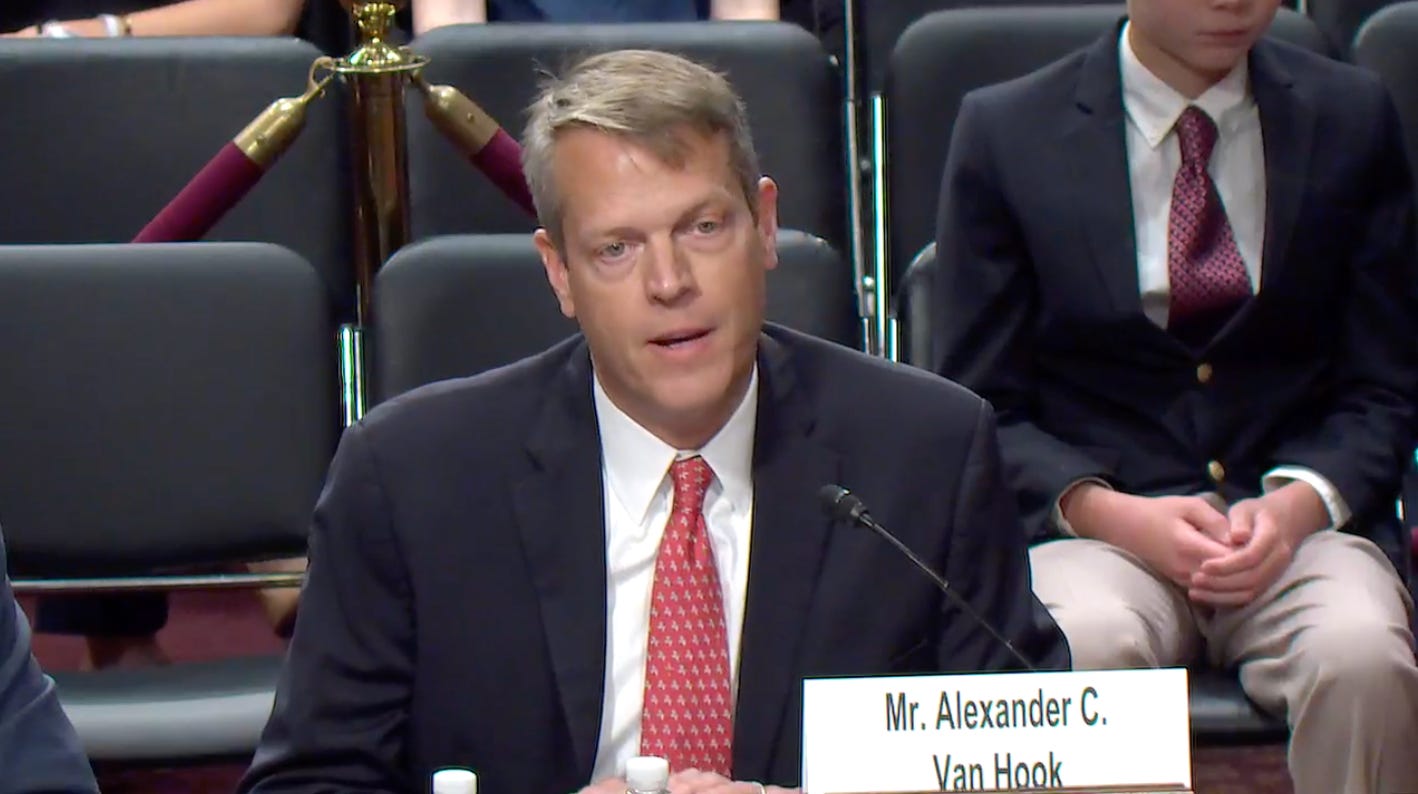
Alexander Van Hook, who will now serve on the U.S. District Court for the Western District of Louisiana, was easily confirmed (53-40). And it wasn’t too surprising: His nomination advanced out of the Senate Judiciary Committee on November 20 on a 16-6 vote, with Democratic Senators Coons, Durbin, Klobuchar, and Welch voting in favor of his nomination. On December 18, the Senate invoked cloture on his nomination (60-35), with Democratic/Independent Senators Coons, Hassan, Kaine, King, Klobuchar, Shaheen, and Welch voting in favor (with five other Democrats missing the vote).
When he was confirmed today, he had the support of Senators Durbin, Hassan, Kaine, King, Klobuchar, Shaheen, and Welch. Seven Republicans missed the vote entirely, meaning the vote could have been 46-47 — and failed — had all Democrats/Independents voted against his confirmation.
Given Van Hook’s refusal to answer certain questions — and given the lawlessness and racism of the president who nominated him and all that this administration is doing right now — it should alarm everyone that so many senators of all parties voted in favor of his confirmation (or in favor of any of Trump’s judicial nominees).
Dodging questions
Van Hook has not been among Trump’s most controversial judicial nominees during his second term. Still, he has responded to written questions for the record, including about the 2020 election and the insurrection, in lockstep with other nominees.
At a Senate Judiciary Committee hearing in December, Senator Richard Blumenthal asked three district court nominees about these topics, and they all refused to give straightforward answers. “These are basic facts. They’re not political. They’re like, is the sun shining today? They’re a matter of historical record,” Senator Blumenthal said during the hearing. “I don’t know how I can vote for someone who declines to answer a clear, factual question and who seems unwilling to recognize the truth. We’re not talking about the politics of the issue. It’s a matter of fact.”
Senator Blumenthal has declined to vote in favor of confirming Trump’s judicial nominees — who have all answered uniformly on these issues. But 18 Senate Democrats did vote in 2025 to confirm at least one of Trump’s judges, something that Demand Justice has been calling out. “These aren’t impartial judges,” their campaign website says. “They’re political cronies, auditioning for lifetime power by repeating Trump’s Big Lies.”
And, there’s more: When asked if he agrees that Democrats are evil, Van Hook didn’t say “no” — just that “it is inappropriate for me to comment on the political statements of others.” When asked if federal judges are “monsters” for ruling against the administration, he declined to comment, instead stating that the question called for him “to express an opinion on a political statement regarding ongoing litigation.” And when asked whether he agrees with Stephen Miller’s statement that a federal trade court’s ruling against Trump’s tariffs represents a “judicial coup” and that “we are living under a judicial tyranny,” Van Hook gave the same nonresponse.
Van Hook was also asked whether it would be constitutional for the president of the United States to punish a private person for a viewpoint that person expresses in a newspaper op-ed, whether it would it be constitutional for the president to terminate government contracts with a private person specifically because that person donated to members of the opposite political party, and whether it would ever be appropriate for the president to punish a law firm for taking on a client that the president did not like. Van Hook declined to answer all three questions.
He also wouldn’t directly answer whether Trump can run for a third term.
Interestingly, while Van Hook agreed that professional and demographic diversity on the federal bench is important, he would not say whether demographic diversity is an important goal in the executive branch. “As a district court judicial nominee, I do not think it is appropriate for me to comment on the diversity goals of the executive branch,” he said.
Judicial diversity concerns
Judicial confirmations going back to last year have looked strikingly similar. With his confirmation today, Van Hook is now the tenth district court judge in a row who is white and who is being appointed to a southern federal district court. He is also Trump’s tenth white appointee overall to a district court in Louisiana — a state where only eight lifetime judges of color have ever served. Nine of Trump’s 10 appointees in the state are men — meaning Trump has appointed more white men to district courts in Louisiana than lifetime judges of color (of any gender) who have ever served there.
I wrote about this last month in an analysis, which identified 16 states where Trump’s white appointees outnumber lifetime judges of color who have ever been confirmed to the federal bench in those states. In six other states, he has appointed the same number of white judges as judges of color who have served there. Soon, with the expected confirmation of Clay Fowlkes, Arkansas will become the seventh state on this list (and, with another white nominee announced this week, Arkansas will likely become the 17th state where Trump’s white judges outnumber lifetime judges of color to ever serve there).
On Tuesday, Trump also announced the nomination of Anna St. John to serve on the Eastern District of Louisiana. Of 11 Trump nominees to Louisiana district courts, she is just the second woman. During Trump’s first term, he appointed two judges — Kyle Duncan and Kurt Engelhardt — to Louisiana seats on the Fifth Circuit, and they are both white men.
Van Hook is the 27th judge confirmed during Trump’s second term. Twenty-four are white.
Coming up
The Senate Judiciary Committee had noticed a markup for this morning but quickly pulled it down, suggesting that all judicial nominees will be deemed held over and will receive committee votes next Thursday, January 15. With the Senate on recess the following week, the six judicial nominees who are currently pending and had a hearing last year — assuming they make it out of committee — will be eligible for floor consideration beginning the week of January 26.