
Trump is appointing loyalists to the bench. Senator Durbin has voted to confirm roughly a quarter of them.
His votes are at odds with statements he’s made during committee meetings.
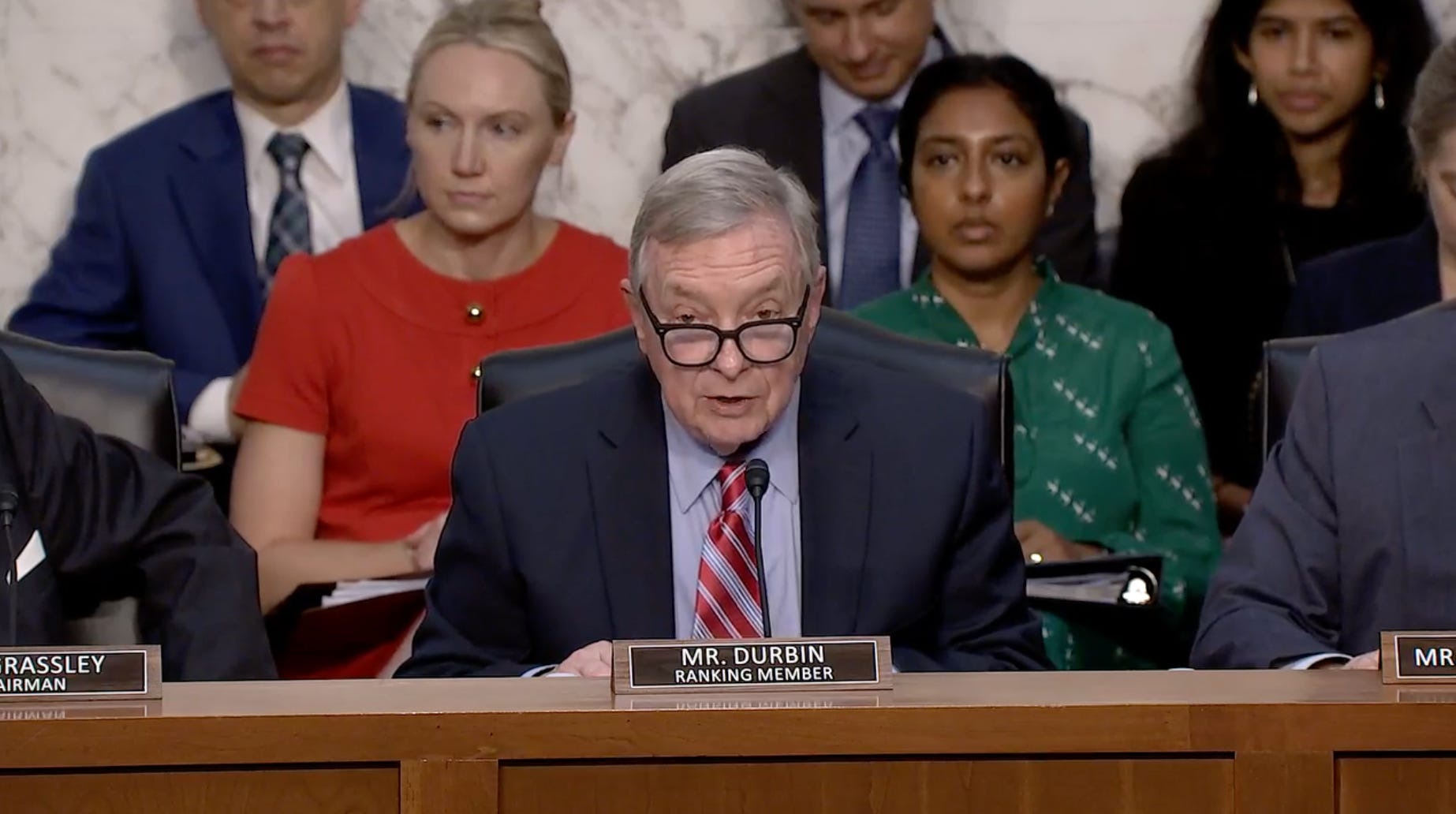
On Wednesday morning, Senate Judiciary Committee Ranking Member Dick Durbin gave opening remarks during a hearing to consider four more of Trump’s lifetime judicial nominees.
“One key question is whether you will have independence as a judge, an Article III judge, to rule against the government without fear or favor if it does something illegal or unconstitutional,” Durbin said, addressing the nominees. “The stakes have never been higher in modern times. In its second iteration, the Trump administration has gone to unprecedented lengths to upend the rule of law, violate the constitutional rights of Americans, and blatantly ignore court orders.”
Durbin’s comments were timely, and he went on to detail the atrocities occurring in places like Minnesota and Chicago, where one of his constituents was shot five times by Border Patrol agents last year.
But moments later, after the nominees introduced themselves and Senator Durbin asked some of them questions, he left the committee room, walked onto the Senate floor, and voted to confirm one of Trump’s judicial nominees. It was the second judicial nominee he supported this week — and the eighth he’s voted to confirm during Trump’s second term.
Durbin has rightly called out nominees for their nonresponses to certain questions
At yesterday’s hearing, all four of the judicial nominees refused to answer Senator Richard Blumenthal’s questions about the outcome of the 2020 presidential election and about whether the U.S. Capitol was attacked on January 6, 2021. All judicial nominees so far during Trump’s second term (and some executive nominees as well) have dodged these questions at hearings and in responses to written questions for the record.
At least twice during committee meetings last year, Durbin has directly addressed this. On June 26, he said the following in his remarks about Missouri district court nominee Cristian Stevens:
I also asked Judge Stevens in written questions whether he denounced the January 6 insurrection. He responded in this way — saying the use of the word ‘insurrection’ drew a legal conclusion, and that it would be inappropriate for him to comment on a ‘highly contested political issue.’ The fact is that a violent mob ransacked the Capitol complex, and many of us witnessed firsthand, in an actual attempt to obstruct the counting of the ballots in the electoral college, that led to the deaths of five police officers and injuries to 140 other policemen. If Judge Stevens can’t acknowledge these basic facts and denounce the violence perpetrated against law enforcement on this day, I can’t support his nomination.
At the November 20 committee meeting, Durbin again addressed this topic:
President Trump is still in full denial, and you hear all our nominees writhing in pain as we ask them the question — Well, who won that election? Well, I’m not supposed to say that Biden won the election, so I’ll just say he was sworn in as president — carefully tiptoeing through the facts of history, because they’re afraid it might offend the president of the United States. This reality has been a thorn in President Trump’s side. He’s taken unprecedented steps to whitewash history, to whitewash what all of us saw with our own eyes. Just like the demolished East Wing of the White House, President Trump is taking a wrecking ball to our democracy and our history. Day after day, he’s dismantling our constitutional order to protect himself and his followers and to attack his political opponents.
During other recent committee meetings, when Darin Smith — nominated to be U.S. attorney for the District of Wyoming — was on the agenda, Durbin again spoke powerfully about January 6 since Smith, who is deeply unqualified, was on the Capitol grounds that day.
Still, even after making these statements, Durbin has voted since last year to confirm eight of Trump’s judicial nominees — who have all avoided answering important questions.
Durbin has been a leader in asking these questions in the first place
What makes this even odder is that Durbin has been one of the senators consistently asking nominees about these issues.
In written questions for the record, he’s been asking all nominees:
Did President Trump lose the 2020 election?
Where were you on January 6, 2021?
Do you denounce the January 6 insurrection?
Do you believe that January 6 rioters who were convicted of violent assaults on police officers should have been given full and unconditional pardons?
Senators Coons and Booker have also asked questions about these topics in writing, and Senator Blumenthal has been most likely to ask nominees these questions during hearings.
Durbin has also been asking judicial nominees this question:
On May 26, 2025, in a Truth Social post, President Trump referred to some judges whose decisions he disagrees with, as “USA HATING JUDGES” and “MONSTERS”, who “…SUFFER FROM AN IDEOLOGY THAT IS SICK, AND VERY DANGEROUS FOR OUR COUNTRY…” Do you agree that these federal judges are “USA HATING” and “MONSTERS” “…SUFFER FROM AN IDEOLOGY THAT IS SICK, AND VERY DANGEROUS FOR OUR COUNTRY…”?
No nominees to date have mustered the courage to say that federal judges who rule against the administration are not “monsters” — debasing themselves in pursuit of proving their loyalty to the man who nominated them. Instead, they say it would be “inappropriate” or “improper” for them to comment on political issues, statements, or controversies.
It is not clear why Durbin, who is retiring from the Senate, has been asking these questions and then supporting some of the nominees who refuse to answer them directly.
Durbin must follow through — and vote accordingly
Last week, I published an analysis examining how Democrats on the Senate Judiciary Committee have been engaging in the judicial nominations process during Trump’s second term — from asking judicial nominees questions during hearings, submitting written questions for the record, attending markups to speak about the nominees, and ultimately voting for or against them.
As I said then, Durbin should be commended for his leadership throughout this process. He has asked questions during every panel of judicial nominees at their hearings, has submitted more questions for the record than anyone other than Senator Booker, and has attended every markup — speaking out about judicial nominations more than any other senator.
And this all makes sense — he is the ranking member and the leader of the Democrats on the committee.
But he must also follow through and actually oppose all nominees — in committee and on the floor.
Senator Durbin’s office did not respond to requests for comment for this story.