
Senate set to confirm another anti-abortion, anti-trans judge to Kansas district court
Powell’s confirmation will mean that all six lifetime judges on this court are Trump appointees.
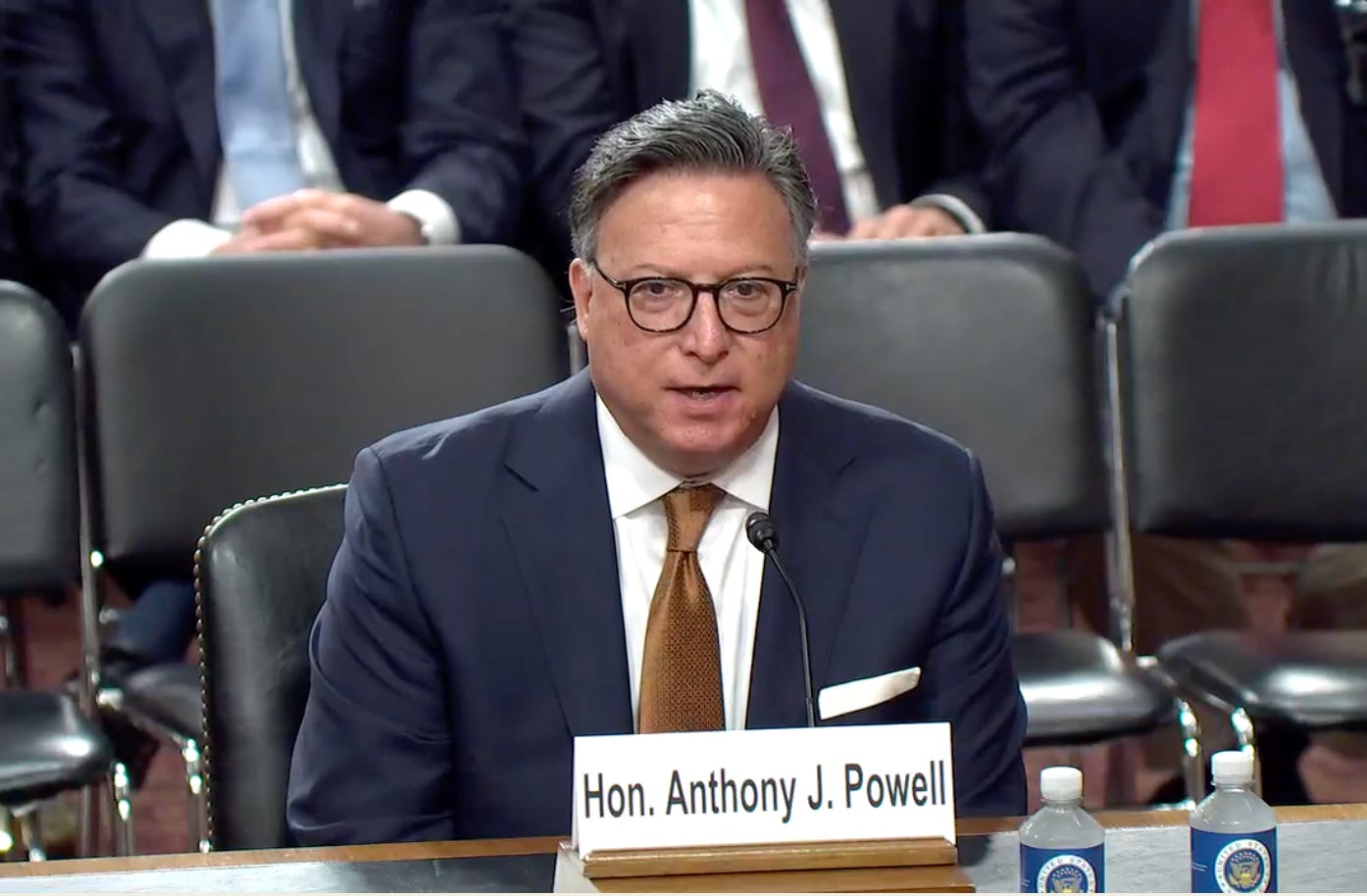
On Monday evening, Senate Majority Leader John Thune filed cloture on the nomination of Tony Powell to serve on the U.S. District Court for the District of Kansas. The full Senate can begin voting on his nomination on Wednesday.
Powell, who serves as the solicitor general of Kansas, is one of three nominees to the District of Kansas named by Trump this year. Last week, the Senate confirmed Jeffrey Kuhlman to the court, making him the 40th lifetime judge confirmed during Trump’s second term. The other nominee, Tony Mattivi, is up for confirmation tomorrow.
If Mattivi and Powell are confirmed this week, all six active (lifetime) judgeships in Kansas will be filled with Trump appointees — five white men and one white woman. Only two lifetime judges of color have ever served in the state.
The 2020 election and January 6
Powell was not asked about the 2020 election and January 6 during his hearing, but in responses to written questions he refused to say much on those topics.
When asked if Trump lost the 2020 election, Powell stated that “President Biden was certified as the winner of the 2020 presidential election and served four years as President of the United States.” When asked who won the election, he wrote the same thing: “President Biden was certified as the winner of the 2020 presidential election and served four years as President of the United States.” Senator Cory Booker tried again, noting in his question that he wasn’t asking who was certified as the winner. Still, Powell used the word “certified” in his response:
This question calls for a response that could be interpreted as a comment or opinion on a topic of significant political debate. See Code of Conduct of U.S. Judges Canons 3(A)(6), 5. Thus, I believe it would be inappropriate to say anything beyond noting that President Biden was certified the winner of the 2020 election and served four years as President of the United States.
Powell also repeatedly refused to answer questions about January 6. Senator Richard Blumenthal simply asked him whether the U.S. Capitol was attacked that day, and he dodged. “As it appears this question touches on a matter of significant political debate and controversy, it would be inappropriate for me to comment on opine on [sic] the events that occurred at the United States Capitol on January 6, 2021. See Code of Conduct of U.S. Judges Canons 3(A)(6), 5,” Powell wrote. When Ranking Member Dick Durbin asked Powell whether he denounced the insurrection, he provided a very similar response.
Powell also demonstrated his loyalty to the president when he wouldn’t say whether he agrees that federal judges are “USA HATING” and “MONSTERS” for issuing decisions Trump disagrees with. He would not say whether it’s a crime for a judge to rule against Trump’s desired outcome in a particular case. And he also would not say whether it’s possible for a judge’s decision to be correct, as a matter of fact and law, even if it differs from Trump’s desired outcome.
Anti-abortion activist
In April, 21 reproductive rights, health, and justice organizations and organizations committed to health equity wrote to Senate Judiciary Committee leadership to share their concerns about several judicial nominees due to their “deeply problematic records related to reproductive freedom and other fundamental rights.” This included Powell.
In their letter, the organizations wrote:
Anthony Powell, who currently serves as Kansas Solicitor General and has been nominated to the U.S. District Court for the District of Kansas, has advanced legal positions that would restrict reproductive rights, undermine access to evidence-based medical care, and support government intrusion into personal medical decision-making. In litigation concerning abortion restrictions, Powell argued that the defeat of the “Value Them Both” ballot initiative should not influence court decisions because the Kansas Constitution itself had not been amended. Powell called specific methods of abortion “heinous” and said that abortion issues can’t be resolved by “judicial fiat.” Powell has also been involved in litigation defending state policies affecting gender marker changes on identification documents.
Powell was asked repeatedly in written questions about his anti-abortion record. In his very first question, Senator Durbin noted that Powell was described as “one of the leaders of a strong anti-abortion faction” during his time as a lawmaker in Kansas — and that he opposed language in a proposed abortion ban establishing exceptions for the life or health of the mother. He also “championed legislation that seemingly would have limited women’s ability to access in vitro fertilization (IVF) and basic birth control methods,” according to Senator Durbin.
Senator Durbin asked Powell three questions:
Do you still believe that abortion should be outlawed even in cases where the life or health of the mother is at risk?
Do you still believe that women’s access to IVF and birth control should be limited?
Given your lengthy and extreme record on this issue, how could any litigant who appears before you in a case involving reproductive rights reasonably believe that you have not prejudged the matter?
Powell said that the first two questions touched on “a matter of significant political debate and controversy,” making it “inappropriate” for him to comment. In response to the third, he noted that during his time as a judge he was called upon to rule on issues contrary to his personal views. “With respect to cases involving abortion or reproductive rights, I will faithfully apply the law regardless of my personal views on the matter, as I would in any matter that could come before me,” he promised.
Senator Blumenthal laid it all out in one of his questions for Powell:
When you were in the Kansas legislature, you opposed an exception to an abortion ban to “preserve the life or health of the pregnant woman.” You also supported a bill that would have given health care providers the ability to limit access to birth control. In your current role as Solicitor General of Kansas, you asked the Kansas Supreme Court to overturn a 2019 ruling that had protected the right to abortion as part of a “fundamental right to personal autonomy” under the state constitution. As Solicitor General, you have also joined an amicus brief supporting the plaintiffs in a case challenging the FDA’s approval of mifepristone. If confirmed, how can future litigants trust that you will remain unbiased on reproductive health issues?
Powell stated that “both the appearance of impartiality and actual impartiality are important in maintaining public confidence in our system of justice. If confirmed, I will address all actual or potential conflicts of interest by reference to 28 U.S.C. § 455, the Code of Conduct for United States Judges, and any and all other laws, rules, and practices governing such circumstances.”
It is alarming that Powell and Mattivi — the latter of whom stated that “I am 100% pro-life, and I am opposed to abortion” — are both being confirmed this week to the District of Kansas, where all residents deserve judges who will uphold their fundamental rights and freedoms.
Anti-trans views
As solicitor general of Kansas, Powell (along with Attorney General Kris Kobach) “sued the Kansas Department of Revenue (‘KDOR’) for allowing transgender Kansans to be identified on their driver’s licenses by their gender instead of their biological sex at birth,” according to Alliance for Justice (AFJ). After losing in court, Powell and Kobach filed an additional motion and received symbolic monetary sanctions of $1 each because they didn’t have jurisdiction and “should have known” better. “Powell’s passionate defense of this discriminatory law demonstrates his willingness to advance restrictions on transgender individuals,” AFJ says. “Such views align him with broader attacks on LGBTQ+ communities.”
Powell spoke about this issue at an “Appellate Update” event hosted by the Wichita Pachyderm Club. During his remarks, he mocked transgender people for believing they have a right to privacy even though “you can usually tell they’re transgender…respectfully, I just don’t think they’re keeping it a secret from anybody.” He said it’s “offensive” that transgender people claim they are subject to violence, and his rationale was this: “I don’t know anyone who hates a transgender person, do you? I mean, we don’t hate transgenders. I don’t know of anyone who does. We may disagree with their lifestyle. We may wish they would choose differently. But I don’t know anyone who hates a transgender person and wants to commit violence against them.”
Referring to trans people as “transgenders,” calling transgender identity a “lifestyle,” and saying he wishes transgender people would “choose differently” is all deeply offensive, and it demonstrates that Powell would not be fair and impartial in cases involving trans people and their rights.
Powell has also worked alongside the Alliance Defending Freedom (ADF), an anti-LGBTQ hate group. In response to written questions, Powell noted that he is “in regular discussions with members of that organization because that organization has been involved in a number of cases the State of Kansas has brought and defended. In addition, I have friends and acquaintances associated with ADF. I have spoken to a few of those individuals generally about my application and the selection process. They have been encouraging and congratulated me upon my nomination.” He also said he has occasionally attended ADF conferences.
I’ll conclude with more from AFJ:
In his current role as Kobach’s top appellate advocate, Powell supports Kobach’s continued efforts to restrict voting rights and push hard line immigration policies. Across his career in all three branches of state government, Powell has repeatedly aligned with partisan political actors and advanced legal positions that restrict judicial oversight, weaken protections for marginalized communities, and expand state-led attacks over individual rights. His record, particularly in his most recent role as Kansas Solicitor General, raises serious concerns about his ideological bias and ability to serve as an impartial federal judge.
Powell could be confirmed as soon as this Wednesday to serve as a lifetime federal judge. The people of Kansas deserve better.