
Senate Judiciary Democrats can ask judicial nominees questions in writing. Their engagement in that process has varied widely.
Some senators have asked 1,000+ questions. Others have asked very few.
One year into Trump’s second term, 33 lifetime judicial nominees have responded to senators’ written questions for the record — commonly referred to as QFRs. This process, which takes place following a nominee’s confirmation hearing before the Senate Judiciary Committee, provides committee members with an opportunity to ask nominees additional questions — as many as they want, and about whatever they want.
A new Nomination Notes analysis reveals that Democrats on the Senate Judiciary Committee are engaging with the QFR process in drastically different ways. Three Democratic members — Ranking Member Dick Durbin, Senator Cory Booker, and Senator Chris Coons — have all asked more than 1,000 questions to date during Trump’s second term, with Booker asking more than 1,500. They are the only three Democrats to ask questions of every nominee.
Four other senators — Amy Klobuchar, Alex Padilla, Peter Welch, and Adam Schiff — have all asked fewer than 100 questions, with Senators Klobuchar (22) and Welch (19) asking the fewest. Senator Welch has only submitted questions to five nominees.
Senators Mazie Hirono, Richard Blumenthal, and Sheldon Whitehouse have asked 108 questions, 177 questions, and 361 questions, respectively.
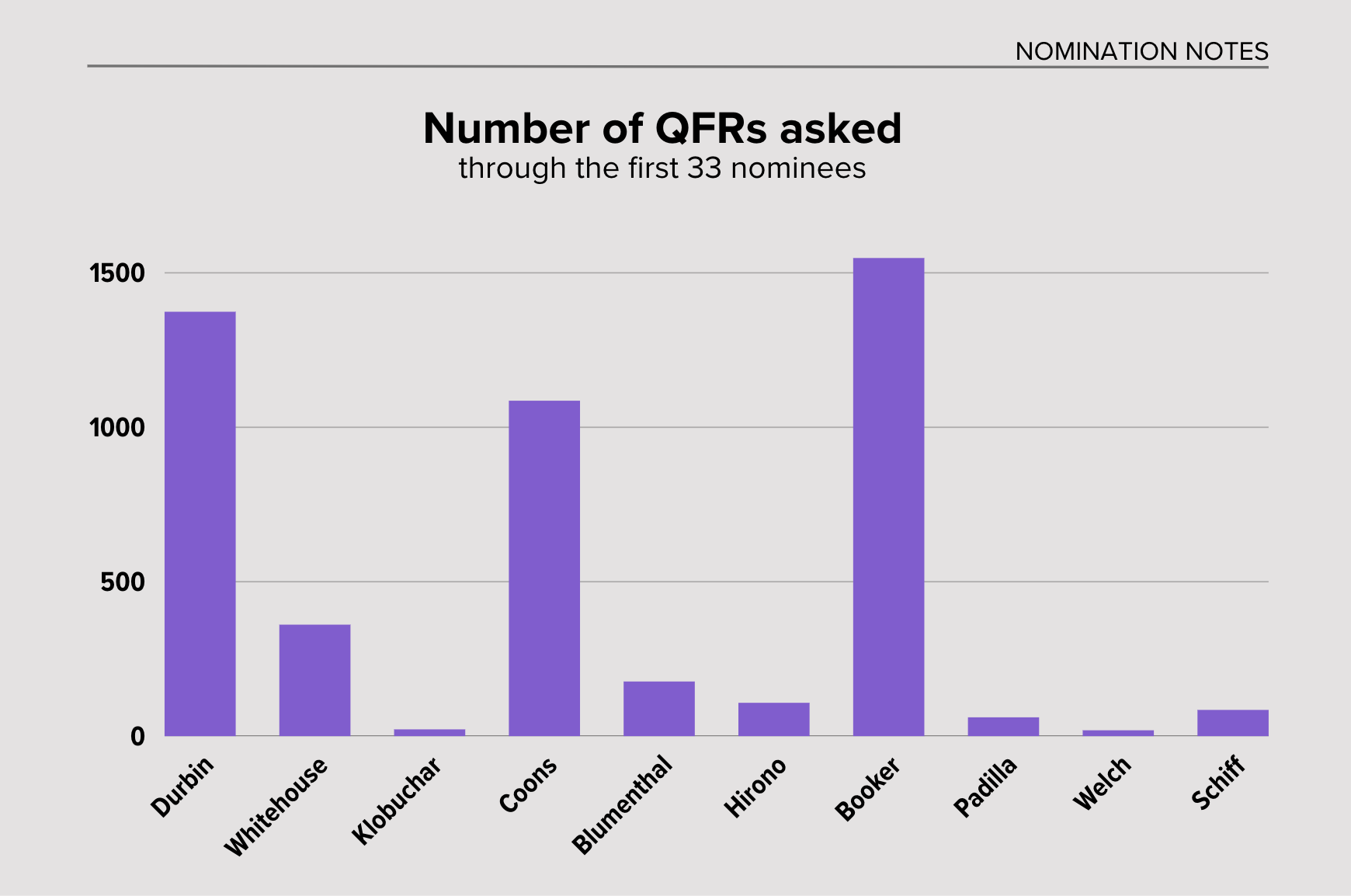
This analysis does not seek to scrutinize the substance of senators’ questions, and it does not count subquestions within broader, numbered questions asked of judicial nominees. Rather, this analysis represents a high-level accounting of how frequently — and to what extent — committee Democrats are taking advantage of the opportunity to ask additional questions of Trump’s extreme judicial nominees.
Some notable trends
While only six circuit court nominees have responded to QFRs compared to 27 district court nominees, circuit court nominees, on average, have been asked more questions — buoyed by the 240 questions given to now-Judge Emil Bove. Circuit court nominees were asked an average of 163 questions, while district court nominees were asked an average of 143 questions.
Strangely, some senators have barely asked any questions of circuit court nominees. Senator Klobuchar asked Rebecca Taibleson three questions, but she didn’t ask the other five circuit court nominees anything. Senators Welch and Schiff asked questions of Whitney Hermandorfer and Emil Bove, but then they failed to ask the other four circuit court nominees any questions. Alarmingly, Eric Tung and Joshua Dunlap, who are now judges on the Ninth Circuit and First Circuit, respectively, and who appeared together at a hearing on July 30, only received questions from five of the 10 Democrats on the committee.
The number of questions has also decreased over time. Prior to the Senate’s August recess last year, the committee considered 14 judicial nominees who received, on average, nearly 160 questions from committee Democrats. Following August recess, the committee submitted QFRs to 19 additional nominees, and they received an average of 137 questions each.
Indeed, the three nominees who had a hearing in December — Justin Olson, Brian Lea, and Megan Benton — only received written questions from five committee members. Senators Whitehouse, Klobuchar, Padilla, Welch, and Schiff submitted zero questions. Additionally, Nick Ganjei, Clay Fowlkes, and Aaron Peterson — the three nominees who had a hearing in November — only received questions from six, six, and five senators, respectively.
Only one nominee so far, Josh Divine, has received questions from all 10 Democrats on the committee.
Senators typically have a full week — until 5 p.m. on the Wednesday following a nominations hearing — to submit their QFRs. This is a lot of time. Every committee member’s office should ensure they are using this opportunity and asking meaningful questions of nominees. This is, after all, part of the interview process for a lifetime gig on the federal bench.
The importance of QFRs
This analysis does not overlay QFR engagement with senators’ actual attendance of Judiciary Committee hearings, where they can ask questions in person, on video, for the American people to see. That will be the subject of future analyses here — with the significant caveat that senators are busy, often have competing hearings to attend, or may otherwise be unable to participate.
That is why — as a standalone vehicle for asking important questions — QFRs remain very useful. Indeed, groups like Demand Justice have used QFR responses to inform reports about how Trump’s nominees are answering questions related to the 2020 election and January 6. In my reporting, I’ve also used QFR responses to write about how nominees are answering questions about Trump running again, about whether Democrats are evil, about whether judges are monsters for ruling against this administration, and more. One story called out a nominee for the way he answered a single question about whether he is pro-civil rights.
All Democrats on the Senate Judiciary Committee should be participating in this process, including by lifting up the responses they receive and holding nominees accountable for their answers. Ranking Member Durbin, for example, has asked every nominee questions related to the outcome of the 2020 election and what happened on January 6, 2021. Still, despite their responses, he has voted for several of those nominees both in committee and on the Senate floor. Senators must ask questions and then — when they receive bad answers — vote accordingly.
As part of my piece this morning, I talked to Josh Orton, president of Demand Justice, about the work moving forward. “We have to call out everything,” he told me. “Our challenge is to make sure that no one forgets that we are not living in normal times.” But advocates, journalists, and other people following this process can’t call out the extremism of Trump’s judicial nominees unless senators are using their power to help uncover it. Asking questions for the record is one essential way of doing that.
APPENDIX: Total written questions asked by each Democratic committee member
Cory Booker: 1,548
Dick Durbin: 1,374
Chris Coons: 1,086
Sheldon Whitehouse: 361
Richard Blumenthal: 177
Mazie Hirono: 108
Adam Schiff: 85
Alex Padilla: 61
Amy Klobuchar: 22
Peter Welch: 19
For questions about this analysis, please reach out to patrick@nominationnotes.com.
To access QFR responses, see: Hermandorfer | Divine | Stevens | Bluestone | Bove | Artau | Lanahan | Dudek | Mascott | Mooty | Moe | Mercer | Meredith | Taibleson | Lewis | Pratt | LaCour | Tung | Dunlap | Chamberlin | Maxwell | Bragdon | Rodriguez | Freeman | Orso | Van Hook | Crain | Ganjei | Peterson | Fowlkes | Olson | Lea | Benton