
Nomination Notes wrapped
A look back at my coverage of judicial nominations in 2025.
As 2025 — and the first two and a half months of this Substack — comes to a close, I’m looking back on the nearly 50 stories I’ve posted and sharing some highlights ahead of what’s sure to be a busy 2026! Here’s a recap of some of my reporting — and a note about what’s to come.
Publishing state-based diversity analysis and consistent reporting on judicial diversity
Earlier this month, I published a first-of-its-kind analysis showing states where Trump’s white appointees outnumber lifetime judges of color who have ever served there. With 260 lifetime confirmations during his five years in office, the analysis offers an alarming look at how Trump has prioritized the confirmation of white judges — and above all else, judges who are ideologically extreme and hostile to civil and human rights.
My stories seek to provide important context about what nominations and confirmations mean for the larger judicial diversity picture. That means calling out trends I’m seeing — like Trump appointing his tenth white district court judge in Louisiana, his appointment of four more white judges in North Carolina, his entrenchment of the Seventh Circuit’s and Eighth Circuit’s diversity problems, and more. Most judicial nominations coverage doesn’t consistently — or ever — include this information, but it’s critical to understanding what this president is doing to our courts and our democracy.
Covering Judiciary Committee hearings and markups
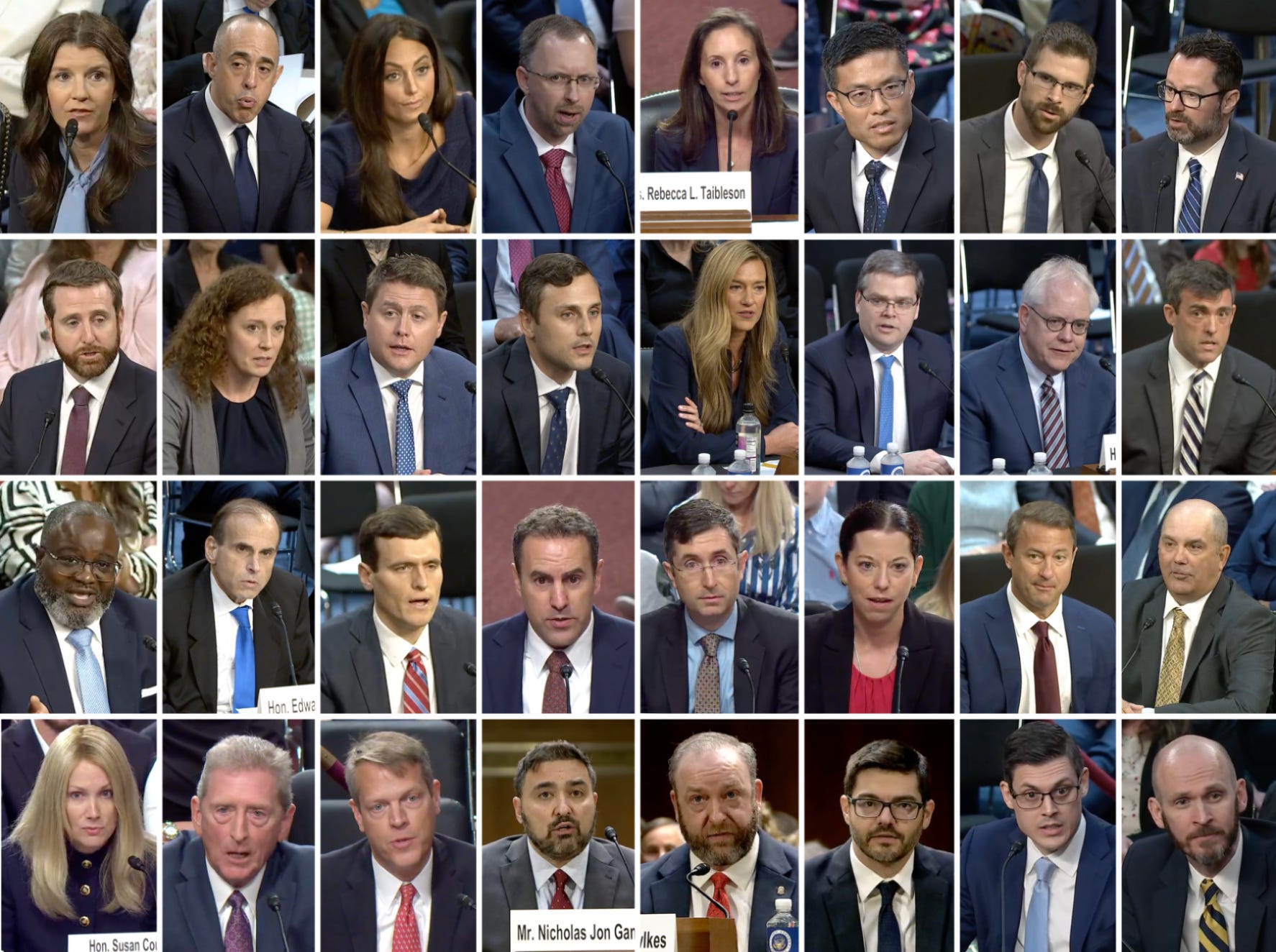
Since Nomination Notes began in mid-October, I’ve been writing about what happens during Senate Judiciary Committee hearings and markups — events that often don’t get much attention, but should.
On December 17, I wrote about Justin Olson’s disturbing testimony that revealed his deeply held beliefs — rendering him incapable of serving as a fair-minded and independent jurist. In a shocking exchange with Senator Kennedy of Louisiana, Olson said “I believe every word of the Bible” and was forced to defend indefensible statements he’s made while delivering sermons. On November 19, I covered Nick Ganjei’s refusal to talk about January 6 despite his record of condemning violence against law enforcement. And on October 22, I wrote about a confirmation hearing for two Louisiana district court nominees who did not receive the scrutiny they should have.
I’ve also covered executive business meetings (or markups), including on December 11 and November 20, to bring attention to what happens when committee members are actually voting on judicial nominations. These meetings are admittedly often very boring, but they are where the public can hear post-hearing commentary about nominees from senators — and where committee members go on record, with their votes, about whether or not they believe nominees are worthy of confirmation.
Identifying patterns — and problems — in nominees’ responses to questions for the record
After confirmation hearings, Senate Judiciary Committee members usually have a week to submit additional written questions for the record. I’ve been reading through nominees’ responses to these questions, and in late October I published an analysis that looked at the bizarre and unsettling ways that the first 25 nominees answered them. I later wrote more about how the first 30 nominees refused to say Trump lost the 2020 election and declined to comment on January 6 — in addition to their weird refusal to say whether they agree that Democrats are “evil” (only one nominee has responded “No.”). I’ve also written about Ranking Member Durbin’s question asking nominees if they agree that federal judges are “monsters” for ruling against the administration. No nominees to date have mustered the courage to respond appropriately.
Last month, I looked at William Crain’s responses, and in particular the way he responded to Senator Hirono’s question about whether he is pro-civil rights. Despite his long record to the contrary — and despite facing opposition from civil rights organizations — Crain said that he is pro-civil rights. And I think that matters. Nominees don’t get to redefine what it means to be pro-civil rights in their pursuit of a lifetime judgeship — a job that comes with the ability to impact the civil and human rights of millions of people in America. Responses like this must be called out.
I’m going to continue reviewing these responses, and I hope senators will ask additional meaningful questions of every nominee who comes before them.
Asking important questions that aren’t being raised elsewhere
My second Nomination Notes story, published on October 20, asked an interesting question: Why did Josh Divine, now a lifetime judge in Missouri, self-report his race as “Other” to the DOJ’s Office of Legal Policy? Of all federal judges in American history, he is the only one listed under the “Other” category in the Federal Judicial Center’s biographical database. Why? As I wrote:
There are valid and complex reasons for someone wishing to self-identify this way. But given Divine’s record and previous writings — and given that he was nominated by Trump to carry out the administration’s white supremacist, anti-DEI agenda from the bench — we should question why Divine did this. If he wrote “Other” as a rejection of race/ethnicity categories as too “woke,” or because he possesses a racial colorblindness ideology, or because he doesn’t value the utility of race and ethnicity data and sought to skew it — then that would be alarming.
Earlier this month I was the first to report on Brian Lea’s lack of professional connection to the state of Tennessee, where he’s been nominated to a lifetime judgeship. Despite never working in Tennessee and only being admitted to practice there earlier this year, he may soon be forced to relocate there from his home in northern Virginia. Why? As I said in my story, the answer is possibly this: “If Trump wants someone on the court badly enough, he will find a place to install them — no matter how tenuous their connection is to that part of the country and its legal community.”
And I’ve also asked questions about what we don’t know about Trump’s nominees following his administration’s decision to eliminate cooperation with the American Bar Association and its Standing Committee on the Federal Judiciary. Given what the Standing Committee revealed about some of the nominees during Trump’s first term, it should concern everyone that their ability to conduct independent, nonpartisan peer evaluations of judicial nominees has been weakened.
Telling stories that matter
On the anniversary of Judge Mustafa Kasubhai’s historic confirmation, I wrote about his courtroom rules that describe best practices for how people should introduce themselves, how to ask others for their name and honorific, and how other judges can include their pronouns on their webpage, in their email signature, and on their orders and other documents. I told this story in light of Trump’s anti-trans judicial nominees and to underscore why having more LGBTQ+ representation on the bench — and more inclusive and respectful jurists like Judge Kasubhai — really matters.
I recently used another anniversary to tell the story of how Trump replaced Adeel Mangi, President Biden’s historic pick for the Third Circuit, with former Trump lawyer and recent MAGA rally attendee Emil Bove. It is a heartbreaking story, not just because of the anti-Muslim smear campaign that tore down Mr. Mangi’s nomination — but because of what our courts and the nation missed out on as a result. And it is a story that should continue to be told so that it never happens again.
What to expect — and how you can help
Nomination Notes will continue into the new year for as long as possible. I’ll keep watching hearings and markups, reading responses to written questions for the record, asking questions we deserve answers to, and telling stories that need to be told. The destruction to our democracy must be documented, and I’m committed to doing so for as long as I can.
Still, I need help growing the Nomination Notes community of readers. You can help spread the word about my work by:
Sharing this story to let your friends, family members, and colleagues know about Nomination Notes — and the gap that my reporting helps to fill.
Making a small donation — either by upgrading to a paid subscription (thanks if you already have!) or by making a one-time contribution at this link (again, thanks if you already have!).
Interacting with my work. Consider sharing my stories on social media, liking or commenting on Substack, or getting in touch with me directly. You can always message me at patrick@nominationnotes.com if you have questions, feedback, or ideas for future stories.
I’ll be back, starting later this week, with more.
Happy New Year!
Sickening to look at the lack of diversity.