
Judicial nominees provide stunningly bad responses to written questions for the record
Four more white men demonstrate their unfitness for the judiciary.
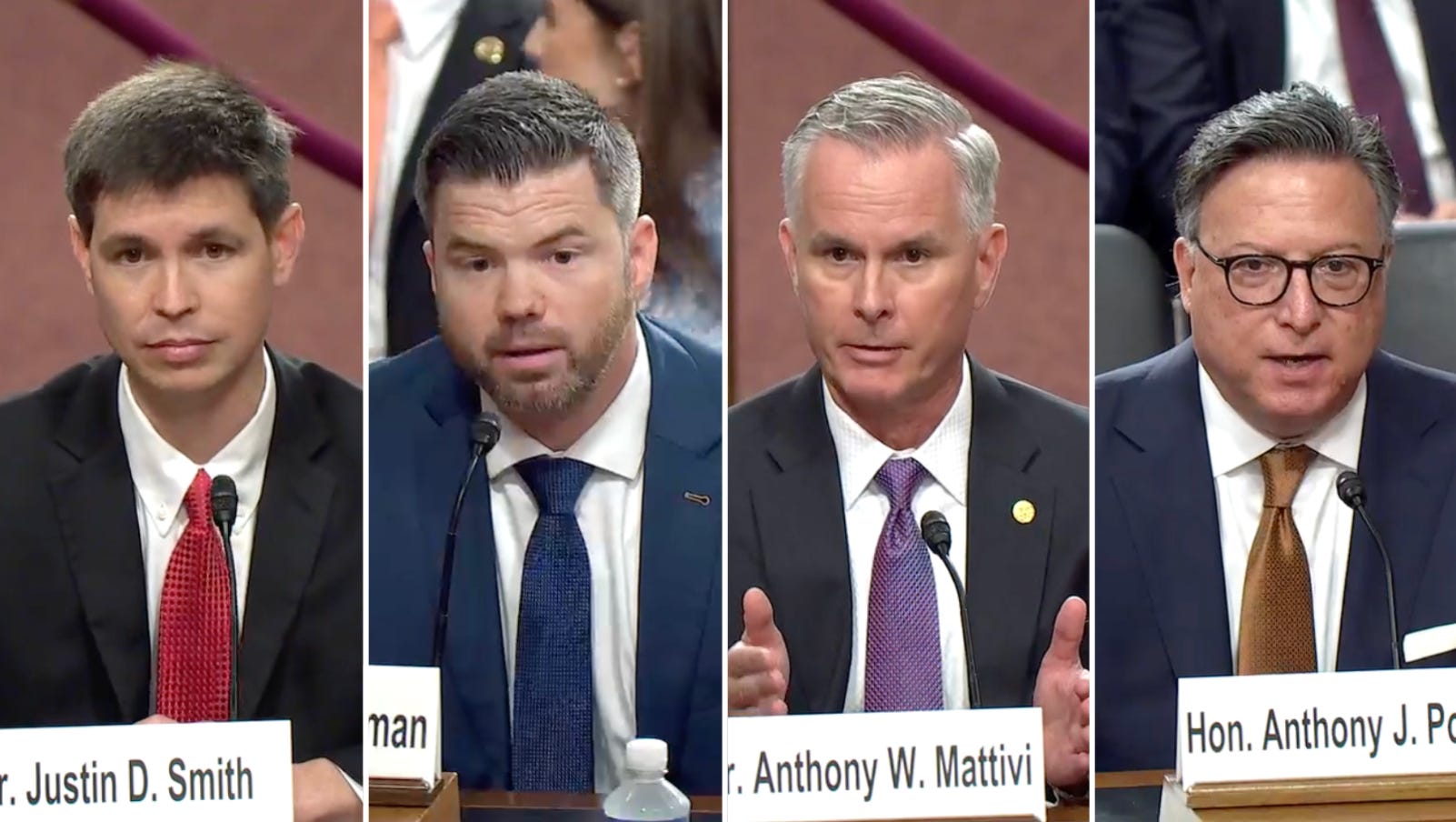
The Senate Judiciary Committee on Tuesday posted responses to written questions for the record from four more of Trump’s judicial picks. District of Kansas nominees Jeffrey Kuhlman, Tony Mattivi, and Tony Powell, in addition to Eighth Circuit nominee Justin Smith, told senators in their responses that President Joe Biden was merely “certified” as the winner of the 2020 election, dodged questions related to January 6, and demonstrated that they are undeserving of lifetime judicial appointments.
Eight Democratic senators on the committee — Ranking Member Dick Durbin and Senators Sheldon Whitehouse, Amy Klobuchar, Chris Coons, Richard Blumenthal, Mazie Hirono, Cory Booker, and Peter Welch — asked written questions for the record of at least one of the nominees. California Senators Alex Padilla and Adam Schiff did not submit any questions for these nominees to answer. No Republicans asked questions.
Committee members asked many of the questions they normally do in writing. Justin Smith, who is one of Trump’s personal lawyers, also received a number of questions about his legal representation of Trump.
In his very first question for the record, Ranking Member Durbin posed this question to Smith: Have you ever represented a client who was found liable for sexual abuse? If so, please provide the name of your client. Smith was forced to respond that he represents Trump “in an appeal of a verdict that included what we contend was an erroneous sexual abuse finding” — citing two Trump-appointed Second Circuit judges who dissented from the denial of rehearing en banc. When asked if he believes the verdicts against Trump are legitimate, Smith responded that “I do not believe that the verdicts in the Carroll cases are in accordance with the law or the facts.”
As Senator Durbin noted, Trump wrote in his Truth Social post announcing Smith’s nomination that he played a “BIG role in securing a Supreme Court Landmark Victory in Presidential Immunity.” When he asked Smith whether Trump’s description was accurate, Smith would only say that he “was grateful to contribute to the successful outcome at the Supreme Court.”
The 2020 election and January 6
So far during Trump’s second term, 44 lifetime judicial nominees have responded to written questions for the record — and notably, all of them have dodged inquiries related to the outcome of the 2020 election and what happened on January 6, 2021. Ranking Member Durbin and Senators Blumenthal, Hirono, and Welch asked Smith during his confirmation hearing about these topics, and he would not give direct answers. Kuhlman, Mattivi, and Powell were not asked about these issues during their hearing. But in responses to written questions, all four nominees were evasive.
Smith wrote that “Pursuant to the process set forth by the Constitution and federal law, President Biden was certified as the winner of the 2020 presidential election and served as the 46th President of the United States. President Trump was certified as the winner of the 2016 and 2024 elections.” Kuhlman said that “President Biden was certified as the winner of the 2020 presidential election.” Mattivi and Powell provided similarly short responses that only said Joe Biden was “certified” as the winner.
When asked whether the Capitol was attacked on January 6 and whether it was an insurrection, no nominee would say “yes.” Instead, they said they couldn’t respond. “January 6, 2021, is a polarizing issue for many Americans. The discourse around the event, including the discourse by many sitting politicians, would make it inappropriate for me to comment,” Kuhlman responded. Powell said that the “question touches on a matter of significant political debate and controversy” and said that it would be “inappropriate” for him to comment on the “events” that occurred that day at the Capitol.
Mattivi wrote that “The legal characterization of conduct of persons at the Capitol on that date is a matter of significant political debate,” saying that “it would not be appropriate for me to comment on that” as a judicial nominee. Given his role as director of the Kansas Bureau of Investigation and with a career spent in law enforcement, Senator Blumenthal asked Mattivi whether he agreed with Trump pardoning several specific individuals for engaging in assaults on law enforcement. This included:
Do you support President Trump’s pardon of Daniel Ball, who threw an explosive device into a tunnel filled with law enforcement officers?
Do you support President Trump’s pardon of Jacob Lang, who was filmed hitting law enforcement officers with a baseball bat and riot shield?
Do you support President Trump’s pardon of Jeffrey McKellop, who stabbed a police officer in the face with a flagpole?
Do you support President Trump’s pardon of Daniel “D.J.” Rodriguez, who plunged a stun gun into the neck of Metropolitan Police Officer Michael Fanone and repeatedly shocked him, and then was sentenced to more than 12.5 years in prison?
Do you support President Trump’s pardon of Julian Khater, who sprayed U.S. Capitol Police Officer Brian Sicknick with pepper spray, pled guilty to assaulting officers with a deadly weapon, and was sentenced to more than 6.5 years in prison?
Do you support President Trump’s pardon of Ryan Nichols, who sprayed officers with pepper spray, pushed the crowd against officers defending a door to the Capitol, and was sentenced to more than five years in prison?
Appallingly, for each question, Mattivi only responded that “I did not play a part in the President issuing this pardon, nor does the judiciary review Presidential pardons.” He said this is subject to ongoing litigation and it would be inappropriate for him to comment. When Senator Durbin asked Mattivi whether law enforcement officers were ambushed and attacked by rioters who mobbed the Capitol, he said that he condemned all violence but that, “as a judicial nominee, it would be improper for me to characterize the events on January 6, 2021.”
Other shows of loyalty
Senator Durbin has been asking judicial nominees the following question:
On May 26, 2025, in a Truth Social post, President Trump referred to some judges whose decisions he disagrees with, as “USA HATING JUDGES” and “MONSTERS”, who “…SUFFER FROM AN IDEOLOGY THAT IS SICK, AND VERY DANGEROUS FOR OUR COUNTRY…” Do you agree that these federal judges are “USA HATING” and “MONSTERS” “…SUFFER FROM AN IDEOLOGY THAT IS SICK, AND VERY DANGEROUS FOR OUR COUNTRY…”?
No nominees to date, including these four, have mustered the courage to say that federal judges who rule against the administration are not “monsters” — debasing themselves in pursuit of proving their loyalty to the man who nominated them. Instead, they say it would be “inappropriate” or “improper” for them to comment on political issues, statements, or controversies.
In this round of written questions, Senator Coons noted the following:
The New York Times reported that on March 25, 2026, President Trump stated the following at a National Republican Congressional Committee event: “The time has also come for Republicans to pass a tough new crime bill that imposes harsh penalties for dangerous repeat offenders, cracks down on rogue judges. We got rogue judges that are criminals. They are criminals, what they do to our country. The decisions that they hand down and hurt our country.” Is it a crime for a judge to rule against President Trump’s desired outcome in a particular case?
All four nominees said it would be “improper” — or that it “would not be appropriate” — for them to respond, citing the Code of Conduct for United States Judges. When asked, as part of the same question, whether it’s possible for a judge’s decision to be correct, as a matter of fact and law, even if it differs from Trump’s desired outcome, only Kuhlman said “Yes.” The other three nominees referred to their previous responses saying they couldn’t respond.
Senators Coons, Booker, and Durbin have also been asking nominees about whether Trump can run for a third term. Nominees have largely been avoiding directly answering these questions, though a few have given yes/no responses (depending on how the question is asked). These four nominees, though, did not give very direct responses, instead quoting the text of the 22nd Amendment and failing to string together the words “Trump cannot run for a third term.”
Smith’s connections to Leonard Leo’s dark money operation
As I previously wrote, Smith is connected to several organizations in Leonard Leo’s orbit, including serving on the boards of American Patriot Fighters, Publius Fund, First Principles Action, and Yorktown Fund all within the last few years (in responses to written questions, Smith said that he resigned from and no longer serves on any of these boards as of earlier this month). He is also a member of Teneo. Senator Sheldon Whitehouse walked through some of Smith’s connections to these and other organizations during his confirmation hearing, describing the web of groups as “a pretty remarkable creation, presumably designed to mislead.”
Senator Whitehouse focused on these connections in his questions for the record, including asking:
Have you disclosed to President Trump that many of the organizations you have been affiliated with have received substantial funding from organizations affiliated with Leonard Leo? If so, when, and what did you discuss?
Have you ever disclosed to President Trump that many of the organizations you have been affiliated with have shared names with organizations affiliated with Leonard Leo? If so, when, and what did you discuss?
Have you ever disclosed to President Trump that many of the organizations you have been affiliated with share personnel with organizations affiliated with Leonard Leo? If so, when, and what did you discuss?
Strangely, in response to all three questions, Smith responded that “I disagree with the assertions in the question, but in response, no.” It is unclear why Smith purports to disagree with these statements, which I’m sure Senator Whitehouse would enjoy the opportunity to discuss more.
Senator Durbin wrote that “The Teneo Network states that its purpose is to ‘Recruit, Connect, and Deploy talented conservatives who lead opinion and shape the industries that shape society.’ In your Questionnaire, you state that you are currently or were previously a member of the Teneo Network. How many meetings have you attended since joining?” Smith responded that, to the best of his recollection, he has attended seven meetings.
When Senator Coons asked Smith if he thinks it’s appropriate for a federal judge to be a member of such an organization, Smith said “Yes.” When asked if he will discontinue his membership in Teneo Network if he is confirmed as a judge, Smith responded “No.”
This is deeply concerning.
Mattivi’s terrible response about antidiscrimination law
As I wrote about last week, Republican Senator John Kennedy of Louisiana questioned Mattivi during the hearing and posed a fairly straightforward question about federal antidiscrimination law:
I’m 17, and I go to work for McDonald’s — go to apply for a job — and I’m wearing a burqa. And the McDonald’s manager says: I really want to hire you, but we don’t allow religious symbols at my restaurant, or at our restaurants. What does the law say about that?
Mattivi responded that “The law prohibits the application of a religious test applied by the government, right? Not by private employers. So, I would say that’s the basis of…”
In written questions, Senator Coons asked Mattivi about that incorrect response, asking him whether he stood by his statement. “Taken in context, I believe the comment to which you refer was an incomplete reflection of the applicable laws,” Mattivi stated, saying that he “immediately clarified” that he “needed more information before answering his question.” This wasn’t exactly what happened. Mattivi only said he would need more information after Senator Kennedy asked additional follow-up questions and Mattivi realized he was not answering the question correctly.
Senator Hirono also asked Mattivi about this in written questions, asking him to explain his reasoning with citations to law. Mattivi responded that “My answer to Senator Kennedy was that I didn’t know and I would require additional information before conclusively answering his question.” I find this response to be misleading, perhaps intentionally. Mattivi did provide a response to Senator Kennedy, but Senator Kennedy’s response to him made clear that he was incorrect. His dismissive and inaccurate response to Senator Hirono’s written question is unacceptable.
Nominees’ opposition to abortion and LGBTQ+ rights
Three of the nominees were asked about their ability to be fair in cases involving abortion and LGBTQ+ rights given their previous work and public statements in opposition to these fundamental rights and freedoms. Here are some of those questions (which did not receive reassuring responses):
SMITH: In 2008, you wrote: “I am a Republican because I believe that life begins at conception.” More recently, in December 2021, you made a statement following oral arguments in Dobbs v. Jackson Women’s Health Organization. You said: “[W]e hope and pray that the Supreme Court […] will allow states to protect those unborn children.’” In light of your past statements, how can litigants expect you to fairly uphold the law in cases involving reproductive rights issues?
SMITH: Do you stand by your statement that “[w]e need true conservatives to defeat the abortion industrial complex, the lawlessness plaguing blue cities, and the woke ideology invading our schools”?
SMITH: During your time at the Missouri Solicitor General’s Office, you defended Missouri against several challenges to the state’s abortion restrictions. If confirmed, how can litigants expect you to be unbiased in reproductive rights cases?
SMITH: You submitted a brief to the U.S. Supreme Court arguing against the participation of transgender women in women’s scholastic sports, referring to them as “males.” In an amicus brief for Little v. Hecox/West Virginia v. B.P.J., you wrote, “[g]irls in Arizona and elsewhere have suffered harm by being defeated and displaced by biological males.” Would you agree that your work on these matters creates at least the appearance of partiality with respect to cases involving the rights of transgender people?
SMITH: In your Questionnaire, you noted that from 2007 to 2009—while you were in law school—you operated a blog anonymously under a pen name. You also noted that you typically wrote using the pen name “Rawhide.” A December 2007 post by “Rawhide” stated: “Abortion is murder. Gay marriage is sin.” Do you still believe that abortion is murder? Do you still believe that gay marriage is a sin?
MATTIVI: As part of your campaign for Kansas Attorney General, you filled out a candidate questionnaire and candidate profile from the religious advocacy group, iVoterGuide. When asked under what circumstances abortion should be allowed, you stated, “I am 100% Pro-life, and I am opposed to abortion.” Do you support access to abortion to save the life of the mother, or in the case of rape or incest?
MATTIVI: The Wichita Eagle reported on July 28, 2021, that upon announcing your candidacy for Kansas Attorney General, you described yourself as “a conservative, pro-life, pro-Second Amendment Republican.” You also wrote in the Kansas City Star on July 25, 2022, that you are “a firm and unapologetic conservative.” Would you agree that these statements create at least the appearance of partiality with respect to cases involving the Second Amendment and reproductive healthcare procedures like abortion?
POWELL: You were described as “one of the leaders of a strong anti-abortion faction” during your time in the Kansas legislature, and you opposed language in a proposed abortion ban establishing exceptions for the life or health of the mother. You also championed legislation that seemingly would have limited women’s ability to access in vitro fertilization (IVF) and basic birth control methods. Do you still believe that abortion should be outlawed even in cases where the life or health of the mother is at risk?
POWELL: In 1999, news outlets reported that a 14-year-old Arizona girl who was a ward of the state traveled to Kansas seeking a late-term abortion. You were quoted as saying that “[c]ases like this once again bring us to the reality that Kansas is the abortion capital of the nation…I think this case helps us.” Why did you state that the tragic case of a 14-year-old girl who became pregnant after she was raped helped your cause?
POWELL: During your time as Solicitor General, you argued before the Kansas Supreme Court to overturn the right to an abortion. Isn’t it true the Court ultimately affirmed that the state constitution protects this right?
POWELL: When you were in the Kansas legislature, you opposed an exception to an abortion ban to “preserve the life or health of the pregnant woman.” You also supported a bill that would have given health care providers the ability to limit access to birth control. In your current role as Solicitor General of Kansas, you asked the Kansas Supreme Court to overturn a 2019 ruling that had protected the right to abortion as part of a “fundamental right to personal autonomy” under the state constitution. As Solicitor General, you have also joined an amicus brief supporting the plaintiffs in a case challenging the FDA’s approval of mifepristone. If confirmed, how can future litigants trust that you will remain unbiased on reproductive health issues?
It should alarm everyone that these questions had to be asked at all.
Some other things that stood out
Senator Coons asked each nominee who in the legal profession they see as a role model when it comes to conducting themself ethically. Smith named now-Solicitor General John Sauer, saying:
John is the most ethical attorney with whom I have ever worked. I have observed John in many different situations in many important cases. Every time an ethics question has been presented, John has chosen the most ethical option. On top of his brilliance and unrivaled work ethic, John’s character makes him a truly great attorney and role model.
It is disturbing that Smith named another one of Trump’s (former) personal lawyers — and especially someone like Sauer — in response to this question.
Senator Booker has been asking nominees whether they agree with this statement from Mike Davis: “I started the Article III Project in 2019 after I helped Trump win the Gorsuch and Kavanaugh fights. We saw then how relentless—and evil—too many of today’s Democrats have become. They’re Marxists who hate America. They believe in censorship. They have politicized and weaponized our justice systems.”
Only Kuhlman, while acknowledging that he was unfamiliar with the statement, was willing to say that “I do not believe Democrats are evil. I believe people are fundamentally good.” The other three nominees said it would be “inappropriate” to respond.
Given Mattivi’s previous work, Senator Durbin asked him whether he agrees with Trump that Somalis are “low-IQ people” and “garbage” who “contribute nothing” to the United States. Mattivi responded that, as a judicial nominee, it would be “improper” for him to offer an opinion on a “political issue or a statement by any political figure.” But don’t worry: He promised that, if confirmed, he “would treat every litigant and victim with dignity and apply the law equally to all, consistent with the Constitution.”
These four nominees are listed on the agenda of this Thursday’s Senate Judiciary Committee meeting and should receive committee votes on Thursday, May 14. They could be confirmed as soon as the week of May 18.