
Judicial nominees aren’t getting better at responding to written questions
New responses posted by the Senate Judiciary Committee raise serious concerns.
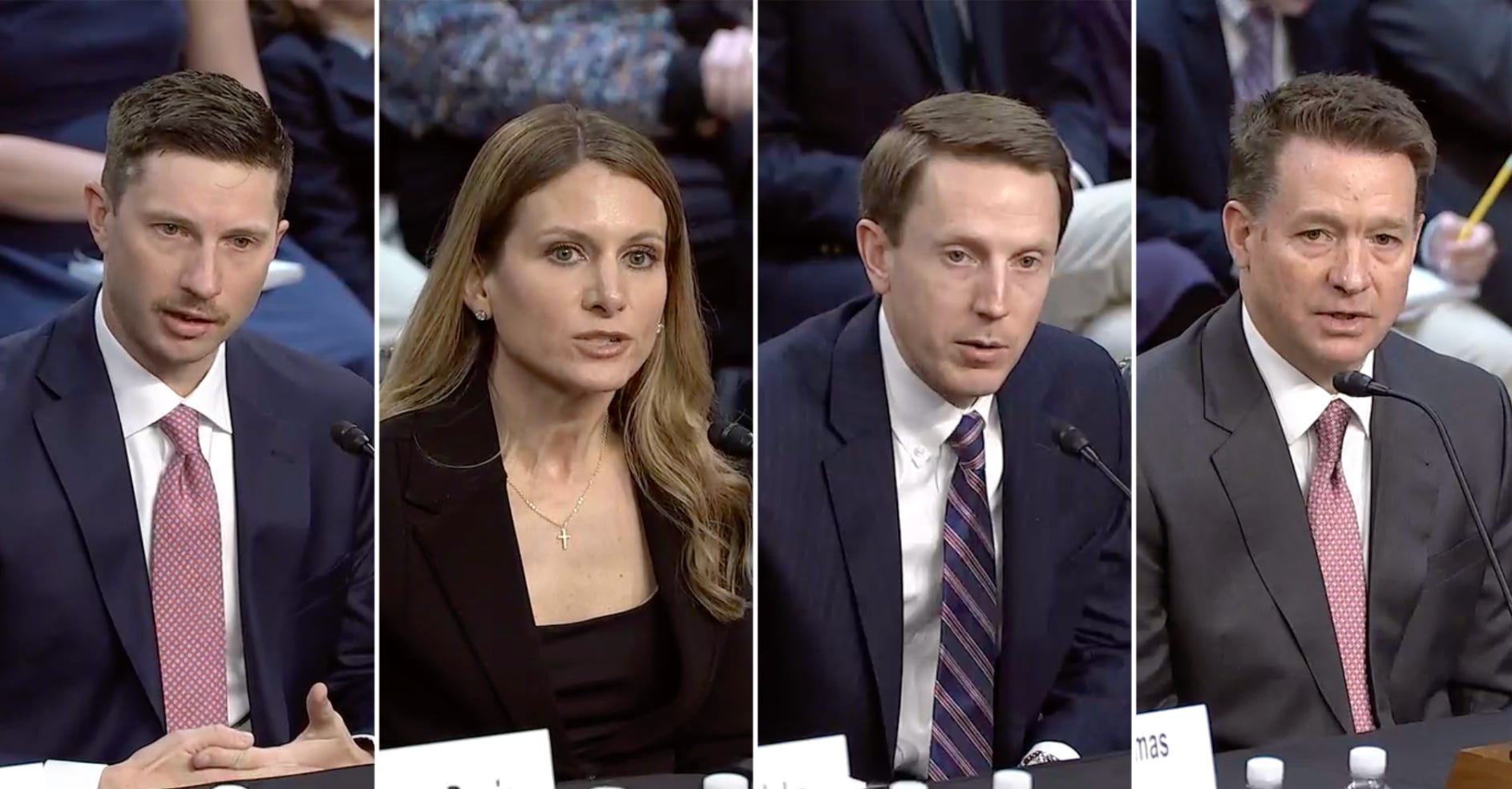
On Monday evening, the Senate Judiciary Committee posted responses to written questions for the record from four more of Trump’s judicial picks. The nominees — Anna St. John for the Eastern District of Louisiana, John Thomas Shepherd for the Western District of Arkansas, Andrew Davis for the Western District of Texas, and Chris Wolfe for the Western District of Texas — were evasive in their responses and demonstrated, as they did during their hearing, that they are unqualified for federal judicial service.
The 2020 election and January 6
So far during Trump’s second term, 37 judicial nominees have now responded to written questions for the record — and notably, all 37 have dodged any inquiry related to the outcome of the 2020 election and what happened on January 6, 2021. Senator Richard Blumenthal asked these four nominees during their confirmation hearing about these topics, and their responses to written questions echoed the nonresponses they gave during the hearing.
Senator Chris Coons is over it, and he is now asking nominees what they’re so afraid of. His new question is this: “Do you believe that you would face any adverse professional consequences if you directly stated, during your hearing or otherwise on the record, that President Trump lost the 2020 election, or that President Biden won the 2020 election? Please explain.”
To me, this question is partially asking whether the nominees believe their nomination would be in jeopardy — whether Trump would immediately withdraw them from consideration — if they tell the truth about Trump’s 2020 election loss. They obviously won’t entertain that question in writing — so John Thomas Shepherd simply responded “No.” Fair enough! Chris Wolfe said that responding to these questions in a different way “may have been perceived as an opinion on a topic of public debate and controversy. Therefore, I believed it was appropriate to respond as I did at the Senate Judiciary Committee hearing.”
Andrew Davis and Anna St. John took it a step further, suggesting that answering the question truthfully — by saying that Trump lost in 2020 — would violate the Code of Conduct for United States Judges and could “lead to a formal complaint or other professional consequences,” according to Davis. And St. John said that it could “adversely affect my professional reputation for impartiality and compliance with applicable professional standards of conduct.”
It’s sort of hilarious to suggest that saying “Trump lost the 2020 election” would somehow adversely affect their “professional reputation for impartiality,” or that it could lead to them being the subject of an ethics complaint — when the opposite is true: Refusing to say Trump lost is what’s actually damaging their reputations.
Two other things stood out to me in Davis’ responses.
First, when Senator Blumenthal asked him if he was “inside the U.S. Capitol or on the U.S. Capitol grounds on January 6, 2021,” Davis responded yes — he “was in Senator Cruz’s personal office in the Russell Senate Office Building pursuant to my duties as Senator Cruz’s Chief Counsel.” He did not disclose this during the hearing when Senator Blumenthal asked him whether the Capitol was attacked and whether he’d seen video of it. “Any characterization of the events that occurred on January 6 would wade into political waters,” he said during the hearing. It’s interesting that — in providing the senators with the same boilerplate response to this question — Davis didn’t personalize his answer and mention that he was on the Capitol grounds that day.
Second, Senator Sheldon Whitehouse noted the following:
According to the House Select Committee to Investigate the January 6th Attack on the U.S. Capitol, you were listed as an attendee on a calendar invitation for a briefing that Cleta Mitchell held on January 4, 2021. Mitchell told the Committee the briefing was to inform Members and staff on how the presidential election results in Georgia were fraudulent. Did you attend that briefing?
Davis responded that “Without additional information and context, I do not recall whether I attended the briefing.” When Senator Whitehouse asked if he discussed the content of the briefing with anyone and whether he told anyone that he believed the Georgia election results were fraudulent, Davis simply stated that “Because I do not recall whether I attended this briefing, I also do not recall whether I discussed the content of the briefing with anyone.” He did not address the part about whether he believed the results were fraudulent.
Cleta Mitchell resigned from her law firm on January 5, 2021, following her involvement in a January 2 phone call between Trump and Georgia officials — the call where Trump told them to “find” more than 11,000 votes. Given the timing and nature of the January 4 briefing that Senator Whitehouse asked Davis about, it is difficult to believe he doesn’t recall whether he attended. He certainly didn’t deny being invited.
Friends with people tied to a hate group
Ranking Member Dick Durbin asks the nominees whether they’ve spoken to or worked with people associated with a number of organizations. That list includes the Alliance Defending Freedom (ADF), which has been designated as a hate group by the Southern Poverty Law Center (SPLC). According to SPLC:
Founded by some 30 leaders of the Christian Right, the Alliance Defending Freedom is a legal advocacy and training group that has supported the recriminalization of sexual acts between consenting LGBTQ adults in the U.S. and criminalization abroad; has defended state-sanctioned sterilization of trans people abroad; has contended that LGBTQ people are more likely to engage in pedophilia; and claims that a “homosexual agenda” will destroy Christianity and society.
ADF also works to develop “religious liberty” legislation and case law that will allow the denial of goods and services to LGBTQ people on the basis of religion. Since the election of President Trump, ADF has become one of the most influential groups informing the administration’s attack on LGBTQ rights.
Three of the four nominees acknowledged some connection to ADF. Wolfe said that “I have friends and acquaintances associated with ADF. I have spoken to a few of those individuals generally about my application and the selection process. They have been encouraging and congratulated me upon my nomination.” It is obviously concerning that people associated with ADF were pleased that Wolfe was nominated for a lifetime judgeship.
Then there’s Davis. “I have friends who work for ADF and I have kept them apprised of significant developments in my selection process,” he said. “I have worked on litigation in partnership with ADF or supporting ADF. I have not spoken or appeared at any ADF events.”
This is also troubling, as is St. John’s connection to the group. “I am acquainted with a number of individuals associated with ADF and may have exchanged small talk or discussed the general logistics for an amicus brief I filed on behalf of high school athletes in the Little v. Hecox/B.P.J. v. West Virginia cases in which ADF represented parties while the selection process was underway,” she said. “I have represented amici that have filed briefs in cases in which ADF served as counsel.”
The U.S. Supreme Court heard oral argument last month in those two cases, which center around the freedom of transgender youth in America to participate in school sports. St. John’s participation in these cases — in opposition to the rights of trans people — is alarming. Indeed, Senators Durbin and Coons inquired about this issue, essentially asking St. John how on earth a trans person could be confident they’d be treated fairly in her courtroom. Senator Coons asked very directly:
You submitted briefs to the U.S. Supreme Court arguing against the participation of transgender women in women’s scholastic sports, referring to them as “males.” In an amicus brief for Little v. Hecox/West Virginia v. B.P.J., you wrote, “thousands of girls each season face a hostile environment where they are compelled to assent to a fundamental untruth: that males are females. This spectacle is rigorously policed by a few militant idealogues, while the many are cowed into silence.” Would you agree that your work on these matters creates at least the appearance of partiality with respect to cases involving the rights of transgender people?
“No, I would not,” she responded.
St. John promises she’ll be a good judge and leave her advocacy days behind. Senators should not believe her.
Another show of loyalty
Senator Durbin has been asking judicial nominees the following question:
On May 26, 2025, in a Truth Social post, President Trump referred to some judges whose decisions he disagrees with, as “USA HATING JUDGES” and “MONSTERS”, who “…SUFFER FROM AN IDEOLOGY THAT IS SICK, AND VERY DANGEROUS FOR OUR COUNTRY…” Do you agree that these federal judges are “USA HATING” and “MONSTERS” “…SUFFER FROM AN IDEOLOGY THAT IS SICK, AND VERY DANGEROUS FOR OUR COUNTRY…”?
No nominees to date, including these four, have mustered the courage to say that federal judges who rule against the administration are not “monsters” — debasing themselves in pursuit of proving their loyalty to the man who nominated them. Instead, they say it would be “inappropriate” for them to comment on political issues, statements, or controversies.
Senators Coons and Booker have also been asking nominees about whether Trump can run for a third term. Nominees have largely been avoiding directly answering these questions, though a few have given yes/no responses (depending on how the question is asked).
These four nominees, though, did not give very direct responses, instead quoting the text of the 22nd Amendment and failing to string together the words “Trump cannot run for a third term.”
Circling back to a humiliating response
During the Senate Judiciary Committee hearing earlier this month, Senator Mazie Hirono noted that St. John was “formerly a fellow at the Independent Women’s Forum, which had previously advocated for exceptions to the right to access contraception for women.” Senator Hirono asked St. John whether she considers the Supreme Court’s decisions in Griswold and Eisenstadt to be settled law and if she would follow the precedents if confirmed.
“If I am so fortunate as to be confirmed as a district court judge, I would be bound by all Supreme Court precedent,” she responded. But when Senator Hirono followed up and asked whether she considered the two cases to be settled law, St. John said that “I would have to look and see whether they’ve been overturned, senator. If they’re binding law, I would apply them.”
“That’s a no,” Senator Hirono replied.
Senator Coons followed up in writing, noting the exchange that St. John had with Senator Hirono at the hearing. He asked St. John if she has examined whether those two landmark decisions have been overturned or remain binding law, and St. John conceded that she now understands both decisions are binding precedent that she would faithfully apply.
Good to know!
These four nominees will likely receive votes in the Senate Judiciary Committee next Thursday, March 5, and they could be considered by the full Senate as early as the following week.