
As shutdown continues, Senate Republicans remain focused on confirming Trump’s judges
Putting more anti-civil rights judges on the bench is their priority.
The Senate on Thursday voted to end debate on the nomination of Joshua Dunlap to serve on the U.S. Court of Appeals for the First Circuit. Senate Majority Leader John Thune also filed cloture on the nomination of Eric Tung to serve on the U.S. Court of Appeals for the Ninth Circuit. In his remarks on the Senate floor, Thune indicated that Dunlap’s confirmation vote would be no earlier than Tuesday, November 4, and that Tung’s confirmation vote — if cloture is invoked on Monday night — would be no earlier than Wednesday, November 5.
Dunlap and Tung, who appeared together for a confirmation hearing in July, are the only circuit court nominees who remain pending in the Senate — and they are the latest nominees to receive votes during the government shutdown. If confirmed, they will be the 10th and 11th lifetime judges confirmed during the shutdown and the 18th and 19th confirmed overall during Trump’s second term.
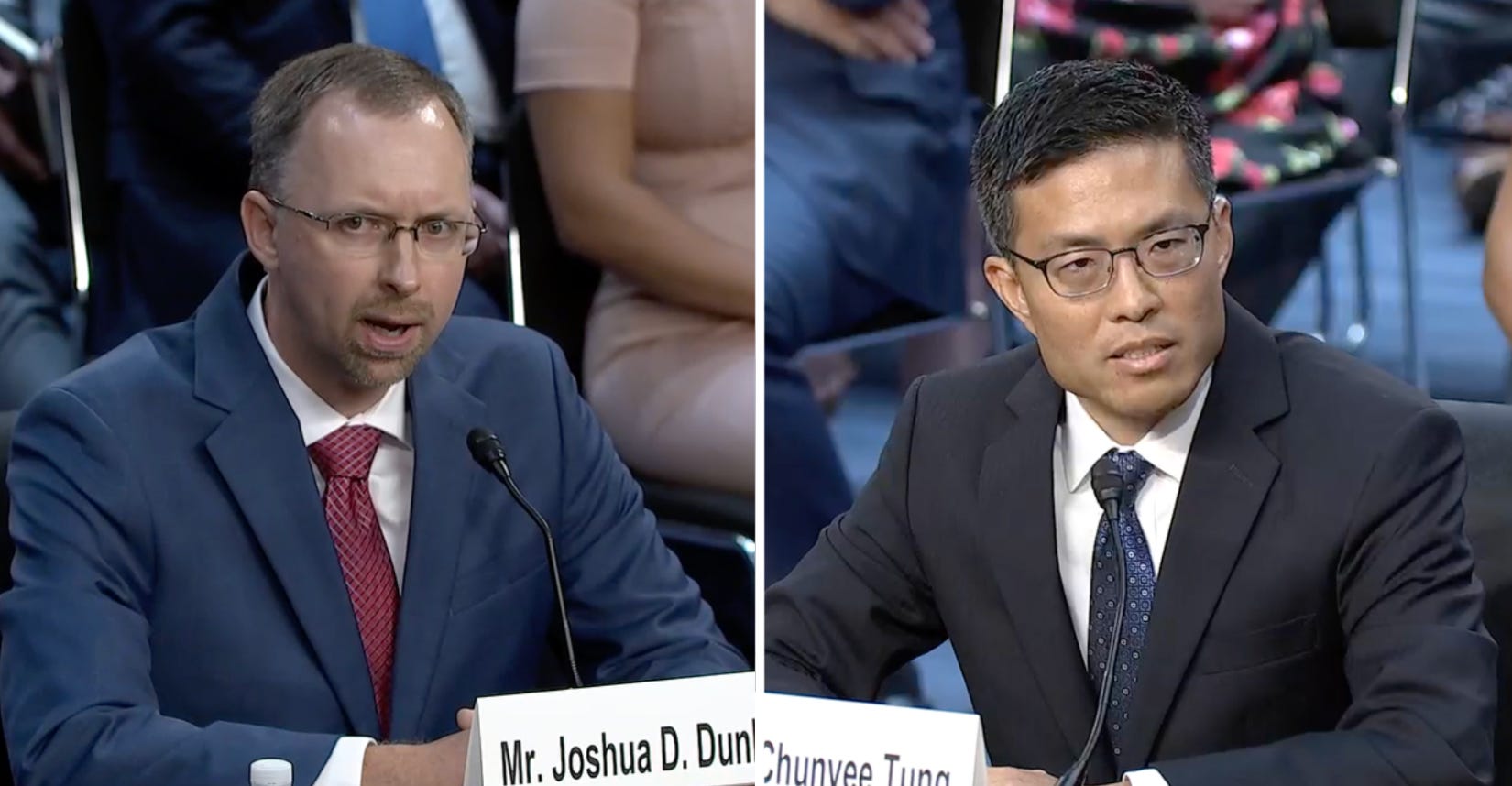
If confirmed, Dunlap — a white man nominated to a Maine seat on the court — will be Trump’s first appointee on the First Circuit, where a judge of color from Maine or a woman from Maine has never served. President Biden did try to appoint Julia Lipez to this seat last year, and she would have been the first woman from Maine on the First Circuit — but the Senate failed to confirm her after then-Majority Leader Schumer’s deal to abandon confirmation of four circuit nominees, including Lipez, in exchange for speedier approval of district court nominees.
Tung would be Trump’s 11th appointee to the Ninth Circuit and the third Asian American man from California appointed by Trump on the court. He would be the 10th Asian American judge on the court in its history.
Their nominations have drawn significant opposition.
Joshua Dunlap
Last month, 20 organizations in Maine sent a letter to Senator Susan Collins, R. Maine, urging her to withdraw her support for Dunlap’s confirmation given his disturbing record.
“Judges are appointed for life and shape laws for generations. They must be fair, independent, qualified, and representative of our communities,” the groups wrote. “We fear that Mr. Dunlap’s record demonstrates an inability to fairly and impartially decide matters involving reproductive and LGBTQIA+ rights, separation of church and state, economic justice, climate justice, consumers, and voting rights.”
On Thursday, Senator Collins voted to advance his nomination. Independent Senator Angus King of Maine voted no.
The National Council of Jewish Women (NCJW) wrote to Senate Judiciary Committee leadership in August urging senators to oppose his nomination as well. “In Jewish tradition, judges are commanded to uphold justice without bias or partiality — to protect the vulnerable and pursue equity without fear or favor,” NCJW wrote in their letter. “Mr. Dunlap’s record reflects a pattern of extreme legal views that run counter to these values and to the foundational principles of fairness and independence that must guide our federal judiciary.”
In their letter to the committee, Alliance for Justice’s warning was even more urgent. “Dunlap’s record, both in and out of the courtroom, reflects a determined effort to weaken civil rights protections, elevate corporate and religious power over individual liberties, and roll back hard-fought gains in reproductive, LGBTQ+, and democratic rights. His legal philosophy poses a grave threat to constitutional equality and the communities who rely on the courts to defend their rights.” They expand on this record here.
AFJ ended their letter with this:
“Taken together, Joshua Dunlap’s career presents a clear and consistent pattern: he advances legal arguments that undermine civil rights, insulate corporate and religious institutions from regulation, and curtail democratic participation. His judicial philosophy prioritizes power over people, process over equity, and exclusion over inclusion. This is not the vision of justice our courts are meant to serve.”
To learn more about Dunlap, it’s worth reading through his responses to written questions for the record, where he was asked such questions as: “Do you stand by your characterization that doctors profit from providing abortions?”
Eric Tung
NCJW and AFJ both spoke out powerfully against Tung’s confirmation as well. NCJW wrote that “Mr. Tung’s record demonstrates a pattern of views and legal interpretations that are fundamentally at odds with core constitutional protections and the values of fairness, equality, and justice. His confirmation would jeopardize the rights of women, LGBTQ+ individuals, and voters — and undermine public trust in the impartiality of the judiciary.”
Alliance for Justice similarly warned of what Tung’s confirmation would mean for equal justice. “Tung’s record reflects a rigid, exclusionary judicial philosophy that privileges entrenched power and rejects the evolving needs of a pluralistic society,” their letter states. “From his attacks on labor protections and reproductive rights to his embrace of radical theories that would disenfranchise millions of Americans, Tung has made clear that he would not be a fair-minded jurist committed to equal justice under law.”
During the hearing, Senator Alex Padilla, D. Calif. — one of Tung’s home-state senators who strongly opposes his confirmation — criticized Tung for past sexist comments and his lack of experience. “Tung has never served as the sole or lead counsel in a case tried to verdict or to judgment from the bench, and he estimates that only 10 percent of his work has been on criminal cases,” according to Padilla’s post-hearing press release.
The release also included this:
Padilla also questioned Tung on his leadership of an anti-Labor Day protest and attacks against workers. At Yale, Tung was the president of a group called “the Committee for Freedom” that organized a protest on Labor Day, with protesters pushing messages including “end mandatory maternity leave — it hurts women,” and “workers of the world, get back to work!” Tung told the Yale campus that “unionized labor hurts consumers,” while proudly holding a sign that read “Union NO.” Padilla questioned how individuals with questions about labor law could trust Tung as a judge given his harsh anti-labor viewpoints.

As I wrote about yesterday, in written questions for the record Tung was asked whether he’s given any public remarks regarding gender-affirming care. He responded that “On March 5, 2025, I appeared on a panel (‘Constitutional Crossroads: A Debate on Interpreting the Law’), hosted by the Federalist Society at UCLA School of Law in Los Angeles, California. As part of that panel, I provided certain remarks about how an originalist would approach the question of whether there is a constitutional right to transgender procedures.”
Senator Whitehouse asked Tung whether he wrote the following in his notes for that event: “To be sure, Originalism recognizes that there may be hard cases. But most cases, including the high profile ones, are not hard. Whether there’s a constitutional right to abortion, same sex marriage, sodomy, pornography, transgender procedures – the answer for the originalist is simple: No.” Tung responded that yes, he wrote that.
Much more could be written about both of these nominees and why they should not be confirmed to lifetime seats on powerful federal appellate courts. But Senate Republicans have demonstrated that — even during what will likely be the longest government shutdown in our nation’s history, as the American people go hungry and as health care costs spike — confirming anti-civil rights judges is their main priority.